

With Birchbark and Breath, Sierra and Hawk Henries Bring Intergenerational Artistry to the ‘Dawnland’
The Dawnland Festival of Arts and Ideas in Bar Harbor, Maine, uplifts Wabanaki and Northeastern Native thought leadership and artistry with panel discussions, performances, and a thriving artists’ market.
:focal(750x500:751x501)/https://tf-cmsv2-smithsonianmag-media.s3.amazonaws.com/filer_public/bf/93/bf93175e-03fd-4445-bb5c-360389e3ba99/sierra-hawk-henries.jpg)
In 2026, the United States of America turns 250 years old. At the Center for Folklife and Cultural Heritage, we are embracing this historic moment by bringing the spirit of the Smithsonian Folklife Festival to you! Through Of the People: The Smithsonian Festival of Festivals, we are collaborating with more than thirty festivals across to country to showcase the nation’s remarkable cultural landscape.
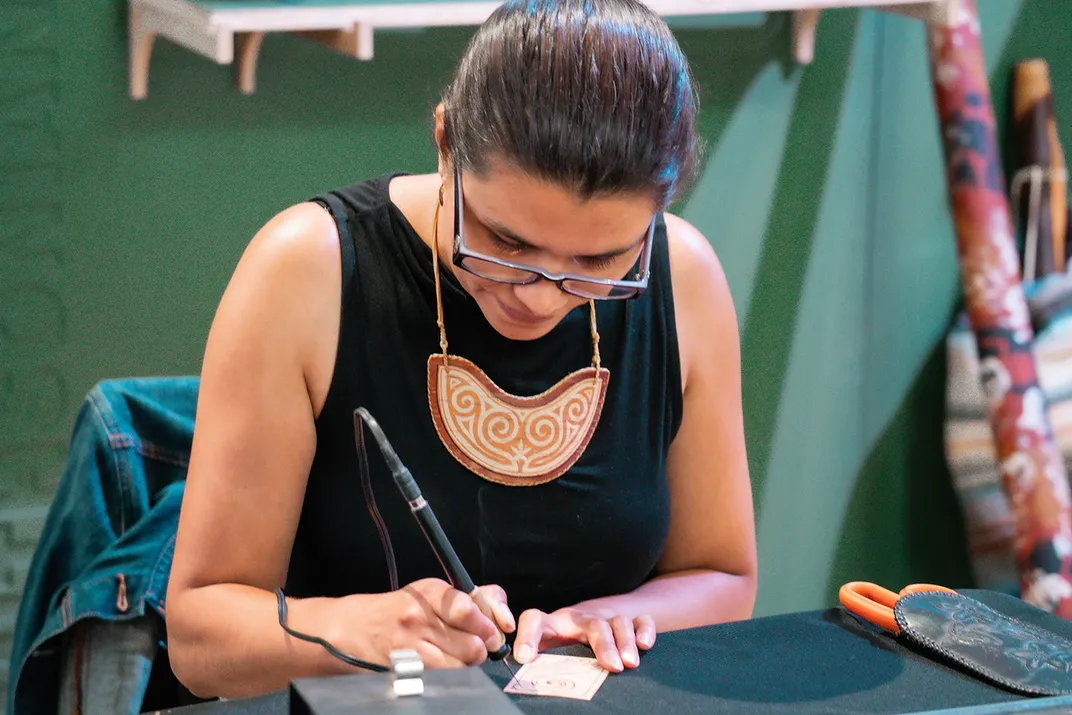
Her hands move slowly and deliberately. Sierra Henries traces a pencil line across a piece of birchbark freehand, without a ruler or stencil. When she picks up her wood-burning tool, she adjusts the temperature, watches the tip meet the bark, and begins to burn. The dark, curling vines that emerge feel less like something she planned than something the bark slowly revealed.
Then a sound starts softly, almost beneath the noise of people moving, talking, and browsing. Yet it cuts through the Arts and Industries Building all the same. Nearby is Hawk Henries, Sierra’s father, with his lips pressed to a wooden flute he carved himself. A small crowd gathers. They watch, they listen, perhaps sensing a connection between the two crafts.
In June, the two artists were in residence at the Folklife Marketplace, housed in the Smithsonian’s Arts and Industries Building in Washington, D.C. Here, visitors encountered Sierra and Hawk Henries, Nipmuc artists based on the coast of Maine, whose distinct artistic practices are rooted in a shared way of understanding materials and making in Native American tradition.
This weekend, July 11 and 12, they will bring that same spirit to the Dawnland Festival of Arts and Ideas, presented by the Abbe Museum in Bar Harbor, Maine. Dawnland—a translation of the Wabanaki word describing the easternmost homelands of North America—uplifts Wabanaki and Northeastern Native thought leadership and artistry with panel discussions, performances, and a thriving artists’ market.


The connection between Sierra’s birchbark pyrography and Hawk’s flute is the result of a lifetime spent creating alongside one another. Although each has developed a distinct artistic practice, both trace their work to the same family tradition of making, learning, and sharing with others. For Sierra (Chaubunagungamaug band of Nipmuck Indians), art was never something separate from everyday life; it was simply the way her family lived.
“I grew up in a very artistic family,” she says. Her father has been making traditional flutes for almost four decades. Her mother and sister are artists as well. “We spent many, many, many years traveling as a family and just creating art and selling at art shows. That is how I came into making things for a living, just being raised in that lifestyle.”
Hawk (Chaubunagungamaug band of Nipmuck Indians ) began his journey into flute making thirty-seven years ago, after receiving his first flute as a gift from his wife and father. Curiosity led him to take the instrument apart in hopes of improving its sound. Instead, he ruined it. Determined to repair it, he taught himself how it worked. “That is how I learned how to make the flutes that I make,” he says.
Growing up in that environment meant Sierra inherited more than an appreciation for handmade art. She learned to work with tools, trees, and natural materials while also discovering that her own artistic path did not have to mirror her father’s.
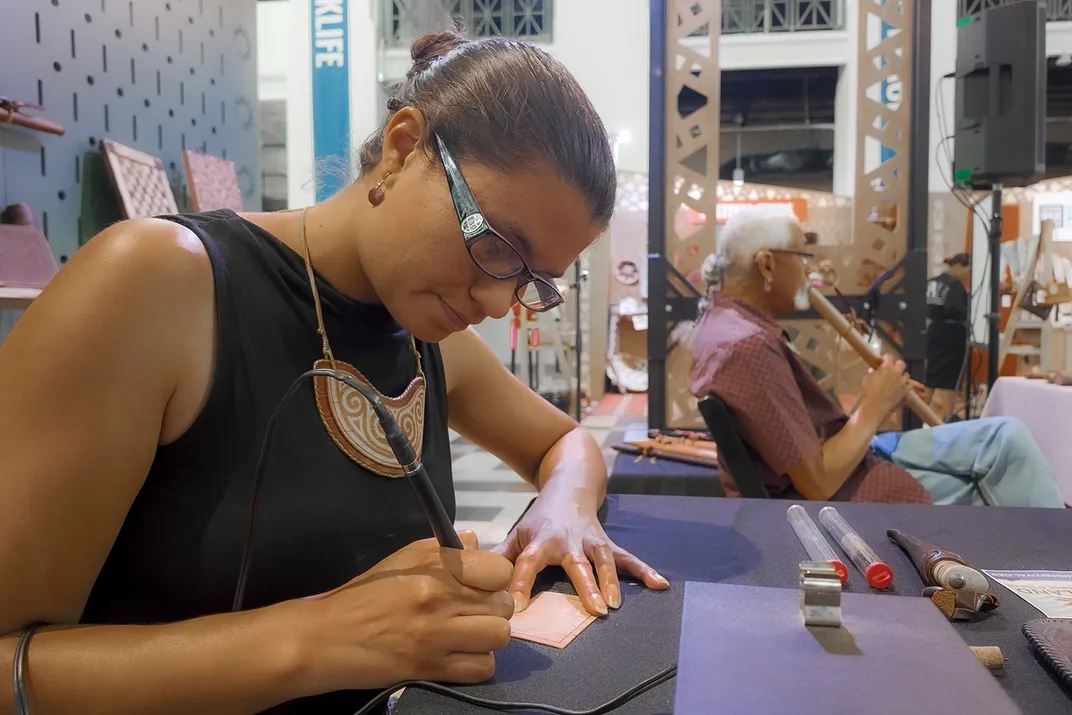
Sierra describes working alongside her father at the Folklife Marketplace with deep gratitude. “It feels like such an honor,” she says. “My father has taught me so much about working with tools and my understanding and relationship with the trees.” Just as important, she says, her parents encouraged her to find her own artistic path. “They really helped not only shape the opportunity for me to make art for a living but also left that door open for me to do what kind of art felt right to me.”
For Hawk, watching Sierra develop her own artistic voice has become one of the greatest rewards of his own journey. He recalls homeschooling their daughters because he and his wife wanted learning to be something the family experienced together. Seeing Sierra build on that shared foundation, he says, is deeply meaningful.
“When I see Sierra utilizing the knowledge and the skills that we together learned, it makes me feel good,” he says.
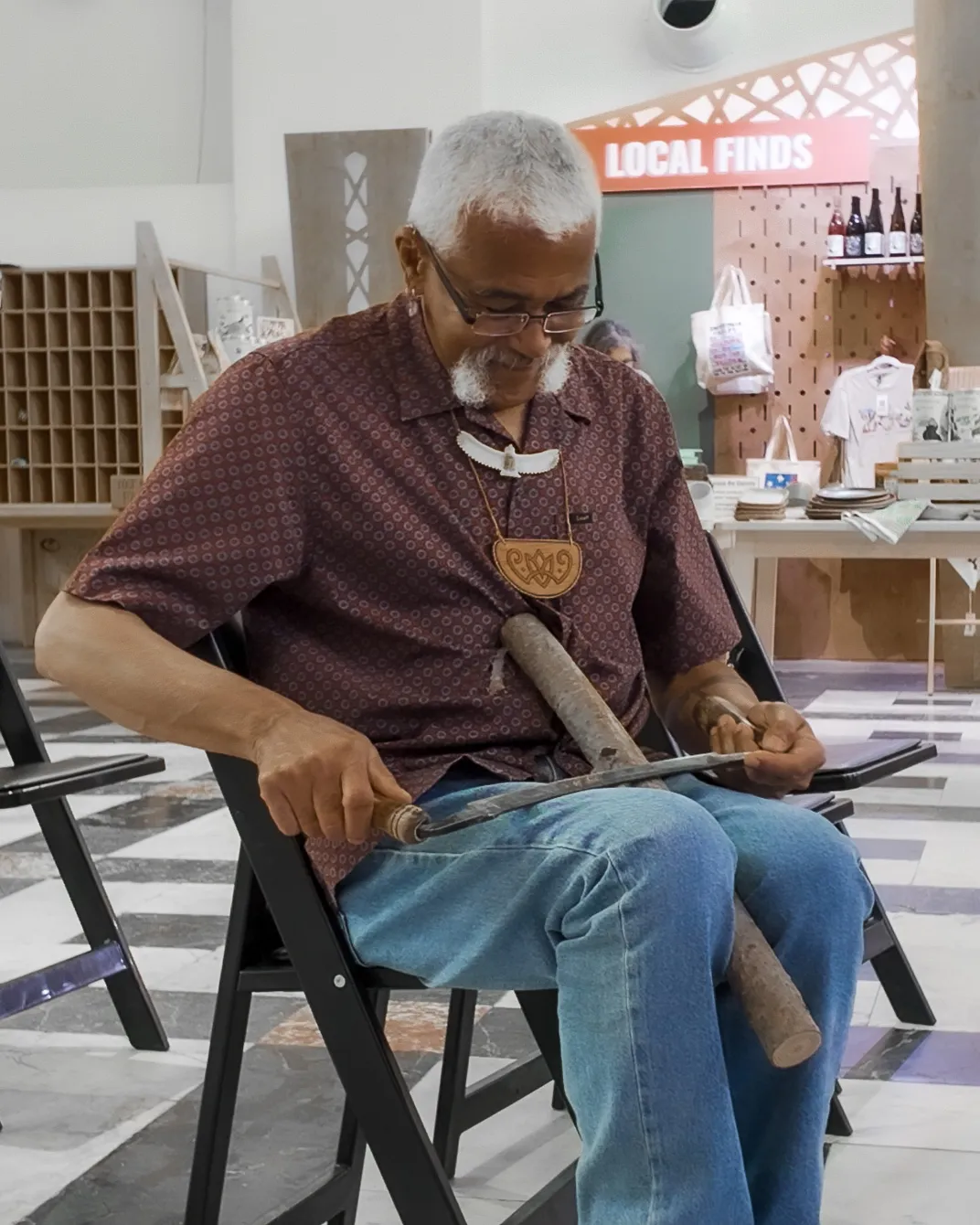
Together, Sierra and Hawk demonstrate that cultural traditions endure not simply by preserving what came before but by carrying forward the values that shape a tradition while allowing each generation to create in its own voice. While Hawk’s decades of flute making shaped the environment in which Sierra grew as an artist, Sierra developed a practice distinctly her own.
Although Sierra and Hawk work in different disciplines, their practices are connected by a shared philosophy of making and connection with their wooden material. The creative process begins not with imposing an idea onto the material, but with paying attention to what it already holds.
“I really have to just let go and step back and just give room and space to the bark itself to show me what is happening,” Sierra says. “I feel like I make my best work when I’m letting go and seeing what stories the bark has.”
Hawk approaches wood with a similar attentiveness. For most of his career, he made flutes entirely with hand tools, but not because it was easier. Working by hand, he says, “allows me to go slow and to be deliberate and methodical” and gives him “a more intimate relationship with the materials.”
That relationship begins long before the work of burning or carving. Sierra speaks of her harvesting as an exchange with the birch tree: “I like to spend a little bit of time with the tree, give an offering, ask if the tree wants to give her bark.”
Hawk describes a similar care when he first uncovers a piece of wood. Stripping away the outer bark is “like opening a present,” he says. “You get to see something beautiful. And then the more you work it, the more beauty comes out.”
Whether working with birchbark or wood, both artists approach their materials with patience, humility, and respect. In their hands, making begins not by shaping the material but by listening to it.
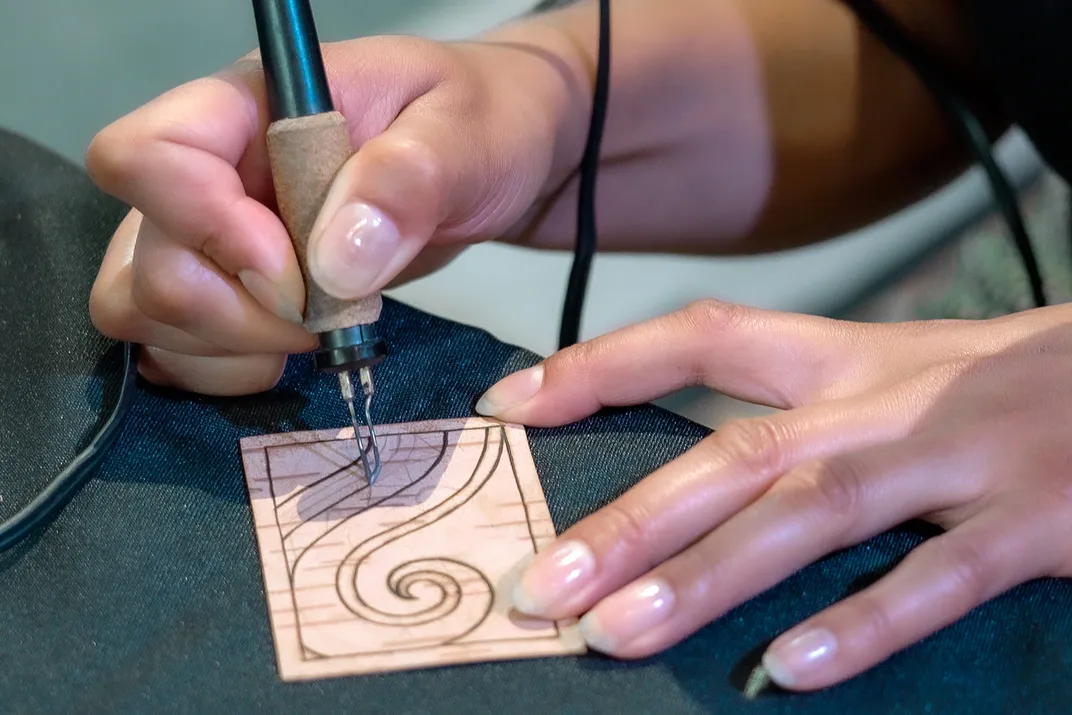
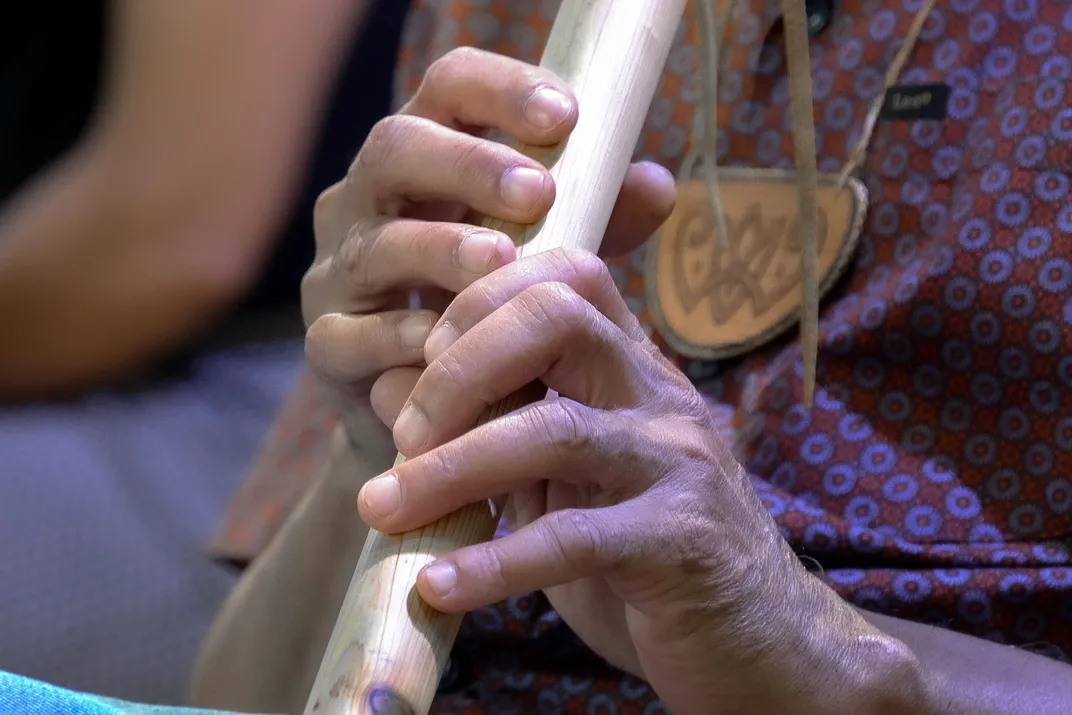
Visitors to the Dawnland Festival will have the opportunity to experience that philosophy firsthand, when Sierra and Hawk will bring their work to the Native arts market. Festivalgoers can watch Sierra’s intricate birchbark pyrography take shape and hear Hawk perform on one of his handcrafted flutes.
Now in its third year, the Dawnland Festival of Arts and Ideas brings together Wabanaki and Northeastern Native artists, culture bearers, and thought leaders for two days of performances, demonstrations, conversations, and a vibrant Native arts market on the campus of College of the Atlantic in Bar Harbor, Maine. The festival is free and open to the public.
This year, through our Of the People program, the Smithsonian Folklife Festival is collaborating with the Abbe Museum to co-present selected Dawnland events and support the Wabanaki Fellowship Program, among other activities. This collaboration has given us the opportunity to connect with artists like the Henrieses, leading to their selection as Folklife Marketplace artists in residence. Hawk also has a longstanding relationship with the Smithsonian, having performed at the National Museum of the American Indian in D.C. shortly after its opening in 2004.
For Sierra, what she is most looking forward to at the festival is the gathering of Native people. “I feel the most excited about being in community,” she says. “When we are all together is when we shine the most.” She also hopes visitors leave with a deeper understanding of the richness of Northeastern Native art. “Fine, fine artists live and work in the Northeast, and I want people who arrive at the Dawnland Festival to walk away with a broader understanding of all of the incredible artisans that come from there.”
Hawk hopes visitors leave with a sense of curiosity that extends beyond the festival. “I hope they leave with more questions,” he says, “that they can then maybe be motivated to find out and seek out the answers to, which will hopefully snowball into more questions.”
At the Dawnland Festival, visitors can watch Sierra work, hear Hawk perform, and experience for themselves the quiet conversation between materials and hands, image and sound, and one generation and the next.
Juliet Tawiah is a writing intern in the Folklife Storytellers Workshop and a PhD student in English at Northern Illinois University, where her research focuses on African American literary criticism and digital culture. After printing on birchbark in one of her doctoral courses, getting to interview Sierra Henries was especially meaningful.