

A Journey to Right the Wrongs on Smithsonian’s ‘Anthology of Central and South American Indian Music’
In 1975, Alan Lazar compiled the anthology for Folkways Records. In the last year, Smithsonian Folkways staff found and corrected several errors in culture-group terminology, track information, and sequencing.
:focal(540x360:541x361)/https://tf-cmsv2-smithsonianmag-media.s3.amazonaws.com/filer_public/93/63/93635c8f-272a-4d7f-8eef-8e36afb1cdd7/fw04542_crop.jpg)
One afternoon, Logan Clark, an ethnomusicologist of Mayan music, was listening to the Anthology of Central and South American Indian Music on the Smithsonian Folkways Recordings website. On the tenth track, she did not hear the reedy twang of the chirimía—a double-reed instrument of the shawm family—as promised by the liner notes. Instead, she heard the tun—a percussion instrument.
The content manager at Smithsonian Folkways, Logan wondered if this was the only discrepancy between the digital album and its liner notes. She knew that it was imperative that this error be corrected. As a principle of shared stewardship of collections, it is our duty to ensure culturally appropriate and accurate representation of artists and their recorded music in the Folkways catalog.
Cultural institutions, like the Smithsonian, distribute knowledge through the heritage they exhibit. Some philosophers raise important concerns about the display of that heritage in Western institutions, including “selective, misleading or culturally limited presentations” that misrepresent source communities. In particular, cultural institutions are subject to misrepresenting culture groups without “full involvement of the Native communities they... represent.” To avoid misrepresentation, institutions should invite source communities to act as “informants and participants in the sharing of knowledge.”
In 1975, Alan Lazar compiled the Anthology of Central and South American Indian Music for Folkways Records, drawing from eighteen preexisting albums in the label’s catalog of Indigenous music from Mexico and Central and South America. Although the album provides a survey of invaluable Indigenous music histories of Latin America, it was not without issues.
The album contained two significant types of errors, as Logan and our team realized last fall. The audio did not align with the track order and accompanying descriptions on the album cover or in the liner notes. And in the liner notes, some source communities were referred to using erroneous or outdated terminology. At times throughout our process of addressing these errors, the identification of one issue resulted in the identification of additional issues, each with their own process of correction.
We share our journey here for transparency and as a model for other cultural institutions.
We analyzed the audio on the original vinyl record of the Anthology of Central and South American Indian Music to find that neither the digitized audio nor the LP audio reflected Lazar’s intentions as outlined in his liner notes. As a compilation of tracks sourced from other records in the catalog, some tracks from one source album were included erroneously in lieu of the tracks Lazar intended to use from the same source album. In a few instances, select tracks were featured in error that were similar in content to the correct track.
For example, it erroneously includes a flute song from an album that differed from the flute song and source album listed in the liner notes. Other tracks that were intended to be on the album were either not present to begin with or sequenced incorrectly (i.e., the record audio did not match the track order in the liner notes). An Indigenous Colla trial-marriage song listed in the liner notes was never included on the original album. And the eighth track, a two-part track, was erroneously split on the online album into two separate tracks, disrupting the sequencing of all subsequent tracks.
Lazar’s liner notes also contained erroneous and outdated spellings of culture-group names and designations. For example, he referred to the Purépecha people of Michoacán, Mexico, as “Tarascan,” a term imposed by the Spanish during colonization. The Kamayurá people of the Brazilian Amazon were erroneously referred to as “Cayamura.” Other communities use self-designations that differ from those in the liner notes, such as the Yaqui people who refer to themselves as the Yoeme tribe. (The designation “Yaqui” is given to the Yoeme people for their proximity to the Yaqui River in Sonora, Mexico.)
In 2005, Smithsonian Folkways began offering online access to its entire catalog. Upon digitizing the collection, some tracks were left without named artists. These tracks often had “N/A” or “Unspecified” in place of an artist’s name. Eventually, these placeholders were addressed, with a push to explicitly name artists and their culture group whenever possible. In some cases, however, terminology in the existing metadata is outdated, incorrect, or otherwise not aligned to how culture groups prefer to be represented.
The present issue of unidentified artists and missing terminology is a problem particularly with Indigenous musicians globally. Early recordists tended to evaluate music by Indigenous artists by the standards of Western music. Indigenous music was treated as data to study the “development” of Indigenous communities in comparison to the West by analyzing its musical composition. As a result of such a focus on musical structure, rather than on the musicians themselves, recordists did not document the names of the musicians.
Over the last two years, collections specialist Samantha “Sam” Parton has worked to resolve the issue of missing artist and culture-group names for around 5,000 tracks in the Folkways catalog. In the process, she has identified around 1,000 musicians and appropriate descriptors that were previously unidentified. She is also addressing incorrect and outdated terminology.
Editing the artist-name field on digital albums allows us to correct such erroneous, outdated terminology and designations without removing individual tracks or entire albums completely. Because this work deals with historical records (in all senses of the word), it is archival practice to keep documentation (including original track titles) intact, rather than alter it. Adding new information in the artist-name field, which appears below the (sometimes erroneous) track title, serves the function of preserving historical records, while also presenting preferred terminology, especially current orthologies (or current endonyms).
This is especially important in cases where certain terminology remains in use by certain source-community stakeholders. For example, on the second track of the anthology, entitled “Yaqui: Deer Dance,” we added “Yoeme” in the artist-name field in lieu of altering the track title.
Making such corrections to work toward accurate representation takes a team with a wide range of knowledge—what I would call an “anthology” of knowledge. Sam, a library and information science professional; Logan, an ethnomusicologist of Mayan music; Eloy Neira de la Cadena, an ethnomusicologist of Peruvian music; and Sharon Arana, a historian and museum professional with Peruvian roots—all staff members at the Center for Folklife and Cultural Heritage—contributed invaluable insights to my research on this project. Throughout this process, we bounced ideas off one another and flagged mistakes that others missed.
While I am neither an ethnomusicologist nor an archivist nor a historian, I am committed to giving attention to items in the Folkways catalog that are too often belittled and do not receive sufficient funding to conduct research on. My cultural connection to one of the regions represented in the anthology as a Mexican American and my academic background in philosophy inform my questions about the ethics of cultural heritage, and about how Folkways and other cultural institutions can ensure ethical display of their collections.
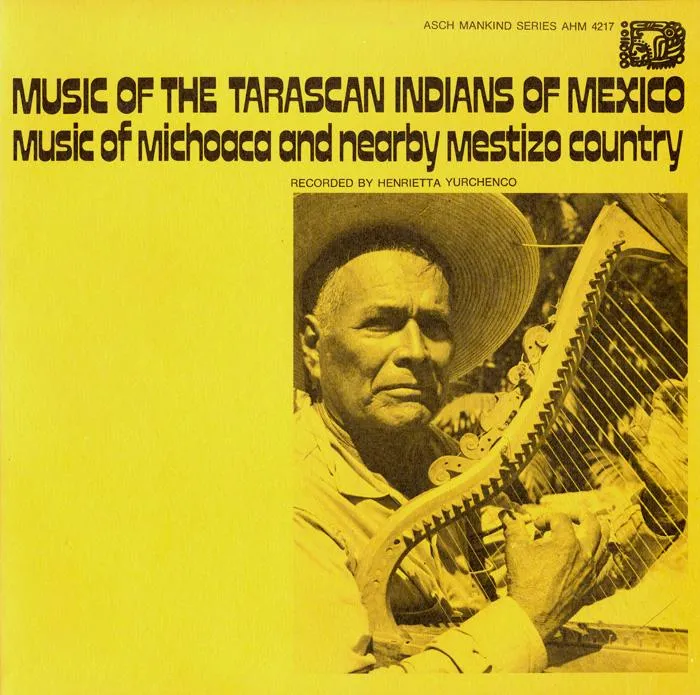
For example, as I perused the source albums that Lazar pulled from to compile the anthology, I noticed that an album of music from Michoacán, Mexico, contained an erroneous spelling of Michoacán on its cover design and in the liner notes. The album, (now) entitled Music of the Tarascan Indians of Mexico: Music of Michoacán and Nearby Mestizo Country, originally misspelled the Mexican state as “Michoaca.”
I approached Sam with my discovery, noting that I am a descendant of family from Michoacán. My cultural background put me in a position to identify an error that was present on the album since its release in the 1970s. The fact that the error went unnoticed for this long affirms my conviction that more resources ought to be invested into this social justice-oriented research.
Similarly, on an Indigenous Peruvian track, entitled “Quechua: Cuzco - Inti Raymi (Festival to the Sun),” that—according to the notes—should have featured the plucked string charango, Eloy noted that the instrument did not make an appearance. And in fact, Eloy claimed that the audio of the track was not concerned with Inti Raymi—an Inca religious festival—at all.
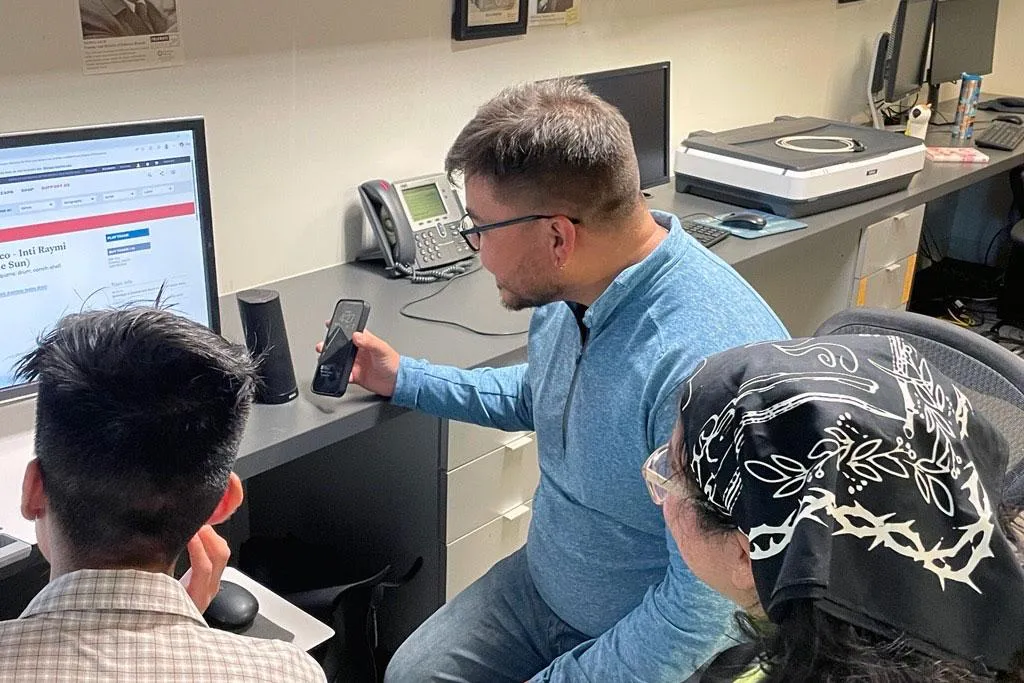
To confirm his suspicions, Eloy called a friend who participates in the annual Peruvian festivity and is knowledgeable about the festival’s music. He played the track’s original audio for his friend aloud on a computer speaker, and his friend confirmed, in real time, that it not only lacked the sounds of the charango but was also not an Inti Raymi song.
A separate Indigenous Peruvian track on the anthology originally played, in error, the audio for a song that was similar in content to the track that the compiler intended to include. The original audio for the track, entitled “Quechua: Huancalli - Shepherd’s Flute,” reflected a Colla shepherd’s tune in lieu of a Huancalli shepherd’s tune. That is, the shepherd’s tune on the original vinyl record was not only from a different region, but it was sourced from a different album. Eloy used his own expertise to confirm that the audio for the original shepherd’s tune was incorrect and that it should be replaced with the audio for the intended track from the intended source album.
This reparative metadata project, among its many aims, strives to make names accessible and searchable, and information correct. At its core, reparative metadata work examines, updates, and contextualizes collections to make accurate information discoverable.
By adding new information into the metadata of the albums (e.g., artist and culture-group names and terminology), the catalog becomes more searchable online, especially to source communities. Addressing inaccuracies and cultural insensitivities and resurfacing previously obscured information also helps avoid the reproduction of errors across digital service providers, such as YouTube and Spotify.
In a conversation with Logan, she differentiated our internal reparative project involving staff from shared stewardship: “There is a difference between what we are doing and the true essence of shared stewardship, which is talking with each of the artists about this. But because of our limited resources, we are only able to correct the stuff that we have really good reason to believe needs to be corrected.”
Even so, we continue to work with shared stewardship in mind, aiming to place artists at the forefront.
“It is going back and repairing this system where people did not think that names of artists were important when recording this,” Logan continued.
Sam echoed Logan’s sentiments, adding that, while our internal work is certainly important, our goal is shared stewardship.
“While I can go on the internet and do a lot of research and find secondary and primary sources, it does not mean that I am an authority on these names or concepts,” she explained. “Our preferred method would be community consultation, which is an element of shared stewardship that we do not have all the resources for at this time.”
We understand that shared stewardship is about dialogue with source communities. At the Center, the Shared Stewardship of Collections Policy was established to respect the right of source communities to steward representations of themselves and their cultural heritage in collaboration with the Center:
“[The policy] affirms the Center’s commitment to consult with source communities and defines our protocols for addressing collections-related inquiries and concerns. Our goals in developing this policy are to foster sustained dialogue with source communities; promote greater engagement with their heritage collections; enhance and refine cultural documentation and associated metadata; ensure culturally appropriate collection care and display; and recognize source community interest in digital return and repatriation.”
Cultural institutions worldwide hold the responsibility of ensuring ethical display of cultural heritage. Such ethical display certainly involves careful collaboration and exchange of insights among staff, but more importantly, it must involve engagement with source communities, as much as possible.
The internal reparative work illustrated in this project is an example of the kind of effort that can open the door to true shared stewardship by making information discoverable to the source communities represented throughout the collections of cultural institutions. From in-person exhibitions to digital platforms, staff across cultural institutions must ensure that the information that is displayed and disseminated is correct, and up to date, to generate more opportunities for shared stewardship with source communities.
Although reparative metadata is an ongoing endeavor, I am pleased to view the Anthology of Central and South American Indian Music, including the artists and cultures featured, represented as it was intended to be heard, for the very first time in over fifty years. At last, Logan can now hear the chirimía on track ten, Eloy can now hear the charango on the Inti Raymi track, and I can read Michoacán in its correct spelling.
Throughout my tenure as a fellow at Smithsonian Folkways, I often heard that resources were unavailable to engage in this work. Now more than ever, as the communities represented on the album and their descendants are subjected to systemic harm, it is necessary to invest resources into collaborating with these communities and centering their recorded histories in as ethical a way as possible. It should not take more than fifty years to correct an error, but it is better late than never. And it is never too late.
Marco Elvis Joven Domínguez is the 2025–26 Dumbarton Oaks Humanities Fellow at Smithsonian Folkways Recordings. He received his AB in philosophy from Harvard College. A former college radio DJ, Marco is interested in the ethics of cultural heritage, particularly world music.
Resources
Brown, Michael F., 2009, “Exhibiting Indigenous Heritage in the Age of Cultural Property,” Whose Culture? The Promise of Museums and the Debate over Antiquities, edited by James Cuno. Princeton, NJ: Princeton University Press.
Eaton, A. W. and Ivan Gaskell, 2012, “Do Subaltern Artifacts Belong in Art Museums?”, Young and Brunk 2012: 235–267. doi:10.1002/9781444311099.ch10
Gallagher, Haley and Iris Bennett, 2020, “Off the Shelf and into the Conversation: Indigenous Music and Shared Stewardship,”Folklife Magazine.
Pantazatos, Andreas, “Epistemic Injustice and Cultural Heritage,” The Routledge Handbook to Epistemic Injustice, edited by Ian James Kidd, José Medina and Gaile Polhaus, Jr. New York: Routledge.
Smithsonian Center for Folklife and Cultural Heritage, 2023, “Shared Stewardship of Collections Policy for the Smithsonian Center for Folklife and CulturalHeritage,” Smithsonian Center for Folklife and Cultural Heritage. doi:10.25573/data.21771155.v3.
Vallejo, Jessie M., 2018, “Intergalactic Pachamama: Kichwa Cosmology vs. Western Astrophysics,” Folklife Magazine.