

In the First City Named for George Washington, a North Carolina Community Celebrates Its Latino Heritage
While artistically stunning, the creation of the new “Viva la Vida” mural follows a multiyear initiative of Washington, working with community leaders and the Latino community, to create a more inclusive, welcoming city through the arts.
:focal(700x467:701x468)/https://tf-cmsv2-smithsonianmag-media.s3.amazonaws.com/filer_public/22/52/225283c4-7b96-4435-9dd3-18225af7f131/viva-la-vida.jpg)
This article is part of a series created in collaboration with UPLIFT North Carolina, a program that supports rural tourism throughout the state. Since July 2023, our partnership has provided participatory workshops and mentorship, working with partners to support and develop festivals and cultural heritage tourism experiences that benefit both visitors and communities.
Drive into Washington, North Carolina, on Fifth Street, one of the main arteries of the city, and you will be immediately greeted by brilliant colors from the “Viva la Vida” mural decorating the Bobby Andrews Recreation Center. The artwork, located in the heart of the Latino Business District, sits clearly beside Highway 264, the main road that cuts through Washington and leads to the major downtown center. A multitude of Latino-owned restaurants and businesses are nestled just across the road.
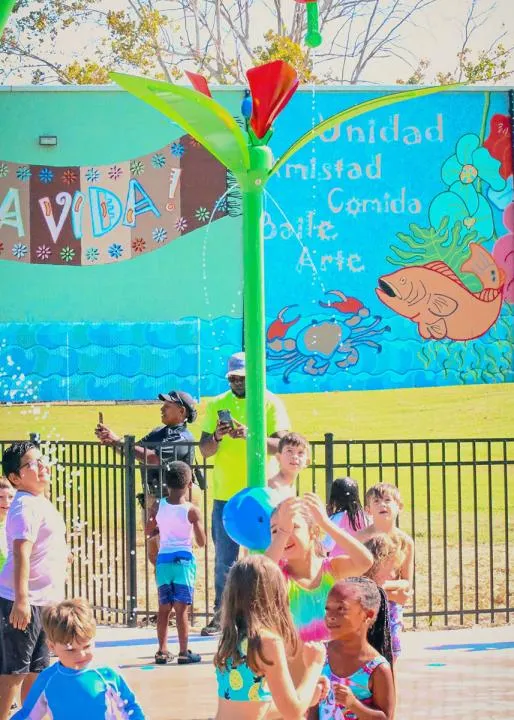
Celebrating the city’s local Latino community, symbolism abounds throughout the artwork. A rich variety of flowers reflect different Latin American countries, interspersed with a variety of words, voted on by the Latino community to represent important values: familia (family), arte (art), unidad (unity), among others. Fish, crabs, and blue waves reflect the local commercial fishing industry, a key part of Beaufort County’s economy.
The 3,300-square-foot mural has a lot to love, but what might grab your eye first is in the center: the large serape, a traditional Mexican shawl, colored to represent the many skin tones of the Latino community, with the phrase “¡Viva la Vida!” or “Long Live Life!” It is a popular expression in Mexican culture for resilience and joy for life in both good and bad times.
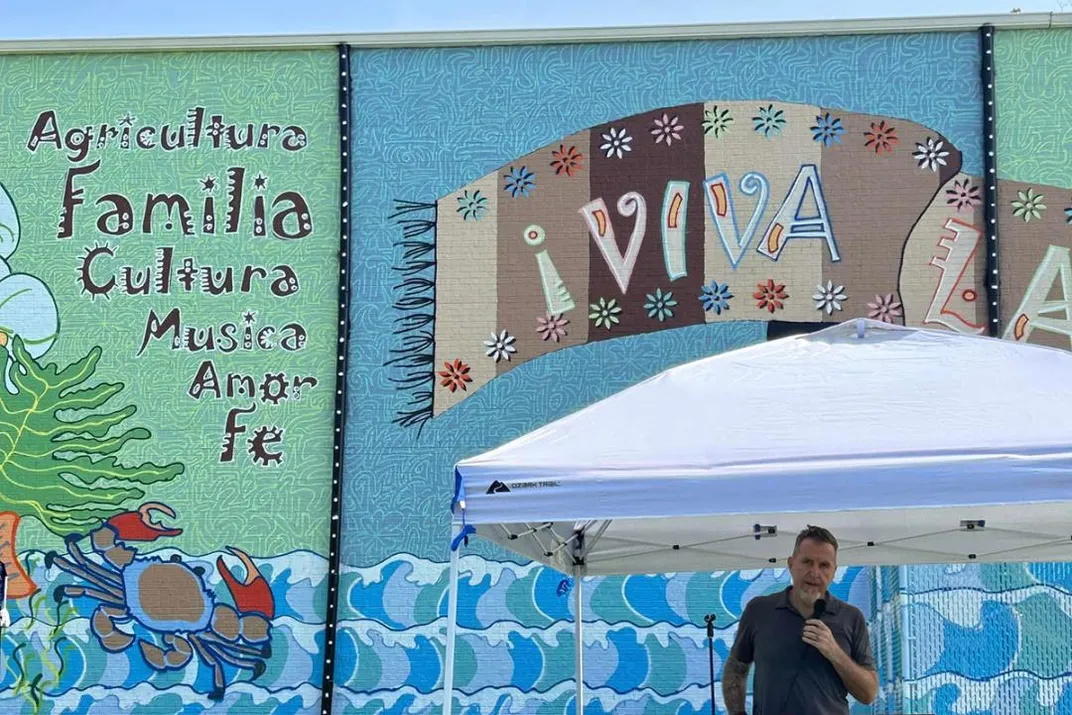
While artistically stunning, the creation of the mural follows a multiyear initiative of Washington, working with community leaders and the Latino community, to create a more inclusive, welcoming city through the arts.
“Washington’s history, culture, arts, should reflect every resident here,” says Leesa Jones, cofounder and executive director of the Washington NC Waterfront Underground Railroad Museum and central partner in the mural project. “Every resident in Washington should be able to see themselves in the culture, the history, the arts, and entertainment. I’m big on that.”
Washington is a city rich in history. Established in 1776 at the outbreak of the American Revolutionary War, its strategic location at the northern bank of the Pamlico River was a crucial spot for resupplying revolutionary ships. While many people think of Washington, D.C., as the first city named after George Washington, the distinction goes to this North Carolina city—something locals hold closely as a point of pride.
“[Locals] don’t like to hear ‘Little Washington,’” says Sarah Godley, the city’s community outreach coordinator. “They like to hear Washington, or they’ll be quick to correct you that this is the ‘Original Washington.’”
Beyond its strategic location in wartime, Washington’s central location among a variety of navigable waterways made it a key cultural and commercial hub at the mouth of the Pamlico Sound, the largest lagoon on the East Coast. During the time of its founding, blue crab harvesting and coastal fishing, along with tobacco farming, were key to Beaufort County’s economy. This legacy is still visible today, as the commercial seafood industry remains the largest economic sector in the community.
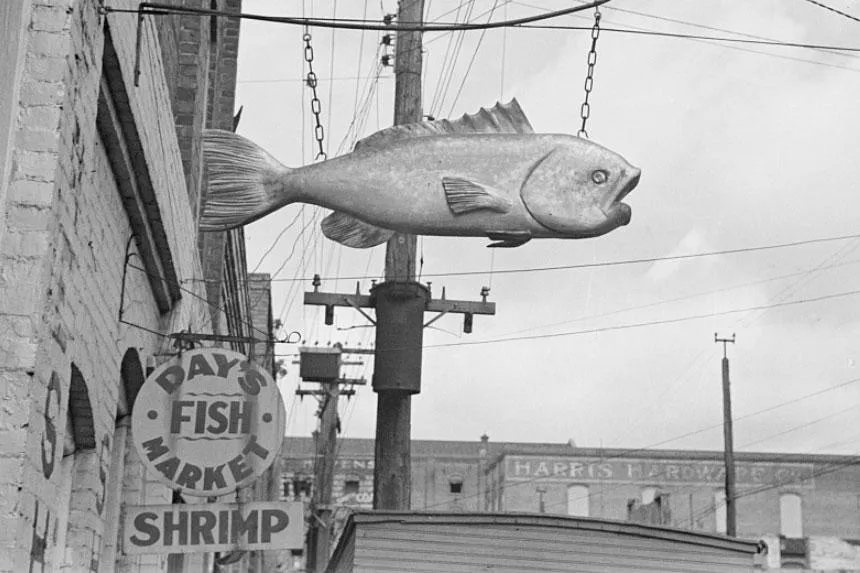
Targeting jobs in seafood, crabbing, and farming, immigration to Washington from Central and South America grew significantly in the 1980s, driven in part by the H-2 visa program that provided an avenue for seasonal or temporary work.
“A large portion of the Latino community came here for jobs in the crab industry,” says Abigail Cabrera, Latino community outreach coordinator for Washington. “A lot of farmers also contract out to different Latino countries to help during the crop season. We have a lot of different kinds of representation from Latin American countries, including Guatemala and Mexico.”
Eventually, many families settled permanently in Washington. By 2021, 70 percent of Beaufort County’s immigrant population came from Latin America, and 13 percent of Washington residents reported Latin American ancestry. However, while the Latino community represented a significant part of the population for several decades, it was relatively isolated.
“I would just say some of the barriers are buy-in and trust,” says Erin Ruyle, the public information officer for Washington, “because there have been groups that have been excluded for so long or feel that way.”
Overwhelmingly, the Latino community wasn’t represented at city gatherings. There were no festivals or events celebrating or including Latino culture, and the neighborhoods where a significant population of Latino families resided were relatively cut off from the rest of the city. Such factors further deepened distrust and cemented a clear disconnect between the city and its neighbors. However, these observations also sparked conversations. Recent initiatives to create a more inclusive and welcoming city by local officials showcased the need to engage with the larger Latino community.
At its heart, the city had two main goals: to create avenues of representation and inclusion with its Latino community and have those goals be created through the Latino community itself, by building relationships, fostering trust, and conducting impactful community outreach.
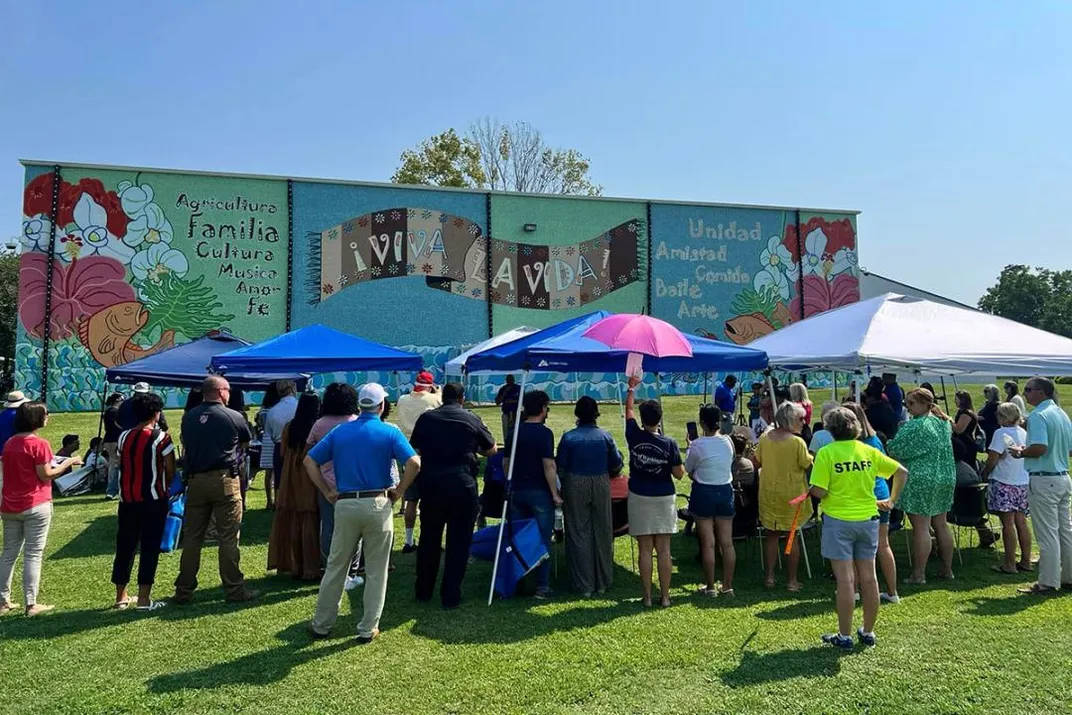
First, though, there had to be a foundation established to begin the work. The city applied for a Building Integrated Communities Grant through the Blue Cross Blue Shield Foundation, leading to a partnership with the University of North Carolina at Chapel Hill. The funding provided the initial steps to identify needs, build trust, increase engagement, and work more actively with the Latino community—an important start. Cabrera was hired as the community outreach coordinator to oversee work with the community, along with several other community members and city officials. Meeting at churches and other community gathering spaces, Cabrera outlined the goals of the city and a commitment to have representation be shaped by the Latino community. From the beginning, there was excitement.
“It was a good reaction,” Cabrera says. “I think it was almost like a ‘really?’ moment, because there’s not a lot of representation of our Latino community anywhere. When the idea of highlighting the community’s culture within the city was introduced, it was received in a really beautiful way. It was inspiring to see that excitement grow as people became part of the initiative.”
While there was enthusiasm, there was also hesitation.
“It took multiple years of collaborative efforts for us to build trust to be able to even get to some of the projects that we are doing now,” says Jones, who was involved in the initial planning phase of the project. “The City of Washington led the project planning and development and began hosting initiatives such as its inaugural Hispanic Heritage Festival. Mayor Sadler issued a proclamation for Hispanic Heritage Month. The speech was a way of affirming the city’s commitment to celebrating and supporting its Latino community. That proclamation meant a great deal to our Latino neighbors, yet it was the trust built along the journey that truly mattered most.”
The city and the Latino community established and strengthened their connections, showcasing the community’s priorities to include all residents of Washington. Local leaders hosted meetings and workshops about inclusion efforts at churches and businesses to create an inclusionary and participatory environment, where the Latino community was always at the forefront of their representation, continuously involved through the entirety of the initiative.
After three years of engagement and identifying need, another opportunity presented itself through the Z. Smith Reynolds Foundation, which offered an avenue to combine community outreach with a public arts project. Using the same churches, community centers, and other gathering spaces, city leaders distributed surveys about the opportunity to both inform and document opinions on the project. When asked about the preferred art medium, the Latino community overwhelming responded with the creation of an art mural.
“We truly wanted it to be a community project,” Cabrera says. “Everything that we did, we always started out with, ‘How can the community be a part of this?’ One of the questions [when creating the mural] was ‘What are the words that represent the Latino community in your eyes?’ And so, they all came out with the different words that are on the mural.”
Just as the mural incorporated Latino community’s input and design, the location was equally important; it needed to be in a place that was both representative of the Latino community and clearly visible to locals and visitors alike.
“Several people suggested that we put it in downtown Washington near the waterfront. I felt it would be best served in and with the Latino community,” Jones says.
The Bobby Andrews Recreation Center was ultimately recommended by the city’s director of public safety, Stacy Drakeford, whose knowledge of the area helped guide the selection. At the time, he was also overseeing Parks and Recreation and the installation of a splash pad at the site. The mural’s vibrant color palette intentionally complemented the design of the splash pad, reflecting the city’s thoughtful and strategic planning. Today, the “¡Viva la Vida!” mural stands prominently at the Bobby Andrews Recreation Center, within the heart of the Latino business community.
After receiving community input and confirming the location, the city issued a request for qualifications and, following a formal review and evaluation process, selected Georges Le Chevallier, a French Puerto Rican artist with a long history of community engagement in the arts.
“I was really aware this mural had to be inclusive,” Le Chevallier says. “And the way I painted it—I tried to bring people in using colors, patterns, words, to make it as inclusive as possible while still celebrating the Latino community.”
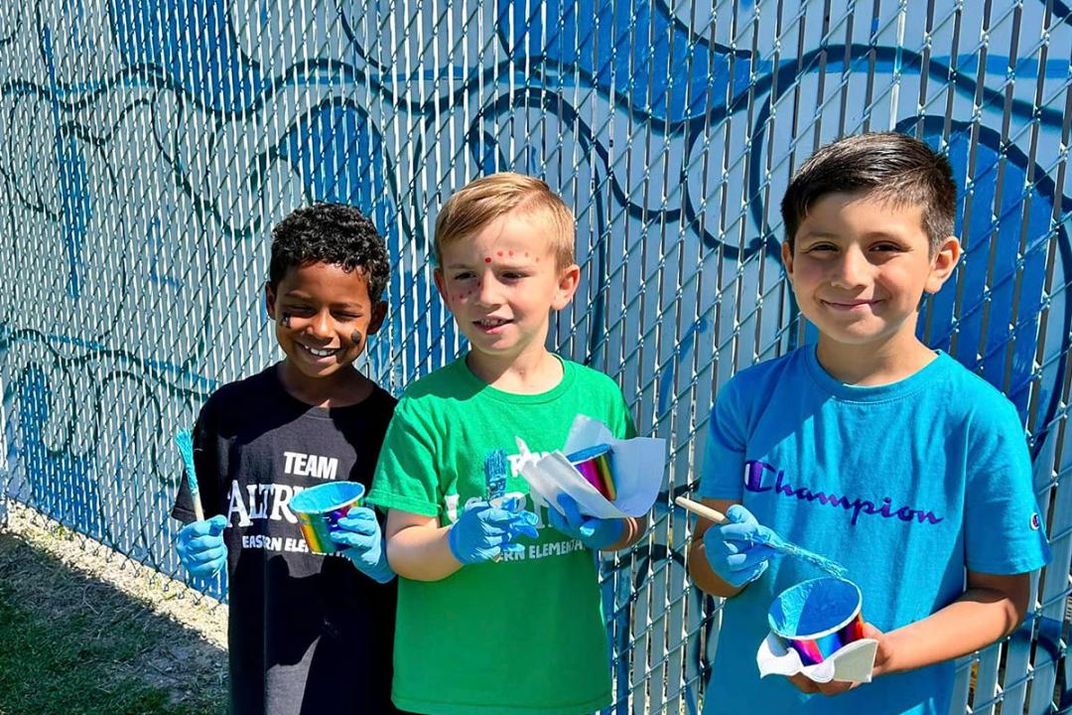
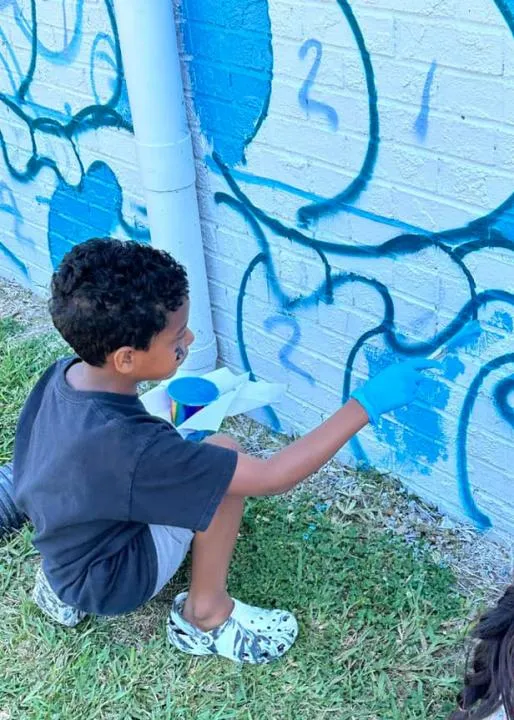
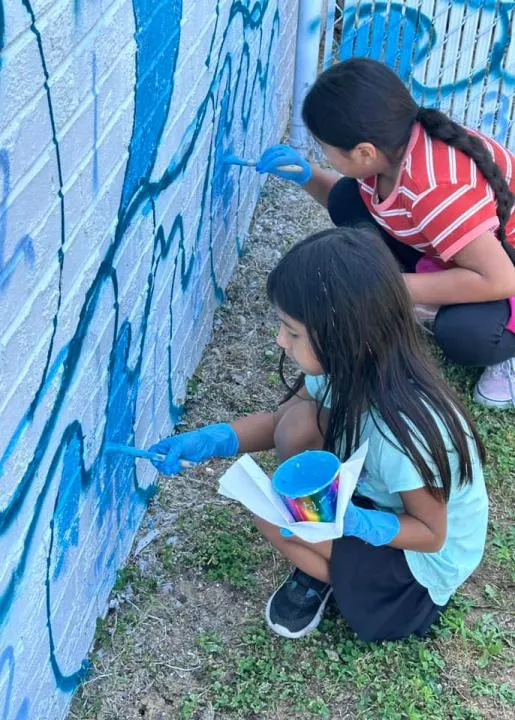
While sharing heritage and culture from the Latino community, the creation of the mural included everyone from Washington to be a part of its creation. When Godley and Cabrera reached out to the schools to have children paint the ocean waves at the bottom, the entire city wanted to participate.
“We had a great response,” Godley says. “There were so many school buses showing up that we created a strict schedule. They each got an hour, and literally as one school bus rode away, another school bus would come.”
The mural was covered extensively in the local newspaper. Not just schoolchildren, but families—both Latino and non-Latino—showed up, adding their brushstrokes and a part of themselves to the mural.
Godley highlights those first moments of creating this mural: “When they were painting on the wall and one of the first strokes of paint was from the little children there, it was beautiful—just the look on their faces and just to be able to share that moment, because that’s something that’s forever.”
The mural itself reflects the years of work by Washington to respectfully engage and build representation with the Latino community. For Berekia Divanga, the city’s grants assistant, the artwork “has sparked meaningful conversations and helped people learn more about the community. It shows that everyone is welcome here and that making people feel represented is an ongoing effort. This project was made possible through our collective efforts, whether behind a computer preparing grants or directly engaging the public, along with strong support of the community.”
These community building efforts have led to additional projects by the city to publicly showcase local history and folklife through the William G. Pomeroy’s Legends & Lore Marker Program, highlighting all communities in “the Original Washington.”
Most importantly, the creation of the “¡Viva la Vida!” mural has shown how important art can be in public spaces and how something long-lasting and impactful can be made through local community engagement. By starting conversations and creating new ways to be seen and included, Jones’s words highlight just how important it is to do this work and the everlasting influence of art in our lives:
“Art is so important because it gives a person a chance to express themselves,” she says. “But it also gives us, the recipients, the ability to reflect to the artist our appreciation for it. It’s a gift that’s freely given for all to enjoy. It’s a wonderful way for people to express themselves, their feelings, their hopes, their dreams, their desires.”
Ian Hallagan is a public folklorist, media producer, and writer. He has worked in a variety of nonprofits, cultural heritage tourism teams, universities, and state and local government institutions across the American South, West, and Southwest.
This article received editorial support from the North Carolina Folklife Institute.