

Seven Beetles So Beautiful You Could Wear Them as Jewelery—and People Have!
A new book explores more than 100 of the world’s most dazzling beetle specimens
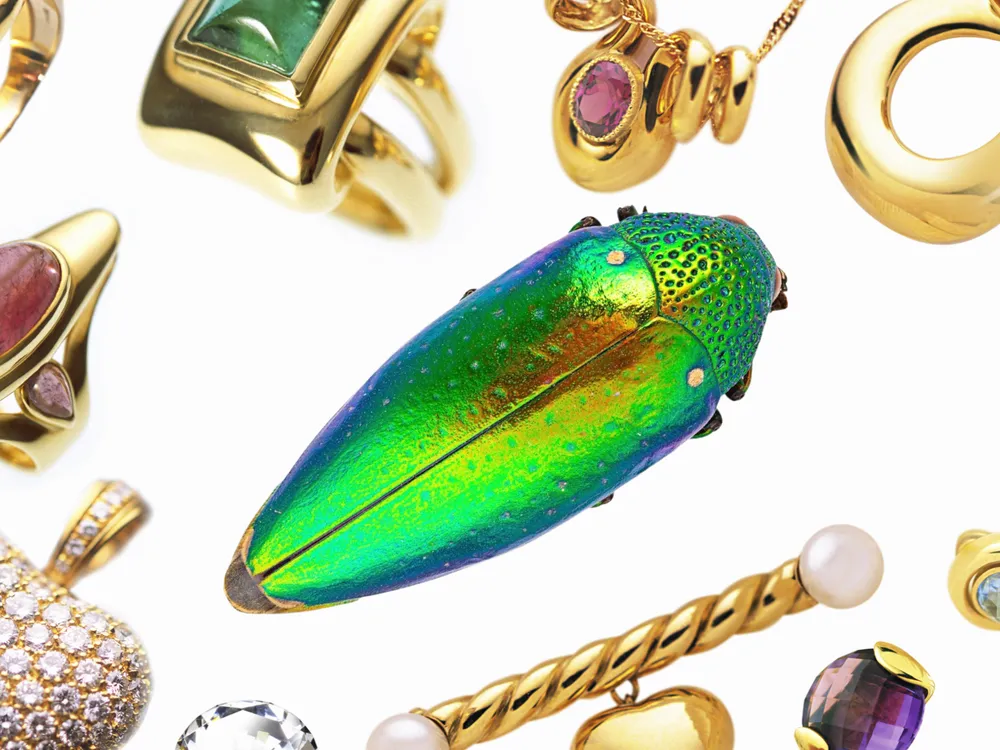
Beetle image: ©The Trustees of the Natural History Museum, London, 2026
Beetles are among the largest and most diverse groups of organisms on the planet. Their distinctive feature is that the front pair of wings is hardened into a pair of strong and often brightly coloured wing cases called elytra, which cover and protect the delicate flight wings folded beneath. This is why the beetle group is called Coleoptera, from Greek ‘koleos’ meaning sheath and ‘pteron’ meaning wing. The Smithsonian Handbook of Interesting Beetles features a range of fascinating beetles from across the world, and today we present eight of them that wouldn't look amiss in your jewelry box.
Golden jewel beetle
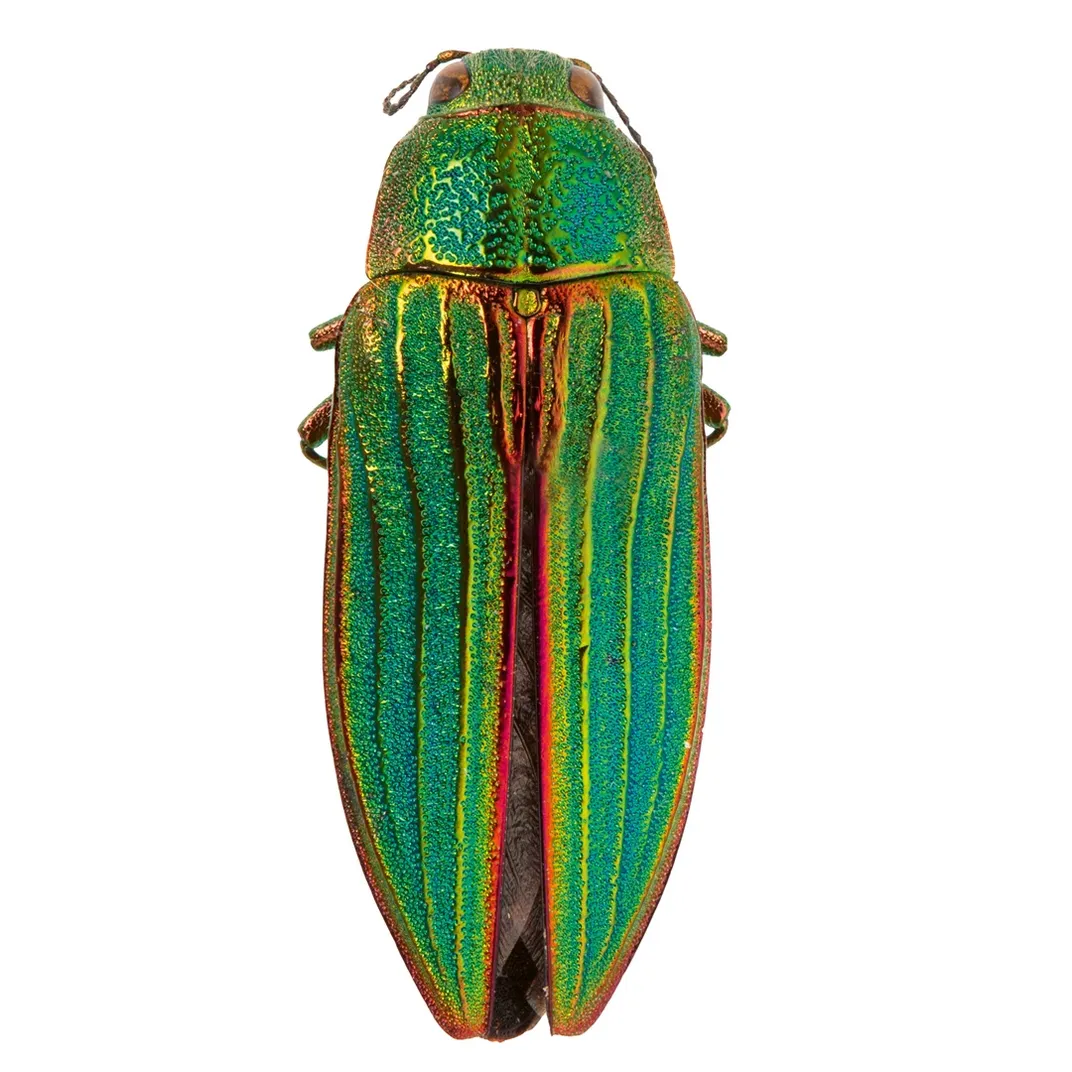
Buprestis aurulenta
The golden jewel beetle is a bright metallic green, with a shining pinkish trim running down the centre of the elegantly ridged elytra. It is a forest species, the larvae boring in drying timber of coniferous trees. Like many wood-boring beetles, the length of the larval development is influenced by the amount of nutrition available – if the wood is fresh or contains a rich supply of fungi, the larvae can grow rapidly, but if the wood is used for construction and allowed to dry out, its nutritional value decreases, and if larvae inside survive, they will need much longer to accumulate enough nutrient to pupate and become an adult. Golden jewel beetles are famous for emerging from items of furniture years or decades after they were produced, no doubt giving rise to the expression that something unexpected ‘came out of the woodwork’. This specimen emerged from a windowsill in England that had been made from American timber 17 years previously, and the record for a beetle of this species emerging from a piece of manufactured furniture currently stands at 51 years. This is probably one of the longest-lived of all insects.
Family Buprestidae
Distribution North America
Beetle length 1.9 cm (¾ in)
Smithsonian Handbook of Interesting Beetles
Admire the world’s most dazzling beetles in this stunning insect book featuring 100+ photos, detailed profiles, and a convenient size that's perfect for nature walks.
Living jewel beetle
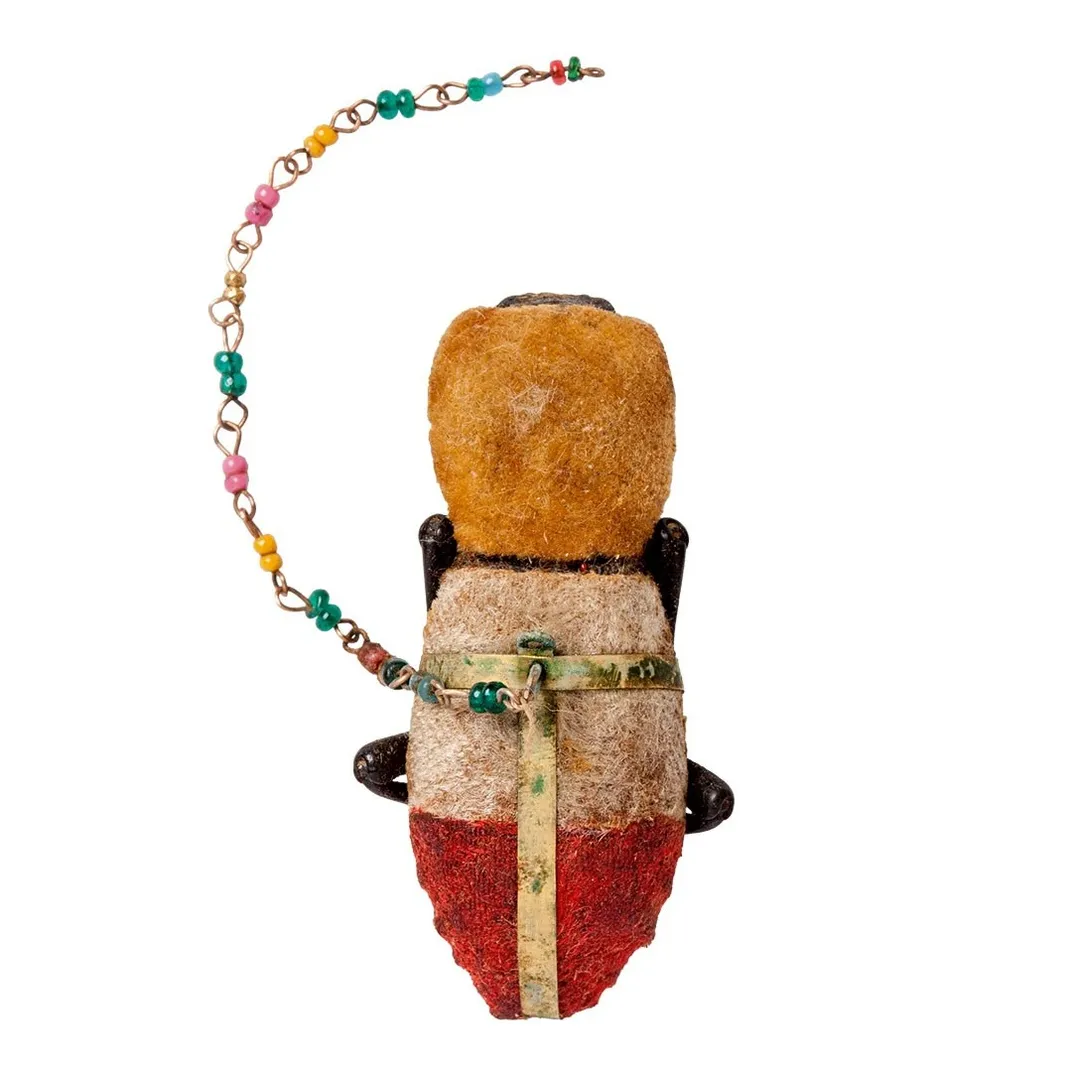
Zopherus chilensis
The living jewel beetle, also called the maquech, is a large insect associated with dead trees in South and Central America. It has a strong heavy exoskeleton, is unable to fly, and adults are very long-lived, surviving at least a few months. In some parts of Mexico these characteristics have led to its recruitment for an unusual fashion. Adult beetles are captured and decorated with pieces of velvet, metal and costume jewellery, attached to a chain and worn as a living brooch. This tradition is particularly common in the Yucatan Peninsula in the tropical south of Mexico. The decorated specimen shown is from the nineteenth century, but the custom continues today often using plastic and modern materials. The living jewel beetle is the largest member of the family Zopheridae. When unadorned it is patterned in brown, grey and black, to camouflage on the lichen-encrusted bark of fallen trees, and lives an unassuming life away from the spotlight, feeding on small pieces of organic matter and plant debris under tree bark. The larvae also live and feed in the wood. The name ‘chilensis’, referring to Chile, is misleading as this species is usually found much further north
Family Zopheridae
Distribution Tropical Central and South America
Beetle length 3.4–4.6 cm (1 ¼–1 ¾ in)
Sky-blue chafer beetle
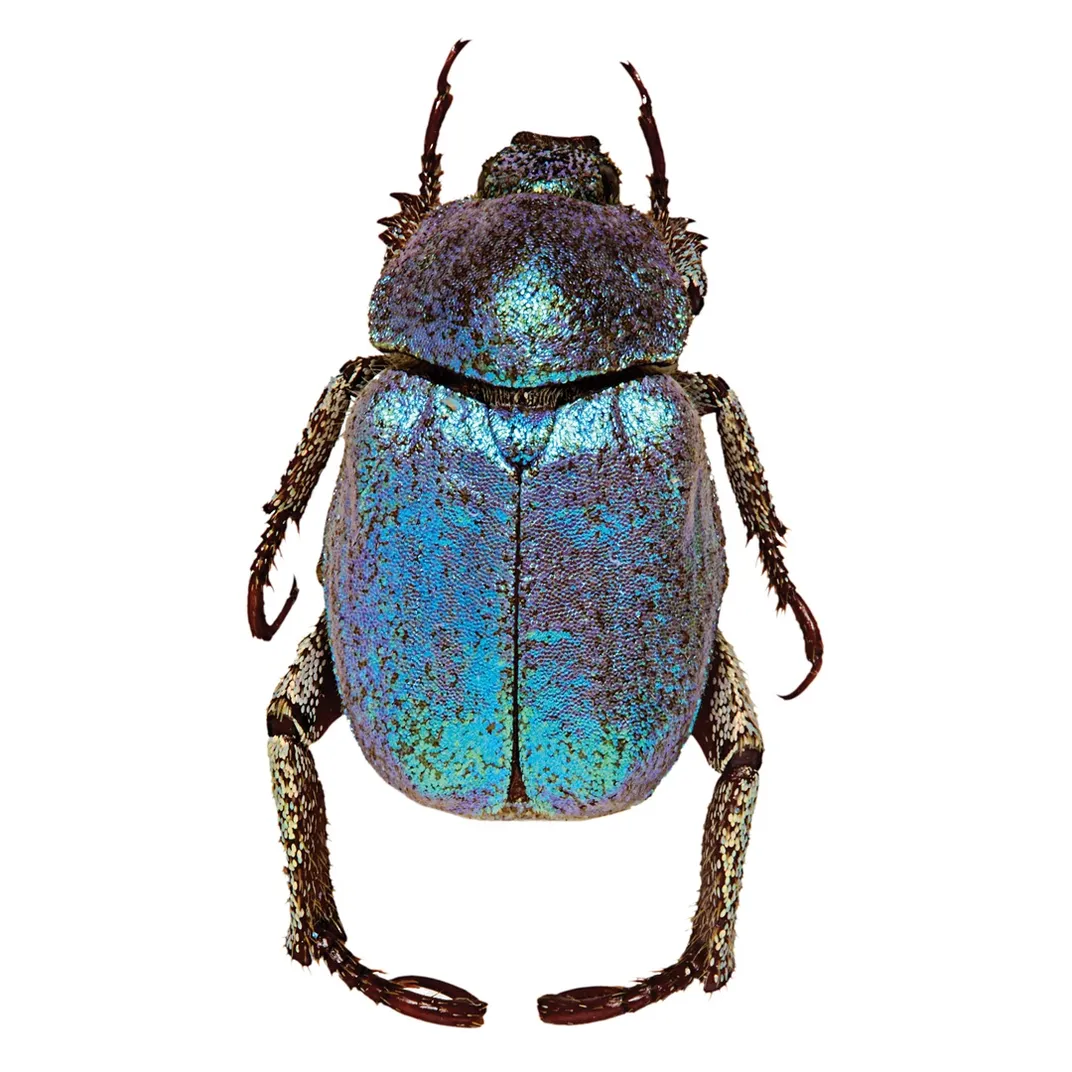
Hoplia coerulea
While many of the most colourful beetles come from the tropics, Hoplia coerulea, from southern France and Spain, is one of the most striking of all, a tiny living jewel that looks like an animated piece of the blue Provençal sky cast down amid the vegetation. Only the males are covered with metallic iridescent scales – the scientific name ‘coerulea’ means sky-blue. The greenish-brown females, less conspicuous but longer-lived, lay their eggs in the ground, and the subterranean larvae feed on roots. Adult beetles of both sexes feed on nectar and pollen, and are seen sparkling in the centres of flowers, or flying from blossom to blossom in bright sunlight. This species belongs to the same subfamily of scarab beetles as the maybugs, cockchafers and pine chafers, but those others are all larger, less colourful and fly in the evening. This species was described by Dru Drury (1725–1804), a silversmith who was also a wellknown early entomologist, also describing the Goliath beetle. Considering his profession, Drury might have been enchanted by the metallic finish on this small but beautiful insect.
Family Scarabaeidae
Distribution Southern Europe
Beetle length 1 cm (½ in)
Silver jewel scarab beetle
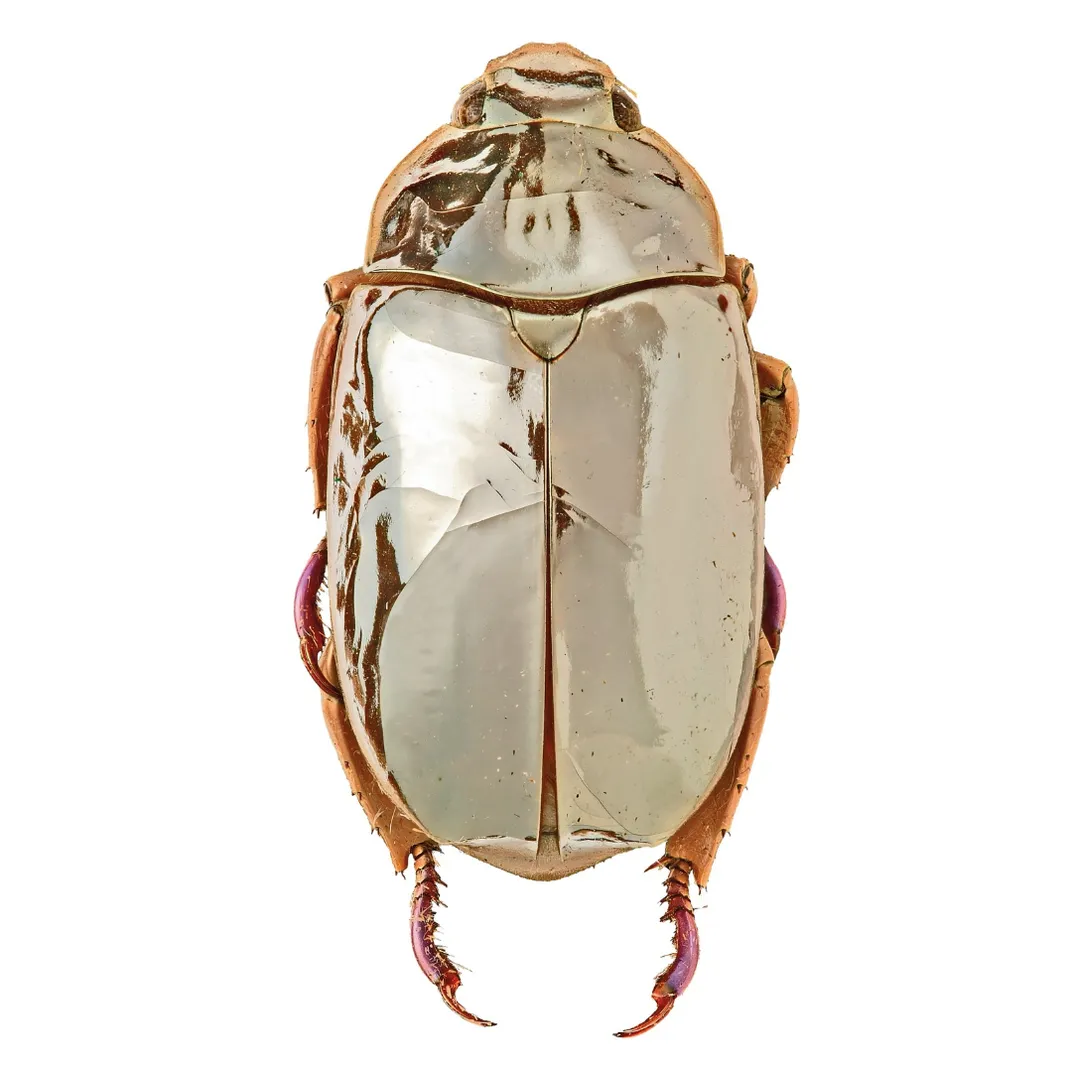
Chrysina limbata
Just as Chrysina aurigans appears to have been hammered from pure gold, its close relative Chrysina limbata reflects a stunning smooth silver colour, like a droplet of mercury. This species also lives in the lush mountain cloud forests of Costa Rica and Panama. Cloud forests are some of the wettest environments on Earth, with nearly continuous rain during the wet season when these beetles are most active. For this reason, many predators may ignore glistening spherical objects, because droplets of water or little pools at the bases of giant forest leaves are such a common sight. The beetles do not seem to mind the wet weather – they are found nowhere else on Earth. The adults fly during the warm humid nights, sometimes being attracted to artificial light. Physicists have taken an interest in the reflective surface of Chrysina beetles, which is almost unique in nature. This species has been shown to reflect around 97 per cent of light, and one can see one’s own reflection in its mirror-like surface. In this specimen, the shining surface has become cracked and crazed as it has dried out during the century since it was collected, in 1926 in Pejivalle, central Costa Rica.
Family Scarabaeidae
Distribution Costa Rica, Panama
Beetle length 3 cm (1 ¼ in)
Hispaniolan regal weevil
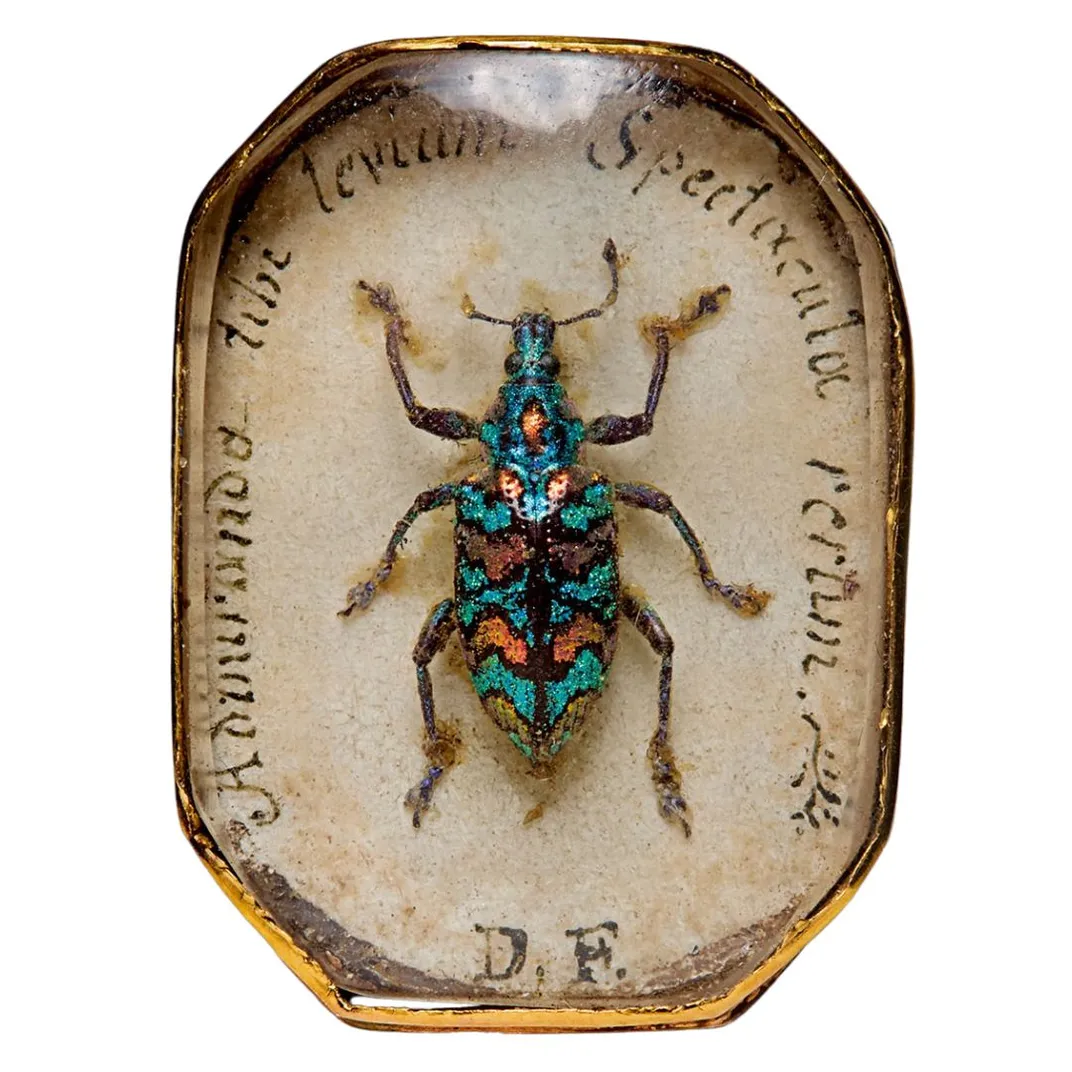
Tetrabothynus regalis
About 200 years ago, someone somewhere loved weevils so much they had one set in a gold ring. Despite its glamorous casting, it is treasured in the beetle collection, among the other, more traditionally pinned specimens. The initials D F are written beneath it, with the charming Latin inscription from the poet Virgil, ‘Admiranda tibi levium spectacula rerum’ – See with wonder what the smallest of creatures shows us. The setting is not glass, but highly polished, clear crystal. From the size, it seems to be a man’s ring, and it is thought to be from the original collection of Hans Sloane (1660–1753), the founder of the British Museum. The weevil centrepiece, Tetrabothynus regalis, occurs only on the Caribbean island of Hispaniola, and is not a common species today. ‘Regalis’ meaning regal, and its glittering bands of copper and gold, catch the light like jewels. The colour comes from minute scales on its surface that, which under the microscope look like tiny balls of glitter as they reflect and distract the light, like the scales of a butterfly’s wing.
Family Curculionidae
Distribution Hispaniola, Caribbean
Beetle length 2 cm (¾ in)
Atlantic tortoise beetle
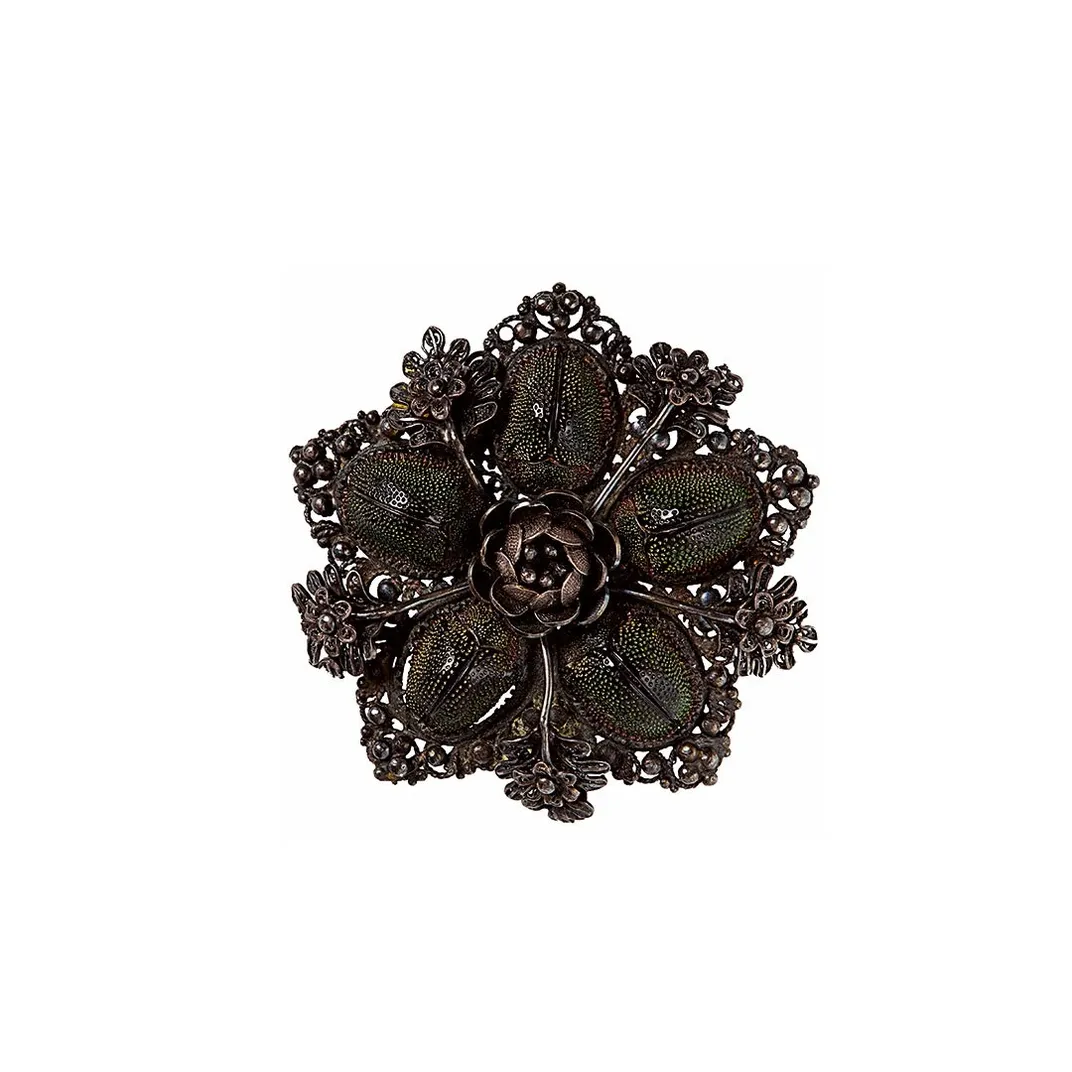
Polychalca punctatissima
Metallic green tortoise beetles, Polychalca punctatissima, are leaf beetles, that used to be common in the Atlantic forests of eastern Brazil. They were popular for use in costume jewellery in Europe at the beginning of the twentieth century, as they are shiny and durable, with a lustrous metallic finish, and also lightweight and easy to work with. They became very fashionable during the Egyptian Revival prompted by the discovery of Tutankhamun’s tomb in 1922. During the Art Deco and Art Nouveau periods they were usually sold in brooches, necklaces or bracelets, as scarabs, which are totally unrelated and not connected with Egypt. This unusual object is an antique mourning brooch, made with five specimens of Polychalca punctatissima, which have, rather strangely, been blackened to make the brooch more funereal. Polychalca punctatissima can still be found in its Brazilian rainforests, but it has declined dramatically because of the destruction of most of the original coastal Atlantic rainforests where it lives, a habitat it shares with many unique animals and plants.
Family Chrysomelidae
Distribution Eastern South America
Beetle length 1.3–1.7 cm (½ in)
Jewel beetle
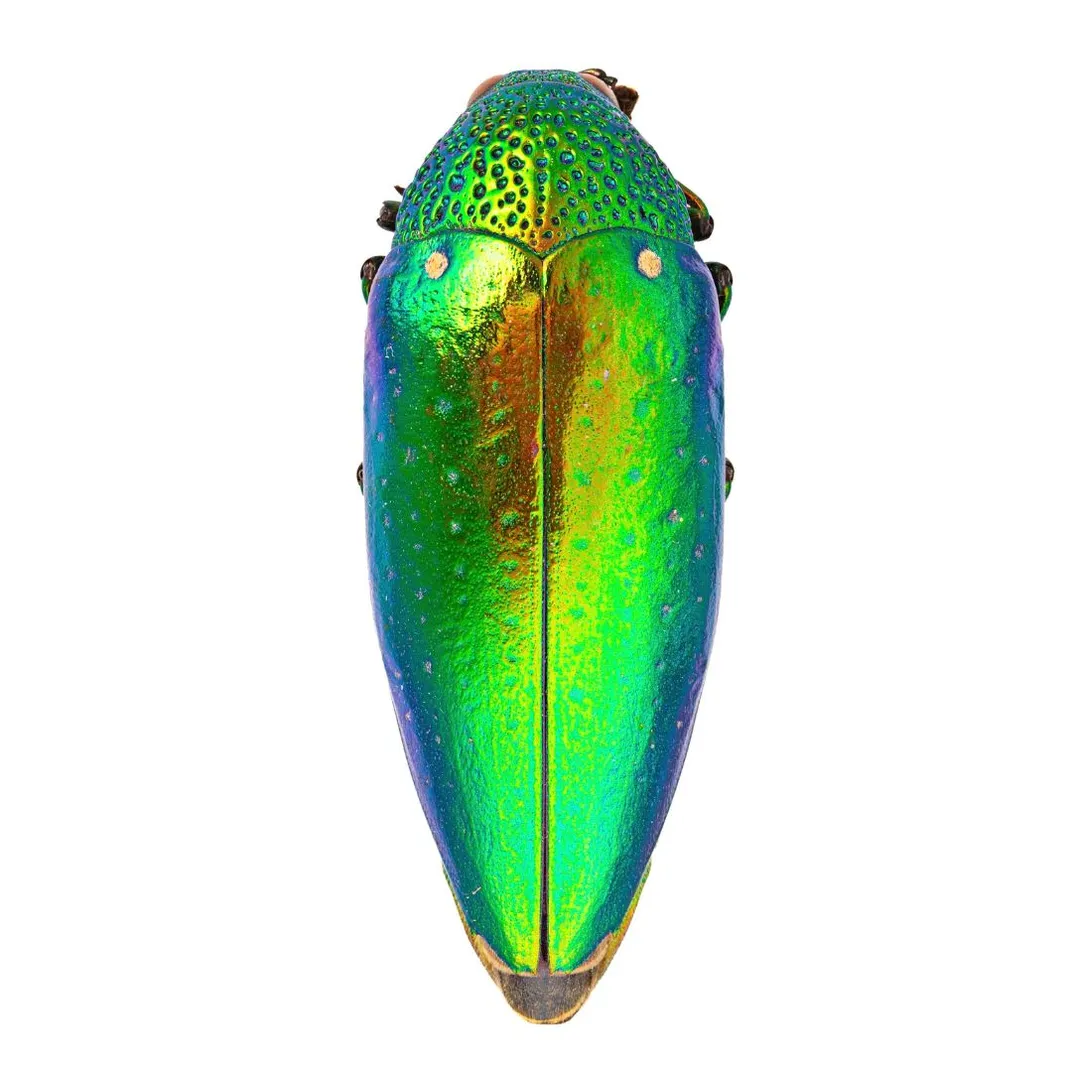
Sternocera aequisignata
The iridescent green beetles of the genus Sternocera, in the family Buprestidae, were used to decorate traditional costume in northern India, Burma and Thailand, where the elytra or wing cases are sewn onto cloth like sequins. Victorian designers were inspired by this style, and the most famous dress of that era was worn by actress Ellen Terry (1847–1928) as Lady Macbeth (1888), immortalized in a painting by American artist John Singer Sargent (1856–1925). Her sensational beetle-wing dress is preserved at her former home at Smallhythe Place, Kent, England, where it still draws tourists after nearly 140 years. Colourful tropical beetles do seem slightly out of place in Dark Ages Scotland, the setting for Macbeth, leading the writer and poet Oscar Wilde to quip that Lady Macbeth must have gone to Byzantium for her shopping. In reality she would need to have gone much further than Byzantium (now Istanbul), to the steamy tropical jungles of Thailand or India, to find these beetles. Most Buprestidae are wood feeders as larvae, but the larvae of Sternocera feed on the roots of woody plants in the soil of wet forests.
Family Buprestidae
Distribution India, Burma, South China, Vietnam, Laos, Thailand
Beetle length 3–5 cm (1 ¼–2 in)
Read more in Smithsonian Handbook of Interesting Beetles, which is available from Smithsonian Books. Visit Smithsonian Books’ website to learn more about its publications and a full list of titles.
Excerpt from Smithsonian Handbook of Interesting Beetles ©The Trustees of the Natural History Museum, London, 2026

A Note to our Readers
Smithsonian magazine participates in affiliate link advertising programs. If you purchase an item through these links, we receive a commission.