

These Five NASA Objects Reveal the Extraordinary Achievements of Space Exploration
A new book explores NASA’s achievements through 100 influential objects
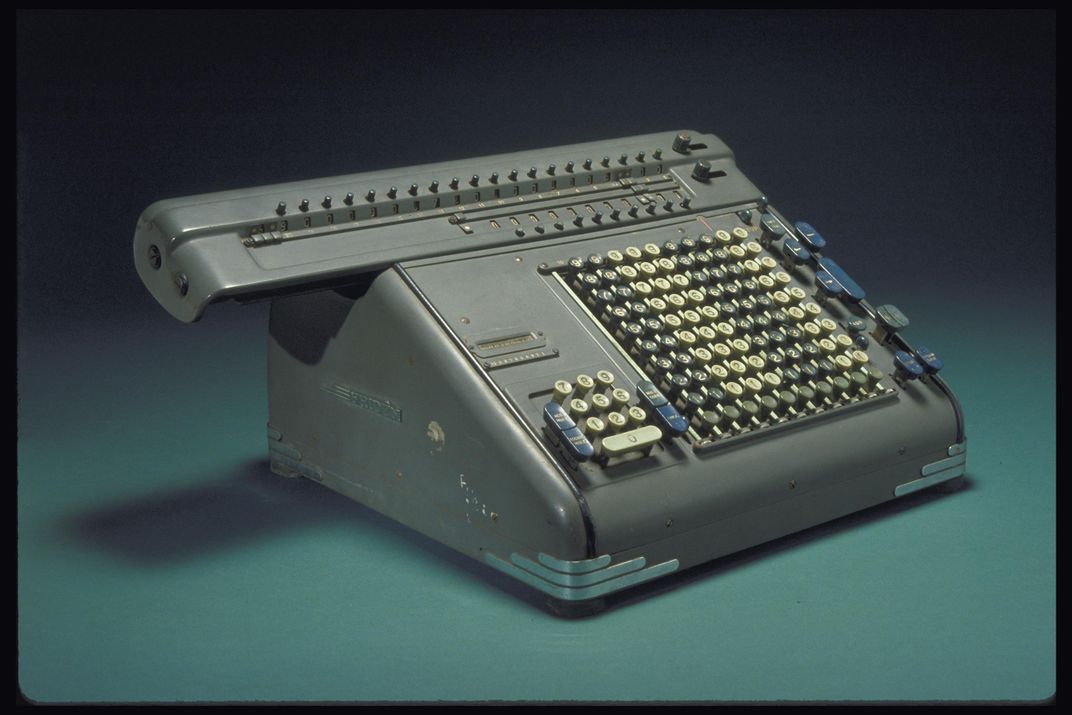
Friden Mechanical Calculating Machine
National Museum of American History; Gift of William L. Jackson
Mechanical calculators, especially the Friden Mechanical Calculating Machine, could be used to process extensive research data from wind tunnels and flight tests. This data enabled the preparation of research reports that proved highly valuable in aircraft design. The findings of the NACA’s aeronautical research appeared in technical reports broadly distributed to all interested parties, often containing thousands of complex mathematical calculations.
The Friden calculator was invented by Swiss immigrant Carl Friden (1891–1945) and soon became a universal tool. Introduced in 1935, the Model C10 was an advanced mechanical calculator suitable for aeronautical engineering. It featured a powered shift and clearing controls, and a typewriter-like carriage, efficiently managing complex mathematical data.
At the NACA, people trained in mathematics and other sciences would use the Friden Calculating Machine to “crunch the data;” they were therefore nicknamed “human computers.” The computers reviewed data, performed calculations, and graphed coordinates for research projects.
Many of them were women, who worked closely with the engineers undertaking the research. The NACA’s Langley Memorial Aeronautical Laboratory employed seventy-five women in this role by the 1930s and over four hundred by the 1940s. They used their technical skills and earned a fine salary for the role, although they were officially classed as “subprofessionals” and received lower salaries than men with similar qualifications hired as junior engineers. These women played an integral role in the NACA’s research from the mid-1930s into the 1970s. Among their ranks was Virginia Tucker—the first female “computer,” hired in 1935; Vera Huckel and Helen Willey, who had long careers lasting into the NASA era; and Marilyn Heyson, who joined because it sounded more interesting than her then-likely path as a teacher, and worked at the laboratory until retirement.
Dorothy Vaughan, Miriam Mann, Kathryn Peddrew, Lessie Hunter, Dorothy Hoover, and Kathleen Land were the first Black women to work at Langley, starting in 1943. Given its location in the Jim Crow South, the laboratory was segregated. They, and later others, worked in the laboratory’s West Computing Pool, where they undertook the same work as their white counterparts. Despite Virginia’s restrictive laws, many of these women spent years at Langley before joining engineering teams in flight research and later NASA’s space operations. Katherine Johnson (1918–2020), for example, had a long career at the NACA. Famously, astronaut John Glenn (1921–2016) said he trusted her calculations of the orbital trajectories for his 1962 Mercury flight above all others.
The NACA’s aeronautical research appeared in more than 16,000 technical reports, consistently noted for their thoroughness and establishing the agency’s reputation as a world leader in the field. This process of presenting technical data to the aeronautical community originated through the rigorous research and documentation process made possible with the Friden calculator and other research tools used at the NACA. It wasn’t until the 1970s that these mechanical calculators were replaced by smaller, easier-to-use digital calculators.
Lunar Landing Research Simulators
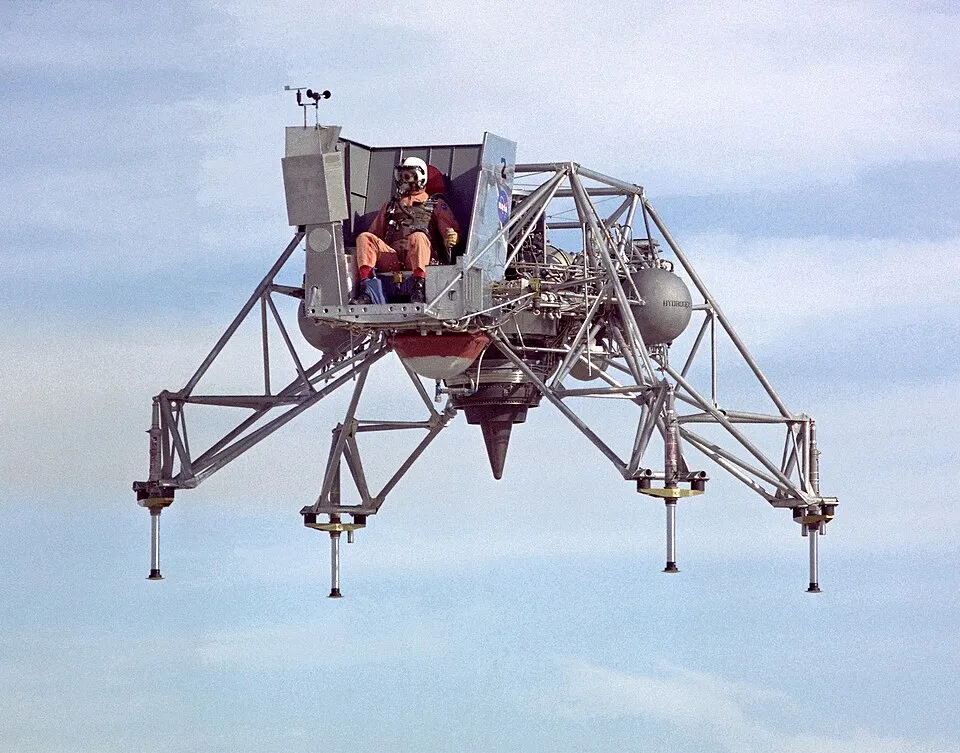
To meet the Apollo Moon-landing commitment before the end of the 1960s, NASA developed a multitude of training capabilities for its astronauts to master. One of the most difficult was the simulation of the 1/6 gravity landing on the Moon. Lunar landing research simulators gave the astronauts a chance to practice what it might be like to touch down on the lunar surface.
These simulators included the Lunar Landing Research Vehicle (LLRV) and the similarly named Lunar Landing Research Facility (LLRF). Together they served as training tools that allowed the practice of the final 200 feet of the descent to the lunar surface. The LLRF was built at NASA’s Langley Research Center in Hampton, Virgina, in 1965. Essentially a giant erector set, it suspended a model of the Lunar Module (LM) from a crane over a simulated lunar landscape. Since it required astronauts to pilot a tethered mock-up of the LM, it could be used in a more aggressive manner to evaluate the limits of lunar landing capability than the LLRV, which was untethered.
The LLRV was an ungainly, free-flying craft nicknamed the Flying Bedstead. It made its first flight on October 30, 1964, and served well to allow astronauts to practice their approach and landing procedures. Its greater freedom of movement compared to the LM in the LLRF meant the astronauts enjoyed using it to simulate landings.
The LLRV’s single jet engine was mounted on a gimbal adjusted to cancel five-sixths of the vehicle’s weight. Hydrogen peroxide rockets accurately simulated the behavior of a lunar lander. NASA only built three of these craft, and two were lost during training accidents. One of these crashes involved Neil Armstrong, who became the first American on the Moon in July 1969. He lost control of an LLRV during a training flight on May 6, 1968 and was forced to use his ejection seat when the vehicle was about 200 feet up. He fell for about 4 seconds with his parachute open before, luckily, landing on the ground unhurt while the LLRV was destroyed.
Following this incident, NASA procured three upgraded vehicles, dubbed the Lunar Landing Training Vehicles (LLTVs), for the remainder of the Apollo program’s astronaut training.
NASA in 100 Objects: Innovation and Exploration from Rockets to Rovers
This space coffee table book takes a visual journey through NASA's amazing achievements, featuring 100 influential objects and more than 300 stunning images
Stardust Sample Return Capsule
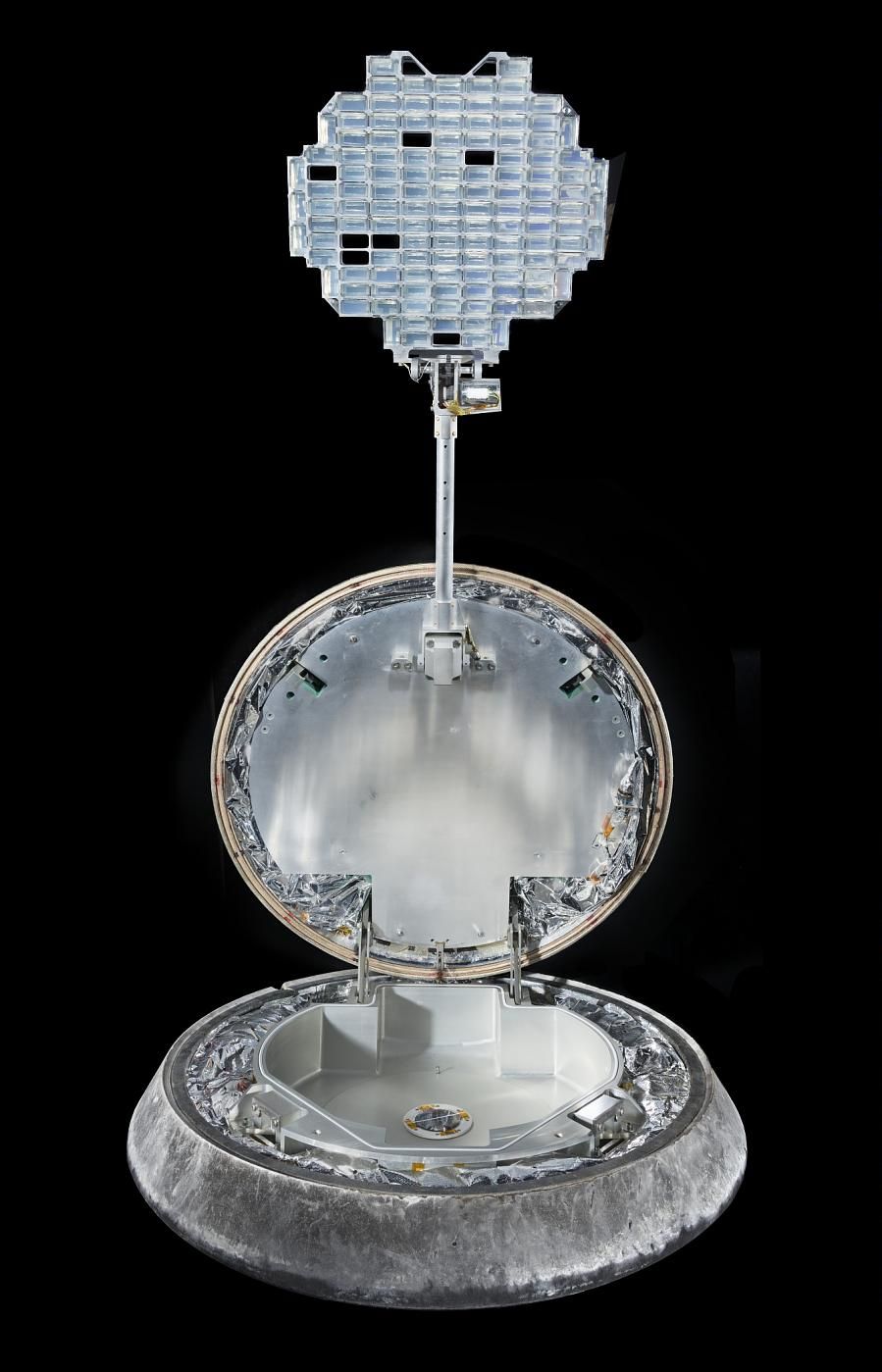
Smithsonian National Air and Space Museum
Launched on February 7, 1999, NASA’s Stardust mission marked a pioneering achievement in the study of comets and the origins of the solar system. It was the first spacecraft to bring comet samples to Earth, and NASA’s first mission to return particles from beyond the Earth Moon orbit. This was made possible thanks to the sample return capsule.
The Stardust mission’s primary objective was to collect carbon-rich particles from Comet Wild 2 in the asteroid belt between Mars and Jupiter, after a flyby of the asteroid 5535 Annefrank. It entered Comet Wild 2’s coma (the massive cloud of gas and dust around a comet) on December 31, 2003, getting as close as 149 miles. In total, Stardust traveled nearly 3 billion miles. On January 15, 2006, its sample return capsule reentered Earth’s atmosphere, landing safely at the US Air Force Utah Test and Training Range via parachute after the fastest reentry on record. Engineer Huy Tran, who had designed the ingenious heat shield that protected the capsule on reentry, called it “probably the proudest moment of [her] life.”
The return capsule weighed 101 pounds and consisted of five key components: a heat shield, back shell, sample canister, parachute system, and avionics. Inside, ablative materials protected the precious samples. To capture comet and interstellar dust, scientists used aerogel—a lightweight, silicon-based material with a sponge-like structure—mounted on a tennis racket-shaped grid at the end of the spacecraft’s arm. The mission successfully returned particles believed to be remnants from the early solar system. These samples have since been distributed to researchers worldwide and are significantly advancing understanding of comets and possibly the evolution of the universe.
The Stardust spacecraft remained in space. In July 2007, NASA approved its exploration of the comet Tempel 1 on a mission called NExT (New Exploration of Tempel 1). This comet had previously been visited by the space probe Deep Impact, which shot an impactor into the comet’s surface in 2005. The Stardust spacecraft reexamined the resultant crater in 2011, marking the first time a comet had been visited in two missions, and the first time a comet had been studied both before and after it had flown close by the Sun.
Voyager Gold Record
NASA/JPL-Caltech
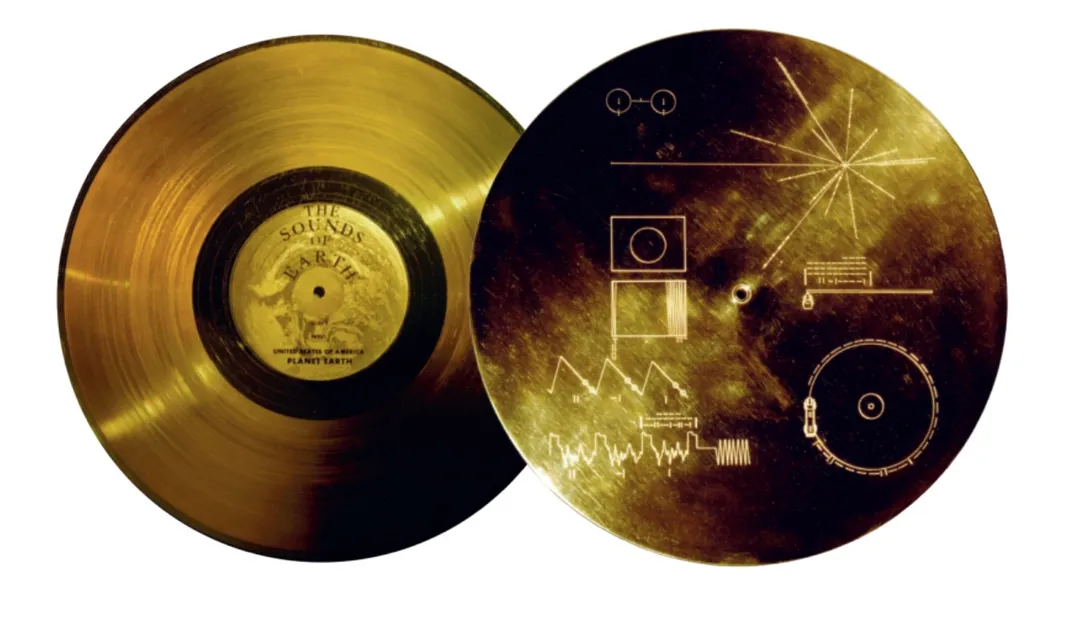
Launched in 1977, Voyagers 1 and 2 left the solar system for interstellar space some twenty years later. Unlike the metal plaques on Pioneers 10 and 11, the Voyagers carried a gold record—a time capsule conceived by a committee led by astrophysicist Carl Sagan on the direction of John Casani, Voyager’s project manager.
A rare alignment of the four outer gas giant planets in the late 1970s—which occurs once every 176 years—created the perfect opportunity for a mission to visit them all, as a spacecraft could use each planet’s gravity to slingshot onward, significantly reducing travel time. Both Voyager spacecraft used this to reconnoiter the Jupiter and Saturn systems, and send imagery and other data about the outer solar system back to Earth. After its encounter with Saturn, Voyager 1 went on a trajectory out of the solar system. Voyager 2 went on flybys of Uranus and Neptune, and eventually explored the heliopause and interstellar space until well into the 2010s.
The gold record built on the concept of the plaques carried by Pioneers 10 and 11—carrying a greeting to any extraterrestial life-forms the spacecraft might encounter. The record was more ambitious: it communicated many more details about Earth than the Pioneer plaques.
The record included 122 images, greetings in fifty-five languages, natural sounds from Earth such as those made by the wind and the waves, as well as animal and bird calls, and 90 minutes of music ranging from Mozart to Chuck Berry. President Jimmy Carter contributed a message describing it as a gift from “a small, distant world.”
The Voyager gold record consisted of two main parts: a gold-plated, aluminum cover and the actual disc, alongside the stylus cartridge required to play the disc. The cover protected the disc and featured etchings providing visual instructions for playing the record. Secured on the outside of the spacecraft and designed to last a billion years, the record symbolized humanity’s attempt to communicate across time and space.
The Voyager record quickly became a cultural icon, inspiring films like Star Trek: The Motion Picture (1979) and Starman (1984), and even a 1978 Saturday Night Live joke imagining aliens replying, “Send more Chuck Berry.”
Ingenuity Mars Helicopter
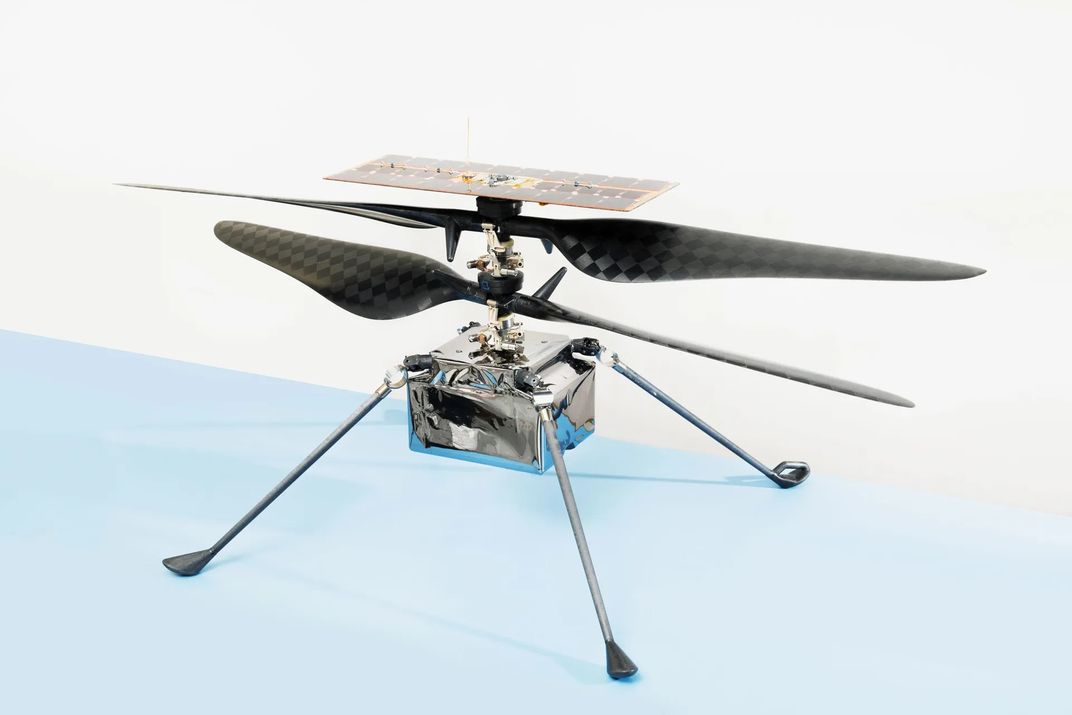
Its name said it all. NASA’s Ingenuity Mars helicopter, which landed with the Perseverance rover in 2021, established for the first time that a small, lightweight helicopter could operate on the Red Planet, even though Mars’s atmosphere is 99 percent less dense than Earth’s.
Ingenuity used four specially developed, carbon-fiber blades, arranged into two rotors, that spun in opposite directions at around 2,400 rpm—many times faster than a helicopter on Earth. Their carbon-fiber foam core helped to provide lift in the thin Mars atmosphere, ensuring this was the first aircraft to achieve powered, controlled flight on another planet.
The helicopter also contained batteries to help power it, a solar panel to keep the battery charged, and ultra-light legs to help it land after flight. In the body were the avionics, protected by insulation and heaters to help them survive the cold Martian nights. It also contained sensors and cameras to collect data on speed and direction.
“The Wright Brothers showed that powered flight in Earth’s atmosphere was possible, using an experimental aircraft. With Ingenuity, we’re trying to do the same for Mars.”
Håvard Grip, Ingenuity’s chief pilot at NASA’s Jet Propulsion Laboratory, 2021
Ingenuity could communicate with Earth via a base station on Perseverance and a Mars orbiter. It didn’t carry scientific instruments; its operators focused on technology demonstration with the intention that this would be the first of many future helicopters visiting Mars. The development team took a succession of careful steps, between 2014 and 2019, to get to the point where Ingenuity could fly on Mars. They evaluated a range of tough, strong, and lightweight materials for the vehicle.
The helicopter that went to Mars passed its last flight test on Earth in January 2019, and on Mars it underwent five planned test flights within a window of thirty Martian days (thirty-one Earth days). The helicopter went on to do much better than planned—it operated for three years, making a total of seventy-two flights in concert with the Perseverance rover near Jezero Crater.
This resilience meant Ingenuity took on a new mission as an operations demonstration. It served as an aerial scout for scientists and rover planners, and helped NASA engineers learn more about Perseverance’s landing gear debris. After a hard landing on its seventy-second flight, the Ingenuity’s controllers declared an end to an exceptionally significant mission.
Read more in NASA in 100 Objects, which is available from Smithsonian Books. Visit Smithsonian Books’ website to learn more about its publications and a full list of titles.
Excerpt from NASA in 100 Objects © 2026 by Bright Press


A Note to our Readers
Smithsonian magazine participates in affiliate link advertising programs. If you purchase an item through these links, we receive a commission.