

In the House of the Bees, Rival Queens Fight to the Death. But See How a Beehive Operates More Like a Democracy
Witness the life cycle of bees with the book “Diary of a Honey Bee”
:focal(960x544:961x545)/https://tf-cmsv2-smithsonianmag-media.s3.amazonaws.com/filer_public/e9/7d/e97d8b00-38bb-463c-9dfe-de86940c0858/diary_of_a_honey_bee.jpg)
The term ‘queen bee’ is somewhat misleading. In many languages, she is simply referred to as the ‘mother bee’, a name that better reflects her role. A beehive operates more like a democracy than a monarchy. In fact, US bee researcher Thomas D. Seeley describes a colony’s social structure as a ‘bee democracy’, where many decisions are made collectively by the colony rather than being dictated by the queen. All power in the hive is vested in the people, in this case the worker bees.
When conditions are favorable, with the honey chambers full and the colony growing to an impressive size of 50,000 or more, the worker bees make a momentous decision: to build queen cells. This is often triggered by overcrowding in the hive. When thousands of bees live in close quarters, their constant contact signals the need to split the colony. The first step in this process is the construction of special queen cells. These cells are larger than regular cells so that they can accommodate the larger body of a developing queen. In addition, they protrude at a right angle from the comb, making them easy to recognize even by a layperson.
Once the queen lays a fertilized egg in one of these cells, a cascade of complex events begins, ultimately leading to the division of the colony. This division, or swarming, is the only way honey bees reproduce – by founding new colonies. Bees have separated sexuality from reproduction. The sperm used by the queen to fertilize her eggs comes from a single nuptial flight during her first spring, when she mates with multiple drones. This event happens only once in her lifetime, yet it supplies her with enough sperm to produce offspring for the rest of her life.
Interestingly, the female offspring of the queen – the worker bees – are not reproductive and will not produce offspring of their own. For a new generation of bees to emerge, a new reproductive female – a queen – must be created. The workers ensure this by building queen cells and caring for the fertilized eggs inside. These steps ensure the colony’s survival and the continuation of the species.
As soon as the queen larva hatches – initially indistinguishable from the other larvae – she is fed royal jelly. Unlike regular larvae, which receive royal jelly for only a few days, a queen larva is fed it until she pupates. The royal jelly fed to future queens also has a slightly different composition, containing about 25 percent more sugar. This enhanced sweetness plays a crucial role in determining which genes are activated in the larva’s body, ultimately shaping its development. As a result, the larva metamorphoses into a larger, reproductive queen instead of an ordinary worker bee.
Meanwhile, the old queen is put on a harsh regimen by her worker bees, who relentlessly chase her through the hive, pinching and nipping her. This treatment serves a purpose: the queen must lose weight and build up her fitness, preparing for the major challenges that lie ahead. Then, something remarkable occurs in the hive, which still puzzles researchers to this day. About half of the bees decide to leave and form a new colony. The decision-making process – determining which bees will stay and which will go – remains a mystery. The result, however, is two relatively balanced swarms, with the youngest and oldest bees staying behind in the original hive. The bees preparing to leave exhibit distinctive behaviour; they bury their heads deep into the honey cells and fill their honey stomachs with as much honey as possible. This is a vital step, as the departing bees will rely entirely on these provisions to survive for several days during their search for a new home. This meticulous preparation showcases the incredible coordination and resilience of the bee colony.
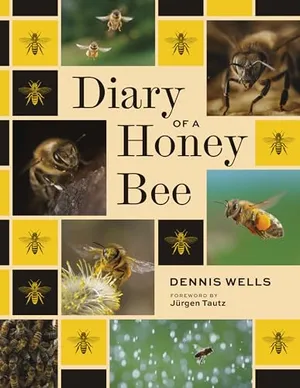
Diary of a Honey Bee
Witness the life cycle of the honey bee with this magnificent entomological guide featuring 120 full-color macro photographs!
As if in response to an imperceptible signal, the bees that are leaving stream towards the hive entrance in the thousands, gathering into a chaotic but purposeful mass. Then she appears: the queen. For the first time since her maiden flight, she leaves the darkness of the hive. If the colony lives in a harsh environment, with little food, this may have been four or five years ago; if the hive lives in a fertile environment, only a year may have passed. However long it has been, she is embarking on a completely new chapter of her life together with her colony. Accompanied by approximately 15,000 bees, she sets out in search of a new home.
The hive they are leaving behind is in prime condition for the next generation. It boasts thousands of cells filled with honey, pollen, and larvae, a vibrant workforce of young, healthy worker bees, and an experienced cohort of older bees who will guide the young and teach them the secrets of bee life. Several young, strong queens remain sealed in their queen cells, ready to emerge and compete for the throne. Whichever queen prevails will inherit a colony well equipped for survival and prosperity.
After departing, the old queen and her entourage settle nearby, typically on a branch or under an overhang no more than 100 feet from the original hive. Here, they form a dense ball, similar to the one they create during winter to conserve heat, with the queen safely positioned at its centre. This stage of swarming is critical and precarious. Without a new home, the bees can survive only a few days on the honey stored in their crops. If the weather turns or the search for a new home takes too long, they are doomed. Only one in four swarms successfully survives swarming. Remarkably, swarming bees are exceptionally docile. With no hive to defend, the bees are focused soley on protecting their queen and seeking a new home.
Now begins one of the most exciting and critical phases in the life of the new bee colony: up to 300 experienced forager bees – called scouts – fly off in all directions in search of a new home. Which bees set off to find a home for the colony seems to be determined genetically. Studies suggest that this trait is inherited from the drone father as scouts are significantly more likely to have the same drone as a father.
/https://tf-cmsv2-smithsonianmag-media.s3.amazonaws.com/filer_public/e3/43/e343aabb-f8fe-475c-bdec-a1330539061d/abd_148_jpeg.jpg)
Meanwhile, back in the bees’ old home, a great spectacle is announced by an unfamiliar sound. A ‘quacking’ is heard in the beehive. Bees don’t have ears, but they can still detect certain acoustic signals using specialized sensory organs. Their antennae are equipped with organs that allow them to perceive particle velocity, a physical quantity related to sound pressure. However, this allows them to hear sounds only in their immediate vicinity. But, like all insects, they possess another organ with which they can perceive sound waves. The subgenual organ located in each of their legs allows bees to detect sound waves that cause the ground they are standing on to vibrate. Fortunately, when they are inside the beehive, bees are usually standing on a comb, and this structure is particularly good at conducting vibrations. This is why Professor Jürgen Tautz also calls it the ‘bee telephone’, as it facilitates a wide range of communication throughout the entire colony.
The queen produces the strange ‘quacking’ sound by vibrating her flight muscles in her queen cell. The sound is probably intended to signal to the worker bees nearby that the queen is hatching. Next, the queen practically saws off the lid of her queen cell with her proboscis. She repeatedly stretches her ‘tongue’ through one of the holes so the worker bees can feed her honey to keep her strength up.
After hours of effort, the moment finally arrives: the new queen manages to open her cell like a tin can and emerges into the hive. Once she has hatched, the queen announces her presence to the entire colony with a distinctive sound known as ‘piping’, also referred to by beekeepers as ‘tooting’. The queen produces this sound, which is unique to this extraordinary moment, by leaning against the comb, uncoupling her flight muscles from her wings and vibrating them.
If the hive still has ample supplies and a large enough workforce, the worker bees may send a second swarm into the world, led by this newly hatched queen. However, a perilous fate awaits the remaining unhatched queens still in their cells. The worker bees actively drive the new queen away from these cells to prevent her from committing a seemingly ruthless act: Newly hatched queens instinctively seek out their unhatched rivals and attempt to kill them with their stingers while they are still in their cells.
If the colony is not large enough or there are not enough resources, the worker bees will not protect the other queen cells, allowing the first queen to hatch and eliminate her rivals. The new queen moves throughout the hive, systematically killing her sister queens before they can hatch. Occasionally, two queens may hatch at the same time, leading to an immediate fight to the death. Only one queen will survive to lead the colony.
The seemingly brutal practice of creating multiple queen cells serves an essential purpose. Not all queen larvae develop successfully, and the colony cannot afford to risk being without a queen for too long. By producing multiple queen cells, the bees ensure the survival of the colony, with the strongest queen ultimately prevailing –unless a beekeeper intervenes.
Read more about the plight of queen bees and their hives in Diary of a Honey Bee, which is available from Smithsonian Books. Visit Smithsonian Books’ website to learn more about its publications and a full list of titles.Excerpt from Diary of a Honey Bee © The Trustees of the Natural History Museum, London, 2025

A Note to our Readers
Smithsonian magazine participates in affiliate link advertising programs. If you purchase an item through these links, we receive a commission.