A collection of diverse insects. The collections at the Smithsonian's National Museum of Natural History offers a glimpse into the richness and complexity of the spectacular creatures that shape the natural world.
James Di Loreto, Smithsonian.
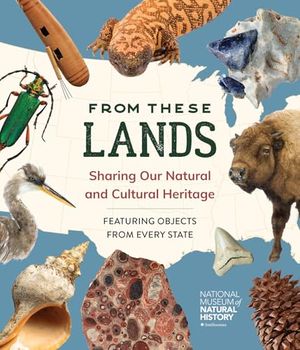
Last week, “From These Lands: Sharing Our Natural and Cultural Heritage” opened at the National Museum of Natural History, and it will remain on view through December 2029. But you can get a close-up look from anywhere with its companion catalog. From These Lands, released from Smithsonian Books, invites readers to examine specimens and cultural from all 50 states, Washington, DC, and five inhabited territories—American Samoa, Guam, Puerto Rico, US Virgin Islands, and the Northern Mariana Islands.
Get a glipmse into the nation's natural history with these five amazing objects!
Arizona - Petrified Tree
Petrified tree that lived 219-213 million years ago
James D. Tiller and Fred Cochard, Smithsonian.
Each part of this fossil tells a story about its formation. About 216 million years ago, a decaying log got stuck in a river channel, perhaps during a flash flood. The uneven margins along the tree’s outer edge show that it had decayed before being preserved. Intense water flow swept together a mix of other stones, which encircled the tree. These came from older rocks that already contained marine fossils. Once the log was buried, groundwater seeped into it and coated and filled the tree’s original cell structures with silica. Elements such as iron and manganese trapped in the silica crystals produced a rainbow of colors, from purple to yellow to smoky gray quartz. You can find many similar examples of petrified wood protected at Petrified Forest National Park in Arizona.
Exquisite photography showcases the beauty of gleaming freshwater pearls, a carved walrus tusk, and 100+ other natural history treasures from all 50 states from a new exhibition at the Smithsonian's National Museum of Natural History
Texas - Alligator Gar Skull
Alligator gar skull collected prior to 1890 from Kinney County, Texas.
James D. Tiller, Smithsonian.
The United States is home to an ancient fish lineage of which only seven species survive today. Alligator gars are the largest members of this family, often reaching a whopping eight feet (2.4 m) long, making them some of the largest freshwater fishes in North America. They live in fresh and brackish water and can gulp air when water oxygen levels get low.
Gars haven’t changed much over their evolutionary history, forming a living bridge between the present and distant past. Fossils show they have sported their distinctive “gar-mor” of hard, interlocking diamond-shaped protective scales for millions of years.
New Jersey - Bog Turtle Shell
Bog turtle shell collected in 1930 from Monmouth County, New Jersey.
Phillip R. Lee, Smithsonian .Phillip R. Lee, Smithsonian.
New Jersey’s official state reptile is also the smallest turtle in North America. Bog turtles reach no more than 4.5 inches (11.4 cm) long and weigh less than four ounces (113 g). Nevertheless, these little guys have surprisingly long lifespans, averaging twenty to thirty years, and they sometimes live up to sixty years in the wild! Bog turtles spend much of that time basking in the sunlight surrounded by slow-moving water and low grasses or buried in mud to regulate their temperatures. They hibernate during the winter under the dense roots of trees and shrubs or under rocks. Bog turtles are listed as threatened or endangered because their habitats have been reduced and fragmented as a result of development.
Maryland - Blue Crab
Blue crab collected from Chesapeake Bay, Maryland.
Phillip R. Lee, Smithsonian..
The blue crab’s life cycle takes it all over the Chesapeake Bay, making this species a great indicator for the overall health of our country’s largest estuary. Females spawn at the mouth of the bay, releasing larvae into the ocean. Young crabs migrate farther into the bay to shelter amid eelgrass beds. Blue crabs are food for many species, from striped bass and great blue herons to humans. In recent years, overfishing and loss of eelgrass have severely reduced their numbers, affecting both recreational and commercial harvests. Smithsonian scientists track blue crabs to learn how environmental conditions affect their population. Blue crabs are a vital part of the Chesapeake Bay’s fishing industry, and this information can help develop sustainable management strategies and preserve one of Maryland’s cultural symbols.
South Dakota - Iridescent Ammonites
Iridescent ammonites collected in 1982 from Corson County, South Dakota. Phillip R. Lee, Smithsonian.
The lands we know as the United States were not always land. Ammonites—shelled relatives of the modern octopus and squid—swam in the vast Western Interior Seaway that once extended from Alaska to Mexico, covering much of what are now the Great Plains. These tentacled predators died out with the dinosaurs, but the layers of the mineral aragonite in the inner layers of their shells maintain their shimmering iridescent colors that do not degrade over time. You may notice there are three different species of ammonites in this one rock. The Cretaceous seas were filled with a variety of life!
Read more in From These Lands, which is available from Smithsonian Books. Visit Smithsonian Books’ website to learn more about its publications and a full list of titles.
Smithsonian's National Museum of Natural History|Read More
Smithsonian's National Museum of Natural History is home to the largest natural history collection in the world and is dedicated to inspiring curiosity, discovery, and learning about the natural world through unparalleled research, collections, exhibitions, and education outreach programs.
Get the latest stories in your inbox every weekday.
A Note to our Readers Smithsonian magazine participates in affiliate link advertising programs. If you purchase an item through these links, we receive a commission.


:focal(800x598:801x599)/https://tf-cmsv2-smithsonianmag-media.s3.amazonaws.com/filer_public/f9/9a/f99a1306-6c5f-48b2-9ea2-f5de92fabcb9/butterflies.jpg)
/https://tf-cmsv2-smithsonianmag-media.s3.amazonaws.com/filer_public/98/50/9850f39f-37df-4f82-a846-2b34d64aaa08/arizona_-_petrified_tree.jpg)
/https://tf-cmsv2-smithsonianmag-media.s3.amazonaws.com/filer_public/59/43/59430a53-8e2e-4380-9f43-ef5c2ecde7a5/texas_-_alligator_gar_skull.jpg)
/https://tf-cmsv2-smithsonianmag-media.s3.amazonaws.com/filer_public/0f/b4/0fb41988-0901-495e-a5eb-d0e366f0c07a/new_jersey_-_bog_turtle_shell.jpg)
/https://tf-cmsv2-smithsonianmag-media.s3.amazonaws.com/filer_public/f6/07/f6071cd4-db29-4da3-8d9e-e408c31ba082/maryland_-_blue_crab.jpg)
/https://tf-cmsv2-smithsonianmag-media.s3.amazonaws.com/filer_public/91/08/91082b30-2070-4eb7-86b4-8b0419684e29/south_dakota_-_iridescent_ammonites.jpg)
