

Experience the Genius and Artistry of Ohio’s Hopewell Ceremonial Earthworks
A new book celebrates eight complex masterpieces of landscape architecture
:focal(2000x1505:2001x1506)/https://tf-cmsv2-smithsonianmag-media.s3.amazonaws.com/filer_public/e0/54/e054891e-6692-4ae4-af4b-eb01af9ea833/mound_city_at_sunrise.jpg)
John E. Hancock
On September 19, 2023, eight ancient American Indian earthworks in southern Ohio were inscribed on the prestigious UNESCO World Heritage List, establishing their status as cultural treasures of “Outstanding Universal Value.” This designation places them among humanity’s shared heritage—worthy of protection and celebration by all people and nations. Joining more than 1,200 iconic sites worldwide, the Hopewell Ceremonial Earthworks now stand in the global public imagination as enduring symbols of their creators’ extraordinary contributions to human civilization.
The Hopewell Ceremonial Earthworks earned their World Heritage designation by meeting rigorous criteria: First, that they bear exceptional and unique testimony to a distinctive culture—in this case, the Indigenous Ohio Valley culture from two millennia ago, now called Hopewell. This criterion is most often used to inscribe ancient sites or those primarily known through archaeological evidence of their builders’ traditions and lifeways. But these earthworks also meet a more stringent and rarely applied UNESCO criterion: their geometrical and astronomical precision justify them as masterpieces of human creative genius.
The terms of their global significance have been summarized by the World Heritage Committee in its concise Statement of Outstanding Universal Value.
Built as ceremonial gathering places, often involving the burial of ancestral remains, the earthworks feature embankment walls enclosing huge spaces, with carefully positioned and often monumental gateways. They show a remarkable consistency of motifs and dimensions across the region, illustrating the full range of the culture’s earthwork types: from landformbased shapes to geometrically precise circles, parallels, squares, and octagons arranged in a variety of combinations. The use of standardized measurement units and geometrical principles ties these sites together across the region.
The builders consistently favored hilltop and glacial terrace sites, all located beyond the reach of floods, yet with prominent connections to water—rivers, streams, springs, and constructed ditches and ponds. Besides the earthwork enclosures themselves, these ceremonial landscapes incorporate mounds, water features, and pavements as architectural elements. Substantial stone and timber constructions, both covered and open-air, preceded earthwork construction.
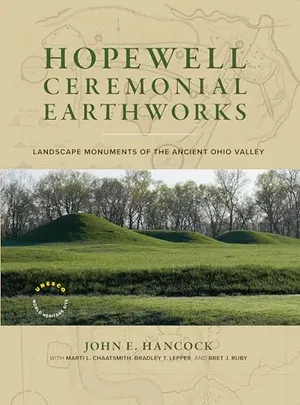
Hopewell Ceremonial Earthworks: Landscape Monuments of the Ancient Ohio Valley
Experience 8 sacred earthworks of the ancient Hopewell culture with this breathtaking book featuring 250+ images and fascinating insights on Native American history.
The archaeological record points to cultural practices such as mortuary rites, votive offerings, and calendrical rituals. These sites have revealed some of the finest artistry ever made by the Indigenous peoples of North America. Objects fashioned out of mica, copper, and obsidian—materials brought in from as far away as the Rocky Mountains—display a three-dimensional sculptural complexity and realism exceeding anything that came before. Their vivid depiction of woodland creatures, powerful beings, and cosmological symbols is unprecedented.
The eight UNESCO-inscribed sites are all are found within the three main clusters of earthwork-building activity in the culture’s Ohio heartland—two in Newark (thirty miles east of Columbus), five near Chillicothe (sixty miles southwest from Newark), and one in the southwestern part of the state (thirty miles northeast of Cincinnati). The Hopewell Ceremonial Earthworks are what UNESCO calls a “serial property,” meaning that although each site is eligible on its own, the greater Outstanding Universal Value comes from a combination of attributes spread across all eight sites. The chronology of their construction is both complicated and as yet undetermined.
/https://tf-cmsv2-smithsonianmag-media.s3.amazonaws.com/filer_public/74/ed/74edea33-a866-4721-b539-0c3cbb068a45/newarks_octagon.jpg)
Three of the sites have been in the care of the Ohio History Connection for a very long time—the Newark Earthworks since the 1930s and Fort Ancient for more than a century. The US National Park Service owns and manages the other five sites in the Chillicothe area as units of the Hopewell Culture National Historical Park, established in 1992. Both agencies maintain management and interpretive plans to ensure the sites’ optimal maintenance, protection, and visitation experience. They consult regularly with various stakeholders, including federally recognized tribal nations who are historically associated with Ohio and who represent the many American Indian descendants of the earthwork builders.
The earthworks can be hard to see. They are designed with a subtle architectural language—soft, gentle swells in the earth’s surface, extending far into the distance. Their barely perceptible outlines will sometimes appear only in fragments. Some have been subjected to many decades of plowing or lie beneath centuries of forest cover. Compared with Greek temples, Egyptian pyramids, or nearly any other global architectural tradition, these earthworks’ conceptual and spatial impacts tend to be elusive.
Yet their brilliance as landscape architectural masterpieces survives through a powerful blend of archaeological integrity (lying under the ground to tell the cultural story) and architectural integrity (creating vivid spatial experiences). Their architecture benefits from their surviving settings—still predominantly rural or low-density residential areas buffered by parkland. The enclosure walls and mounds retain their integrity—whether as visible, well-preserved or carefully restored architectural forms, or as intact foundations still detected by high-resolution remote sensing methods. Where visible features have faded, those images have informed the architectural plans included in this volume.
The earthworks are not only archaeological sites (scenes of research) and architectural works (enduring monuments), however. They are also places of ongoing Indigenous meaning. Many contemporary American Indians see them as ancestral places, as still-powerful evocations of ceremony and community, resonating with traditional themes surrounding earth, water, land, sky, and time.
“All of us who are Indian are descendants of the mound builders, and their blood runs in our veins.” —DONALD L. FIXICO (Shawnee/Sac and Fox/Muscogee Nation and Seminole)
For all people, the earthworks’ Outstanding Universal Value is rooted in their self-evident sacredness, as well as in their astonishing forms and their builders’ genius. They invite engagement as sacred places with their vast scope, their beauty and precision, and their cosmological functions.
Each of the three words in the name of the UNESCO-inscribed series—Hopewell Ceremonial Earthworks—has a history and specific implications; each deserves some initial explanation.
The modern name of this culture, “Hopewell,” derives from Mordecai Cloud Hopewell, the owner of a farm outside Chillicothe, Ohio, where, in the l890s, archaeologists uncovered the defining characteristics of a cultural tradition so spectacular that it needed to be distinguished from all others before or since. According to the professional archaeological convention of the day (still in use), those cultural characteristics were named after the place where they were first identified. Many American Indians today find it problematic that this ancestral site is named after a non-Native landowner.
We will never know what the earthwork builders called themselves. The sites’ managing agencies have consulted with tribal representatives on this question and determined—albeit with some reluctance—that Hopewell is unavoidable for the time being. Communities across eastern North America, speaking diverse and unrelated languages, all contributed to the cultural flourishing now known by that name. Naming the ancestors after one modern descendant tribe could imply that this group was the sole or most important part of that coalition. In this book we use the term but respectfully restrict its use: “Hopewell” here will refer only to a general time period and the set of cultural practices that define it, or to the earthworks and other things made by people during that time—but never to the people themselves. There were no “Hopewell people;” there was no “Hopewell tribe.”
The ceremonial nature of these places is evident in their vast scope, formal precision, and cosmic alignments. People gathered here for ceremonies. The archaeological record confirms that no one lived inside the enclosures; they were not domestic or urban centers; they were not fortifications. Their extreme architectural scale and elaboration, their connections with the cosmic orders, their embellishment with water and stone, the lavishness of their deposited artistry and material wealth, and the presence of mortal remains of kin and ancestors all point to meaningful public functions—ritualized gatherings that gave structure to the community’s understanding of the world and their place in it.
Colloquially, people tend to refer to these monuments as the mounds, but this is misleading and can seem trivializing. While it’s true that mounds are earthworks, not all earthworks are mounds. This distinction matters for three reasons. First, a “mound” implies a self-contained form of piled up earth—a circle, an oval, a conjoined group, or a figure like an animal effigy. By contrast, the term “earthwork” better describes any of the elaborate spatial enclosures and other complex arrangements—which can include mounds—that are the subject of this book. Second, “mound” connotes burial, as was usually the case especially for earlier Adena architecture but is not true of many of the mounds at Hopewell earthworks. Third, when “mounds” is used as the inclusive term for both mounds and enclosures, it can also connote the nineteenth-century convention of calling their architects the Moundbuilders—a name still burdened by the long-discredited racist myth that they were some distant, lost, non-Indian race.
Finally, Ohio—the seventeenth state admitted to the Union—took its name from the river that its early American settlers either crossed or floated down. The Ohio River was named, in turn, by the Seneca: ohi:yo’,
meaning “Beautiful River.” The Hopewell earthworks are concentrated along the larger, south-flowing tributaries draining the southern half of today’s state of Ohio. Although modern state boundaries are clearly irrelevant to an understanding of the land’s ancient inhabitants, the greatest examples of earthworks were in modern Ohio, between Marietta to the east and Cincinnati to the west.
/https://tf-cmsv2-smithsonianmag-media.s3.amazonaws.com/filer_public/99/59/99597ded-9cba-4a61-be02-0eeda974bc97/mariettas_conus_mound.jpg)
Read more in Hopewell Ceremonial Earthworks, which is available from Smithsonian Books. Visit Smithsonian Books’ website to learn more about its publications and a full list of titles.
Excerpt from Hopewell Ceremonial Earthworks: Landscape Monuments of the Ancient Ohio Valley © 2026 by John E. Hancock

A Note to our Readers
Smithsonian magazine participates in affiliate link advertising programs. If you purchase an item through these links, we receive a commission.