

Beat the Winter Blues by Learning How to Fly Smithsonian Paper Airplanes With Your Kids
Learn about the science behind paper airplanes
:focal(800x602:801x603)/https://tf-cmsv2-smithsonianmag-media.s3.amazonaws.com/filer_public/fc/52/fc5268e7-676f-43ec-8bd6-f516392988c3/smithsonian_paper_airplanes.jpg)
How Do Things Fly?
Understanding how things fly, from airplanes to spaceships to paper planes, begins by learning about the four forces of flight.
1. Weight is a measure of the force of gravity pulling on an object. Gravity is an invisible force that pulls things in a downward direction, toward the center of the Earth. It is what keeps you on the ground and brings you back down when you jump up.
2. Lift is the opposite of weight—it pushes a plane up. For a plane to get off the ground, the amount of lift must be greater than the force of gravity pulling the plane down. Lift is created by differences in air pressure.
3. Thrust is the force that propels a flying machine in the direction of motion. For a real airplane, engines produce thrust. For a paper airplane, your arms give the plane thrust when you throw it.
4. Drag is the force that acts opposite to the direction of motion. Drag slows a plane down. Have you ever tried walking into a strong wind? It is difficult to walk forward because the wind pushing on you slows you down. That is what happens when a plane flies through air.
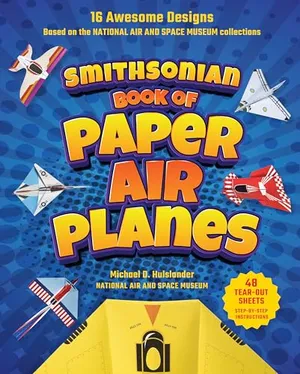
Smithsonian Book of Paper Airplanes
Become an expert flyer with 16 amazing airplane designs and fun aviation facts from the Smithsonian’s National Air and Space Museum—for kids ages 8-12!
When an airplane flies, the wings are designed to provide enough lift to overcome the airplane’s weight, so the plane doesn’t drop out of the sky. The plane can move forward because its engine provides enough thrust to overcome the drag slowing it down. An airplane in flight is always in the middle of a tug-of-war with the four forces.
The forces of flight are interconnected. A small change in one force affects the others! Increasing the weight of an aircraft affects the amount of lift needed. A larger wing provides more lift, but increases the amount of drag on the plane, which means more thrust is needed.
For a plane to stay in the air, its flight needs to be both controlled and powered. This means to fly you need a source of sustained thrust, and that is what an engine provides. Unlike real airplanes, paper airplanes are technically gliders: heavier-than-air flying machines built to move through the air without engines.
A paper airplane gets its thrust from the throw, but the thrust is only temporary. The wings provide the lift, allowing the plane to glide. The weight of a paper airplane is affected by the type of paper used and anything added to the plane in the construction process, such as tape or paper clips. The amount of drag on a paper plane is influenced by three things: the materials used to make the plane, the overall shape of the plane, and how it was folded. Whether your plane goes fast or slow, how far it flies, or whether it glides at all depend on the balance of the four forces of flight—just like a real plane!
Did You Know?
If you threw a paper airplane into space while orbiting the Earth, it wouldn’t glide because a paper airplane needs air to generate lift. But there is no air in space!
Aerodynamics
Aerodynamics is how objects move through air and the forces that act on the objects as they move. Everything moving through the air (including paper airplanes, rockets, and birds) is affected by aerodynamics.
When an airplane flies through air, the shape of its wings causes changes in the speed and pressure of the air moving over and under them. These changes result in lift. To understand lift, you first must understand how air behaves under certain conditions.
In the early 1700s, Swiss mathematician Daniel Bernoulli made a discovery. He noticed that when fluids, such as water and air, changed their speed, their pressure also changed. This discovery was called Bernoulli’s principle. According to Bernoulli’s principle, when the speed of a moving fluid increases, the pressure exerted by that fluid decreases.
This same principle explains how air interacts with the wings of an airplane. When moving air encounters an obstacle—a person, tree, or airplane wing—its path narrows as it flows around the object. Even though the path of the air narrows, the amount of air remains the same. For this to happen, the air must either compress or speed up where its flow narrows. When you “squeeze” a stream of air, two things happen. The air speeds up, and as it speeds up, its pressure—the force of the air pressing against the side of the object—goes down. When the air slows back down, its pressure goes back up.
The size and shape of an airplane wing, the angle at which it meets the oncoming air, the speed at which it moves through the air, and even the density of the air affect the amount of lift a wing creates. An airplane wing—also known as an airfoil—is shaped in a way that causes the air flowing over it to move faster than the air moving under it. The fronts of airplane wings, called leading edges, are usually rounded. The back edges, called trailing edges, are usually sharp. Air moves smoothly around a wing’s leading edge and flows off its trailing edge. You might wonder why the front edges of an airplane wing are rounded rather than sharp. It’s because air can’t turn a sharp corner, so a sharp wing would disrupt the smooth airflow over the wing, increasing drag.
Tilting is moving an airplane’s leading edges up or down, which changes the angle at which the oncoming air hits the wing. Tilting the wing up helps generate more lift. However, if you tilt it up too much, the air flowing over the upper surface of the wing turns turbulent, causing the wing to suddenly lose lift—a condition known as a stall.
Did You Know?
On December 2, 2022, three engineers set the new world record for farthest distance a paper airplane has flown. Dillon Ruble, Garrett Jensen, and Nathaniel Erickson designed a paper airplane that flew 289 feet and 9 inches, almost the length of an American football field.
Learn more about paper airplanes and how best to fly them in Smithsonian Book of Paper Airplanes, available from Smithsonian Books. Visit Smithsonian Books’ website to learn more about its publications and a full list of titles.
Excerpt from Smithsonian Book of Paper Airplanes © 2025 by Smithsonian Institution

A Note to our Readers
Smithsonian magazine participates in affiliate link advertising programs. If you purchase an item through these links, we receive a commission.