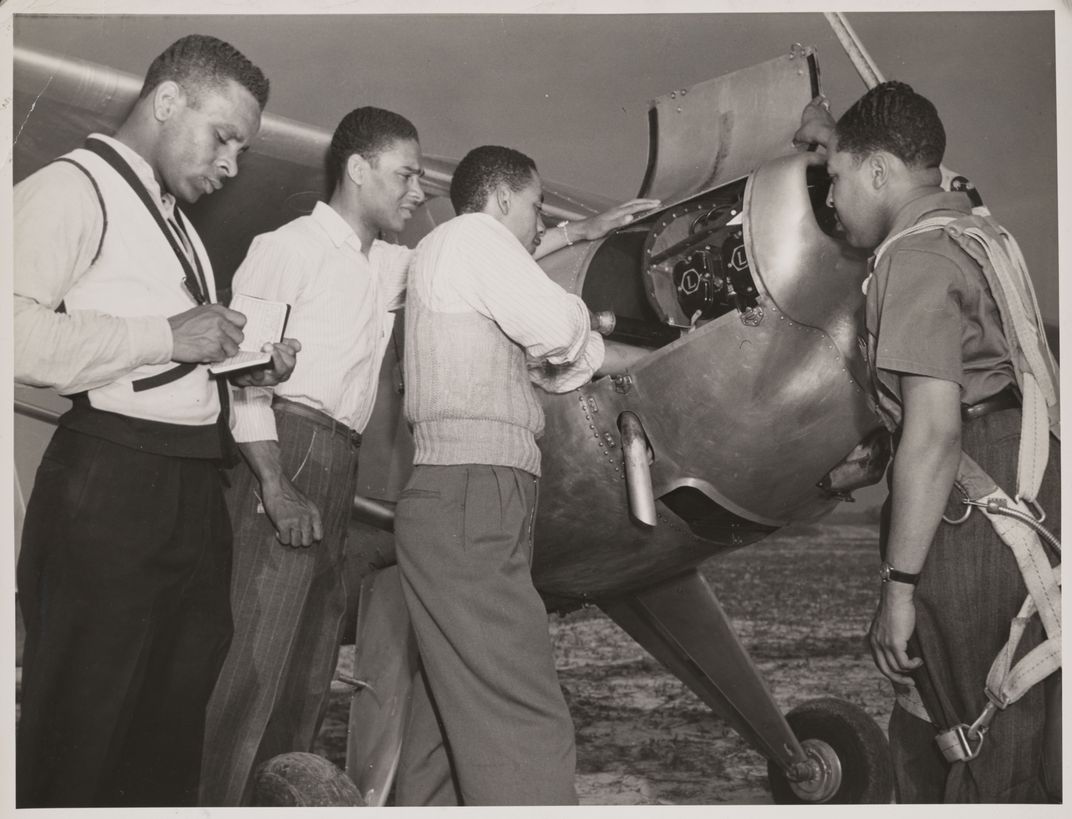
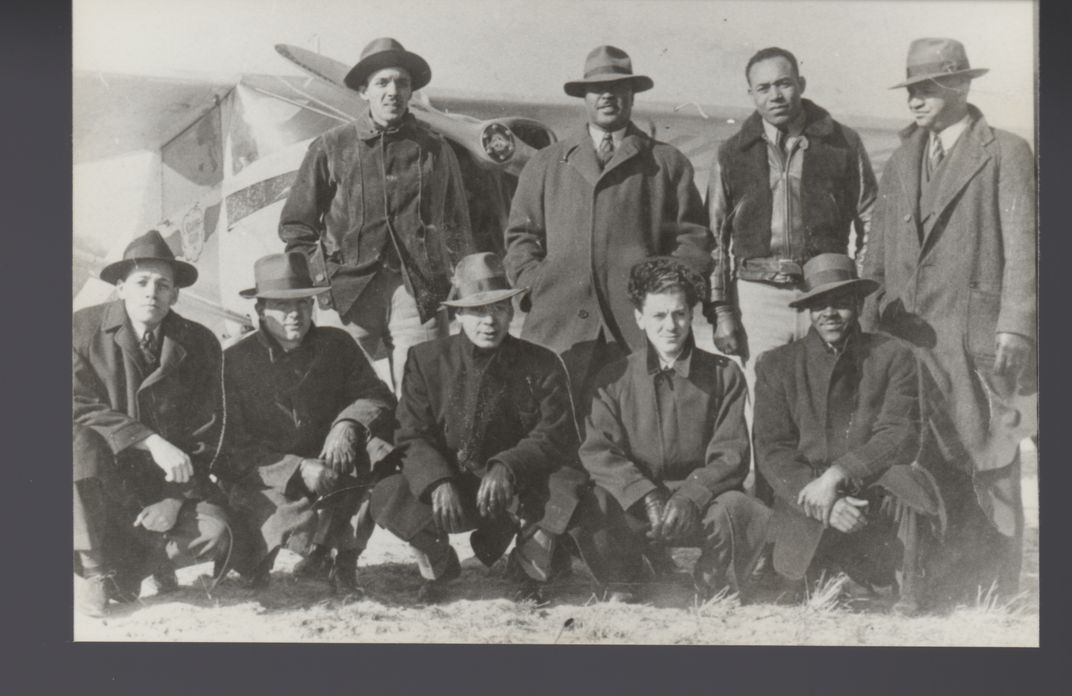
Left to right: Roland Brawner, John Pinkett Jr., Jimmie Lunceford, and John Greene Jr., c. January 1941.
Edward Fletcher Collection, DC Public Library People's Archive.
The Tuskegee Airmen are widely recognized as pioneering African American aviators. Aviation enthusiasts may also be familiar with Willa Brown and Cornelius Coffey’s historic Coffey School of Aeronautics in Chicago—both examples of excellence in the face of racial prejudice. Yet few know about Riverside Airfield, later renamed Columbia Air Center, which deserves recognition alongside these icons.
Riverside Airfield was the first licensed Black-owned and operated airport in the United States. Located 25 miles southeast of Washington, D.C., in the unincorporated community of Croom, Prince George’s County, Maryland, it is now part of Patuxent River Park. The airfield opened in 1940, was commandeered by the Navy from 1942 to 1944, and reopened as Columbia Air Center until its closure in 1962.
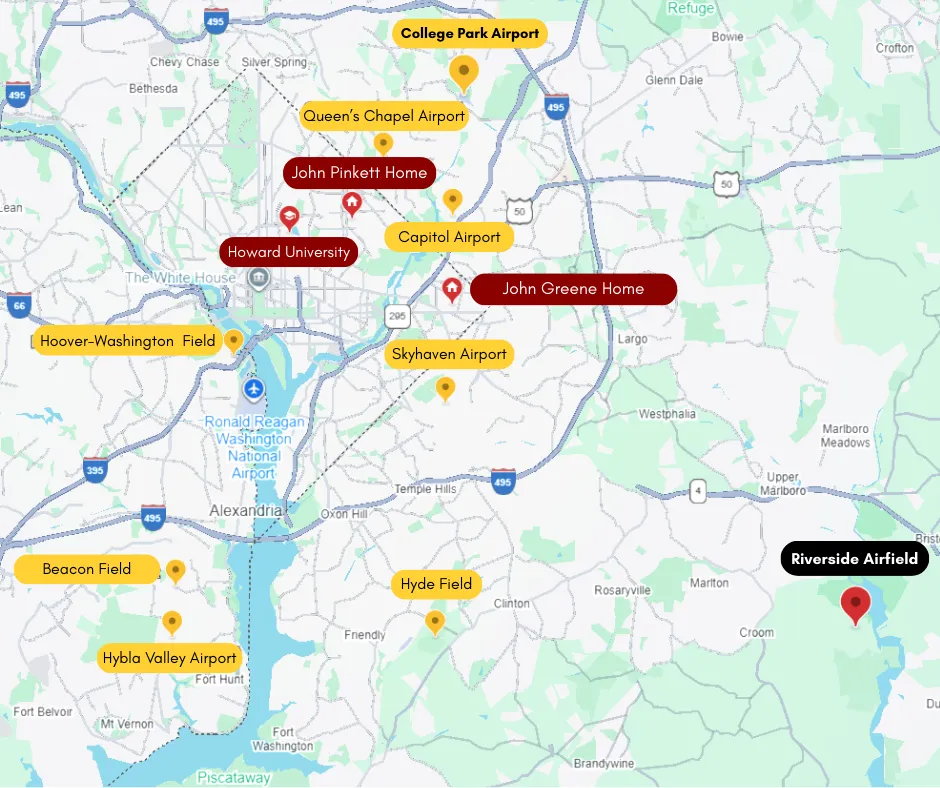
A map of general aviation airports in the Washington, DC area, 1941. The locations of John Pinkett and John Greene’s homes are shown to demonstrate how far Riverside Airfield was in comparison to white-owned airports.
College Park Aviation Museum
Before becoming known as the “Father of the Tuskegee Airmen,” Charles Alfred Anderson moved to Washington, D.C., in 1938 and began teaching African Americans to fly. He taught at Hybla Valley Airport and Beacon Field, two neighboring airports in Fairfax County, VA, south of Alexandria. These airports were 13 miles from central D.C., and although there were seven airports closer to the city—including College Park Airport—none allowed African Americans to fly. Despite the distance, many aspiring Black aviators sought Anderson’s instruction. A group of Anderson’s students formed the Cloud Club, the region’s first Black flying club. Comprised primarily of businessmen and children of the Black elite in their 20s and 30s, the club shared the costs of purchasing an airplane and flight instruction. Formed in 1939, the Cloud Club formally incorporated in May 1940.
The Cloud Club Inc’s logo shows a seaplane. There are no records of seaplanes flying out of Riverside Airfield. However, Charles Alfred Anderson likely taught the first Cloud Club members how to fly on a Piper Cub seaplane. Anderson out of a seaplane at Buzzard’s Point, DC, on the Anacostia River. Buzzard’s Point is near the modern Audi Field.
That same year, Howard University became one of seven Black institutions permitted to participate in the national Civilian Pilot Training Program (CPTP), hiring Anderson to operate their program. While cost was a major barrier to aviation—flight training in the 1920s and 30s could exceed $1,000—the greater obstacle was discrimination. The CPTP opened doors for African Americans and women, offering college students flight training for $40, albeit within a segregated and unequal system.
Howard University Civilian Pilot Training Program students at Riverside Airfield, c. 1941. This photograph was taken by Robert McNeill, a prolific newspaper photographer.
Library of Congress, Prints & Photographs Division, Robert H. McNeill Family Collection.
In the summer of 1940, Tuskegee Institute recruited Anderson from Howard University. The Cloud Club assumed operation of Howard’s CPTP, but tensions with the white aviation community escalated. After Anderson’s departure, the Cloud Club was evicted from Hybla Valley Airport and relocated to neighboring Beacon Field where the manager fabricated violations and harassed members. As one Cloud Club member recalled, “Southern whites simply do not want you flying from their airports.”
Anticipating further eviction and harassment, the Cloud Club left Beacon Field to establish its own airfield. For weeks, Cloud Club members searched the surrounding area after work—some flying overhead while others followed by car. Progress was slow until a local Marylander suggested they investigate a fallow field along the Patuxent River. At first, the Club members were unsure if it was worth a visit due to its distance, but once they saw it, the club was impressed. Future airport manager John Greene Jr. said “My goodness what a field! What possibilities! The majority of us agreed that this was Utopia.”
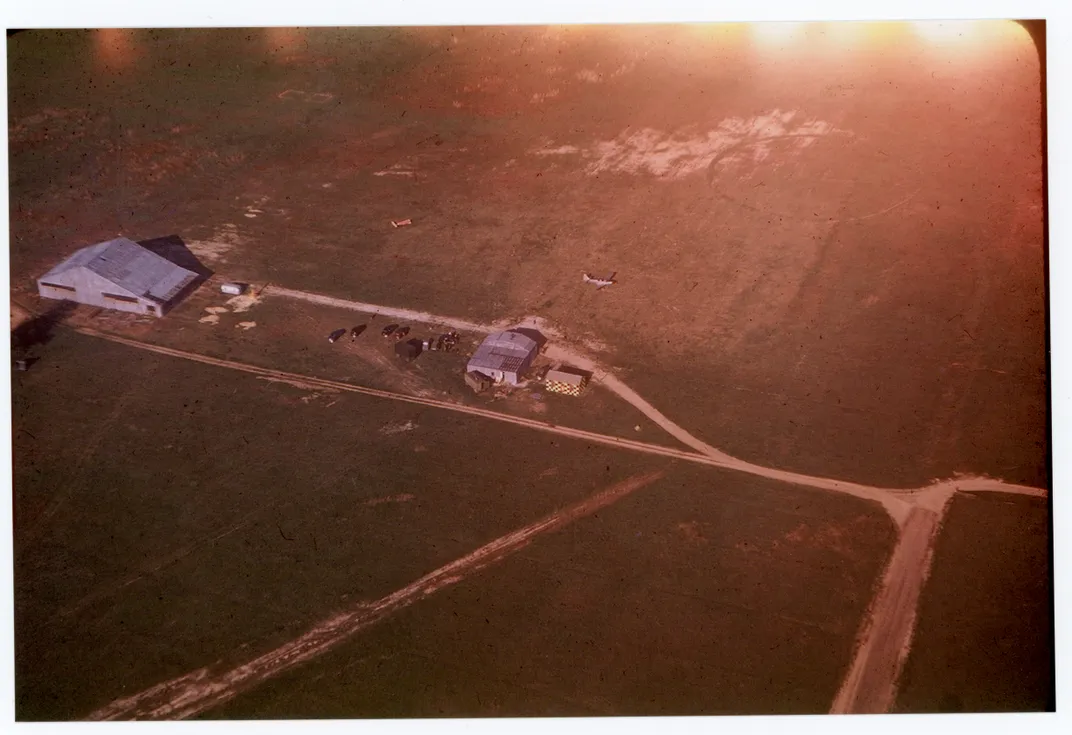
An aerial image of Riverside Airfield c. 1948, when it was named Columbia Air Center. The two buildings seen in the center of the image, a small hangar and office building, are the only buildings original to Riverside Airfield.
Courtesy of the Julianne Bethea Loan
The flat, two-mile long field was ideal for flying. Despite its location 25 miles southeast of D.C. in Croom, MD, many members believed the distance was worth it. Others, however, “bitterly complained that the distance from Washington was too great and forever more would have nothing to do with the activities of the Club.” The land was held in trust by Rebecca Fisher, a white widow from Maryland’s Eastern Shore, who agreed to lease the 120 acres for $30 per month.
By January 1941, Riverside Airfield was open for business, and the Cloud Club resumed operation of Howard University’s CPTP. They earned an airport license from the Civil Aeronautics Authority, marking it as the first licensed Black-owned and operated airfield. The only known earlier Black-owned airfield was Robbins Airport, near Chicago, IL. It was founded by the Challenger Air Pilots' Association in 1933 and operated just for 6 months before a storm destroyed the hangar and aircraft.
Unlike other CPTPs which relied on white-owned operators or airfields, the Black-owned corporation of Cloud Club Inc. owned and operated Riverside Airfield as a business entity and held the lease for the land. They also employed both Black and white flight instructors—a remarkable achievement in 1940 that drew attention from the National Black Press, including the Chicago Defender and Pittsburgh Courier.
One of the only known photos of the members of the Cloud Club, January 1941. Those identified are: top row (l-r): John Pinkett Jr. (Treasurer), Jimmie Lunceford (Director of Publicity), John Greene Jr. (Airport Manager), and Roland Brawer (Vice President); bottom row, far right: Harold Smith, (President).
College Park Aviation Museum
The Cloud Club also attracted the attention of saxophonist and band leader Jimmie Lunceford, a renowned aviation enthusiast who would become their most famous member. It is unknown how the Tennessee-born musician learned about the Cloud Club, but connections to one or two of the Cloud Club members who were either current or former U Street jazz club owners may have played a role. Lunceford earned his private pilot’s license at Riverside and would fly to performances to avoid segregated commercial transportation. On one visit to Los Angeles, he showed a young Celes King III how to fly. King later became a Tuskegee Airmen and civil rights activist, establishing the California chapter of the Congress for Racial Equality (CORE).
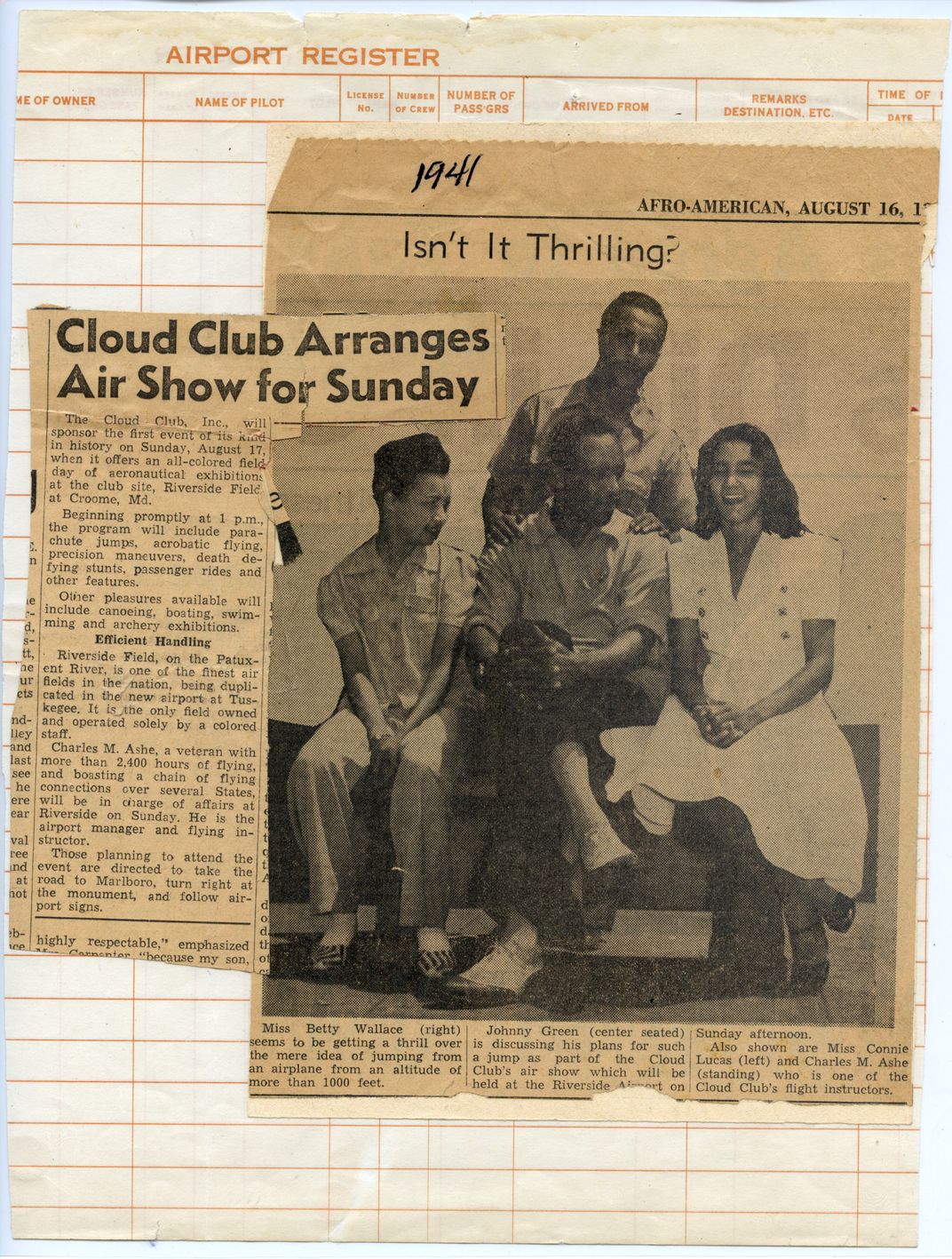
John Greene (center, seated) clipped this newspaper article of the Cloud Club’s August 1941 airshow and preserved it alongside many other photos and mementos of his time as an aviator. Greene would go on to perform a parachute jump but a change in the wind left him stuck in a tree for over an hour.
Courtesy of the Herbert Jones Jr. Family Loan.
Riverside Airfield was not only an active airport but also a social hub. While operating Howard’s CPTP, the Cloud Club continued to offer private training, hosted air shows, and even held a crab feast. The activity of the airfield overwhelmed the young leaders of the Club, so they turned to their most senior and experienced member for guidance, John W. Greene Jr. Greene, 14 years older than President John R. Pinkett Jr., had learned to fly in the 1920s, was the first African American licensed airplane mechanic, and the second to earn an air transport license after Anderson. Greene moved from Boston to D.C. in 1940 to start the DC public school’s first African American vocational aeronautics program. He immediately joined the Cloud Club as a member and instructor. He was formally hired as Riverside Airfield’s manager in November 1941.
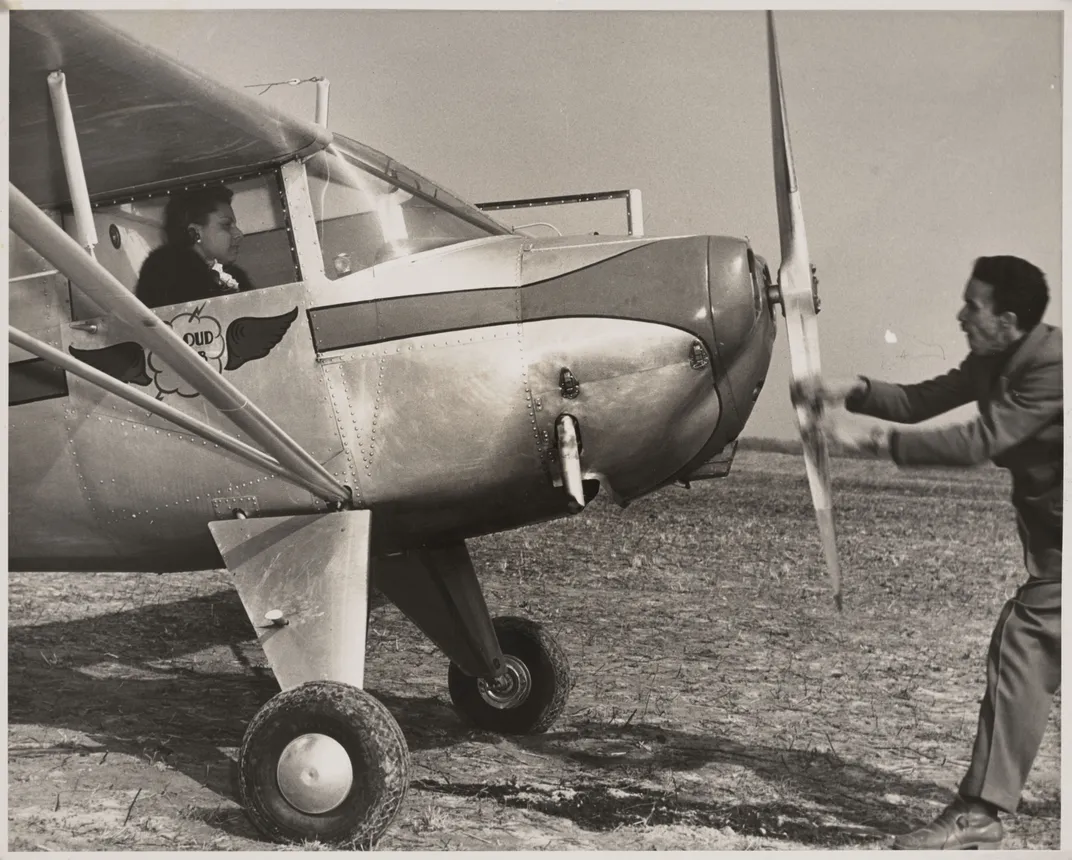
Willa Brown, the famed “aviatrix” from Chicago, visited Howard University’s Civilian Pilot Training Program at Riverside Airfield in March 1941. Club President John Pinkett Jr. spins the propeller of the Cloud Club’s plane.
Library of Congress, Prints & Photographs Division, Robert H. McNeill Family Collection.
World War II abruptly halted the growing airport and Greene’s tenure as its manager. Civilian aviation in the D.C. area was halted after the attack on Pearl Harbor in 1941, and in February 1942 the Naval Reserve Station at Anacostia commandeered Riverside Airfield. For the next two years, the Navy used the airfield for drills and practice, expanded the runways from four to eight, and built a pier on the river.
College Park Aviation Museum is a Smithsonian Affiliate and home to Columbia Air Center’s historical artifacts and collections. After four years of development, with the input and support of descendants and community members, the museum is unveiling the first gallery exhibition dedicated to this history. Columbia Air Center – Determined to Fly opens Thursday October 9, 2025. To specifically track the Columbia Air Center History Project, visit https://www.fieldoffirsts.com/cac.
Luke Perez is the Curator of Collections at College Park Aviation Museum, a Smithsonian Affiliate, which is operated by The Maryland-National Capital Park and Planning Commission. He is a practitioner in the care and preservation of US history who enjoys bringing new history to light through his curatorial and collections work. He earned an MA in Art and Museum Studies at Georgetown University, an MA in Social Sciences-History at the University of Chicago, and a BA in History at Brown University. He invites everyone to visit College Park Airport, in operation since 1909, and College Park Aviation Museum, located in College Park, Maryland, just outside of Washington, DC. Visit here to learn more.
Get the latest stories in your inbox every weekday.


:focal(725x577:726x578)/https://tf-cmsv2-smithsonianmag-media.s3.amazonaws.com/filer_public/1e/3e/1e3e1752-aba9-4520-9c04-ac9a56c8d08f/01-dcmlk003-cloud_club_1_at_coorm_pinkett_brawner_jlunceford_john_green_1950.jpeg)