

For a Quarter of a Century, We’ve Helped Make It Possible to Protect Birds Over a Cup of Coffee
The Smithsonian’s bird-friendly coffee certification program started after researchers made an unexpected correlation around a farm. It has been helping migratory birds and forest farms for 25 years now, one sip at a time
:focal(450x300:451x301)/https://tf-cmsv2-smithsonianmag-media.s3.amazonaws.com/filer_public/cc/dd/ccddbe2d-130e-4576-8f2f-8a96321ac1b4/bfc.jpg)
At the start of my tenure, I vowed to bring the Smithsonian to every home in America. Though it was a lofty goal, I knew we already touched so many lives in innumerable ways: a child experimenting with a microscope from the National Museum of Natural History, friends exploring a digital art exhibition—even an early riser pouring a morning cup of coffee.
The Smithsonian’s Bird Friendly coffee program, turning 25 this year, has a secluded headquarters in the Migratory Bird Center at the National Zoo and Conservation Biology Institute, but its footprint is worldwide.
In the 1980s, Smithsonian ornithologist Russell Greenberg was conducting research in Latin America when he noticed an unusual shortage of migratory birds. Greenberg eventually confirmed that the drop was due to the local agricultural industry’s efforts to pressure farmers to ax trees—which birds rely on for shelter and food—and prioritize farmland.
One day, as Greenberg and his crew drove around a valley in Mexico, they noticed a lush forest in the distance. As they approached, they discovered that it was actually a coffee farm, where crops were grown under a canopy of shade trees. They looked up, and migratory birds were “dripping from the trees,” says Ruth Bennett, Bird Friendly’s lead researcher.
Greenberg proposed an idea: a Smithsonian certification that labels coffees grown under conditions favorable to birds, allowing farmers and roasters to charge a premium that covers the labor and production costs of transitioning to an organic, biodiverse farm. With that mission, Bird Friendly helps farmers globally determine whether their land qualifies by auditing the farms’ growth of dense and diverse trees and connecting with coffee companies. The program is partially funded through a small royalty that the Smithsonian receives on each purchase.
Today, the Smithsonian certifies more than 4,000 farms in 14 countries, working with around 110 roasters. Much of that growth happened in the past five years. “When we launched, we were a science organization trying to run a certification. No one was focused on building the market,” says Bennett.
Now, her team partners with economists to increase demand. “For the first time,” says Bennett, “I hear from other farms saying, ‘My buyers are asking me for Bird Friendly coffee. What is it?’” Today, the program is expanding into cocoa and launching new certification options for farmers who conserve native tropical forest on at least 40 percent of their land.
The Institution, too, began as a scientific organization, evolving to encompass the rich tapestry of disciplines it does today. That tapestry is woven with the knowledge of how peculiar and wondrous certain connections can be: ecologists and economics, birds and coffee. These are the kinds of unexpected pairs I have learned to expect at the Smithsonian.
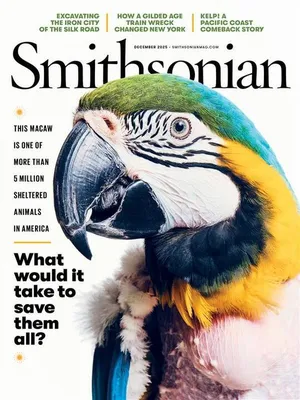
Subscribe to Smithsonian magazine now for just $19.99
This article is a selection from the December 2025 issue of Smithsonian magazine