

Meet the Retirees Turning Their Virginia Farms Into Wildlife Corridors
As habitat fragmentation threatens Virginia’s wildlife, two retired neighbors are turning their farms into biodiversity havens backed by Smithsonian science.
:focal(700x347:701x348)/https://tf-cmsv2-smithsonianmag-media.s3.amazonaws.com/filer_public/76/8f/768ff91c-439d-4e57-9c65-a5335a55f82d/20260603-_mg_4842-022em.jpg)
John Rice starts his morning early, trading an empty cup of coffee for a water bottle. It’s a summer day in rural Virginia, set to reach a high of 95 degrees Fahrenheit. It’s not the heat, but the humidity that’ll get you.
Up the road, just as the pavement gives way to dirt, an old farmhouse sits on the edge of the dirt road. Here live Rice’s neighbors, John and Debbie Sessler.
John Sessler grabs his leather gloves and applies insect repellant. Throughout the summer, both John Rice and John Sessler are busier than ever – retirement hasn’t slowed them down. They’re farmers working together toward a larger goal: increasing biodiversity – the variety of all living things and their interactions.
Unfolding on farms in Virginia’s Shenandoah Valley are Smithsonian science-guided management practices that create, restore, and connect habitat while keeping farms productive – and farmers and neighbors like Rice and Sessler are willing to work across fence lines to help keep then region home to bustling biodiversity.
Meet the Two Johns
Both Johns are conservationists and historians; they both recall their interest in the outdoors stemming from hunting and fishing, and they share a deep historical knowledge spanning back to before the landscape became what it’s now known as. As land managers, they look forward to what the land can become and the species it can support. As neighbors, they're creating different habitats through specific land management practices for a common goal: fostering biodiversity to maintain healthy ecosystems.
/https://tf-cmsv2-smithsonianmag-media.s3.amazonaws.com/filer_public/3a/37/3a375175-12b5-4e7e-98c0-b543cc8a3661/20260527-_mg_2796-013em.jpg)
Rice takes a heavier hand to managing his land, riding his electric utility side-by-side, equipped with an industrial sized herbicide sprayer – his saber against invasive plant species sweeping across his farmland. Invasive species are often introduced by humans — sometimes intentionally — that spread and cause harm to environmental, economic or even human health. He battles plants like wavyleaf basketgrass and Japanese stiltgrass that creep across forest floors, creating dense carpets and outcompeting native species.
Rice’s well-worn work clothes express the toil of his daily routine. But, underneath his visor and behind his round glasses, his eyes crinkle as he beams a big smile when he speaks.
“The average person is not going to do even close to what I'm doing. It's too much work, it's too physical, you get bit up, you get eaten with ticks,” he said with a contradicting smile as he wiped his brow.
His management also includes using existing seed reserves in the soil to bring more native plants to the farm. He noticed interesting plants in his fields when he began managing the land, so he jumped on the opportunity to cultivate those. Incorporating more native plants creates benefits like ecosystem restoration and wildlife habitat, and he’s seen improvement in his land.
/https://tf-cmsv2-smithsonianmag-media.s3.amazonaws.com/filer_public/89/52/89526c61-3624-4411-94c4-da5ae895bc10/20260709-_mg_8111-034em.jpg)
Rice and his wife, Babette Thorpe, have not just been working, learning and connecting with this land for decades, but have been sharing the wealth of their knowledge with others and rallying the community around them to advocate for conservation, such as their neighbors, the Sesslers.
The Sesslers have a soft demeanor with an easy smile always painted on their lips. They often spend time sitting on their front porch listening to the birds in the fields sandwiched between the Shenandoah River and dusty dirt road.
“We do what we do purely for the enjoyment of nature,” Debbie Sessler said. “We maintain the property for the access to nature, enjoying it for photography, the enjoyment of IDing species new to us, photographing butterflies, listening to birds."
“And hunting and fishing,” John Sessler cut in, giving Debbie a playful chuckle. “We are both naturalists at heart,” he added.
/https://tf-cmsv2-smithsonianmag-media.s3.amazonaws.com/filer_public/45/f7/45f7dab1-7727-40db-b164-d224477ad8f7/20260527-_mg_2457-003em.jpg)
A tour of their farm doubled as morning chores, stopping to cut the occasional protective tube off planted trees that have grown beyond the need of their protection. John pointed out a grove of young trees in the middle of his field that don’t have tubes.
“Cottonwoods,” he noted the aggressive species with a nod. He stated he should remove the woody encroachment before his field turns into a forested grove.
Unlike Rice, the Sesslers didn't initially identify many beneficial plant species. So, they planted a native seed mix in their fields, growing a plethora of native plant species that host habitat for birds, pollinators, and other wildlife. In the summer months, the fields become a carpet of vibrant wildflowers.
Whether it's adding in plants by planting a seed mix, like the Sesslers, or sticking with what's already there, like Rice, both are differing but effective management strategies reaching the same objective.
The Crisis Playing Out in Rural Landscapes
The biodiversity crisis doesn't spare Virginia. Globally, about 30% of species have been globally threatened or driven to extinction since the year 1500. Rural Virginia sees biodiversity loss through habitat degradation, competition between invasive species, overexploitation, pollution, and climate change associated with global warming. In the Johns’ case, it manifests through aggressive species like Japanese stiltgrass or cottonwood trees on their farmland.
Throughout the rest of the commonwealth, native biodiversity is threatened by land development, polluted rivers, aggressive invasive species outcompeting native ones, and rising sea levels disrupting coastal wetlands. With less habitat, species like bats, salamanders, songbirds, and more are threatened.
Habitat fragmentation occurs when large, continuous tracts of natural landscapes are broken down into smaller, isolated patches of “habitat islands.” Rice pointed to a map showing small chunks of farmland between protected mountain ranges. They seem close on paper, but for wildlife, they are effectively boxed in by roads and development.
Habitat fragmentation limits wildlife movement and creates cut-off populations. These small populations can experience inbreeding, leading to a loss of genetic diversity and further blocked migrations.
The solution to fragmented landscapes is reconnection.
How Private Landowners Are Reconnecting Habitats
Wildlife rely on habitat connectivity to thrive. Vital for maintaining healthy ecosystems, habitat corridors allow animals to migrate, reproduce, and locate resources without dangerous human-wildlife conflict or interaction.
The Johns not only champion the idea but have also spent decades putting it into practice.
Rice put his championing spirit to work when he noticed what he described as a “logical corridor protection area.”
“Because I had an ‘in’ in this area, I saw this opportunity to protect this cross-valley connection here between Massanutten Mountain, which is otherwise completely isolated,” he said.
/https://tf-cmsv2-smithsonianmag-media.s3.amazonaws.com/filer_public/98/7d/987d3c3a-8d8e-43f1-879c-a9e51f94de7d/20260709-_mg_8254-035em.jpg)
Rice bought his land and immediately put a conservation easement on it, an agreement that limits future development. His easement was the first in Page County, and he started a domino effect by reaching out to neighbors.
“Twenty-five years later, here we are, and we’ve got almost 2,500 acres of private land protected,” Rice said.
It took a lot of convincing – he said that outside of his job, it was all-consuming.
“Sometimes I couldn’t get any work done, because all people wanted to do was talk,” he laughed. “It was time consuming because we had to build up a level of trust.”
Down the road, it was a no-brainer for the Sesslers, too. When they bought the property 25 years ago, John noticed on the map just how close the borders of Shenandoah National Park and George Washington National Forest come to his land.
“I just remember seeing it on the map and thinking, ‘wow,’ that’s really cool. It’s neat they’re that close together,” Sessler said.
/https://tf-cmsv2-smithsonianmag-media.s3.amazonaws.com/filer_public/e4/27/e4271467-f711-47d6-8790-8cd492099793/20260717-_mg_0303-042em.jpg)
Connecting the lands is half the battle – then comes managing them. Prescribed burns help the Johns do just that. Fire is fundamental to the natural cycle of most ecosystems, and the absence of fire leads to a buildup of decaying organic matter, which can intensify wildfires. Prescribed burns alleviate the severity and devastation of fires, and Rice saw an opportunity.
Rice created the Shenandoah Valley Prescribed Burn Association. With weather conditions just right, the ability to safely burn an area leads to encouraging new growth of native vegetation. It's a tool in both of their land management belts--something that benefits both Sessler’s planted fields and Rice’s dormant seed bank.
“Ideally, you would use burning and animals to open up the woods and allow for more diversity,” Sessler said.
Both Rice and Sessler see the benefit in safe, controlled burns and rally their community around prescribed burning.
A Strategy Backed by Science
In the Johns’ fields, a prairie warbler rang out its rapid notes, rising in a perfect musical scale. A ruby-throated hummingbird zipped right in front of the group and later perched high on the branches of an old tree.
These observations are just one example of the data collected by the Smithsonian’s National Zoo and Conservation Biology Institute’s Virginia Working Landscapes program (VWL). VWL scientists, volunteers, and interns conduct annual biodiversity surveys, which help guide landowners like the Johns to management practices that best support their land and native biodiversity.
/https://tf-cmsv2-smithsonianmag-media.s3.amazonaws.com/filer_public/14/5d/145dfbdd-42e6-4382-a017-1f68bb985efa/20260603-_mg_4755-020em.jpg)
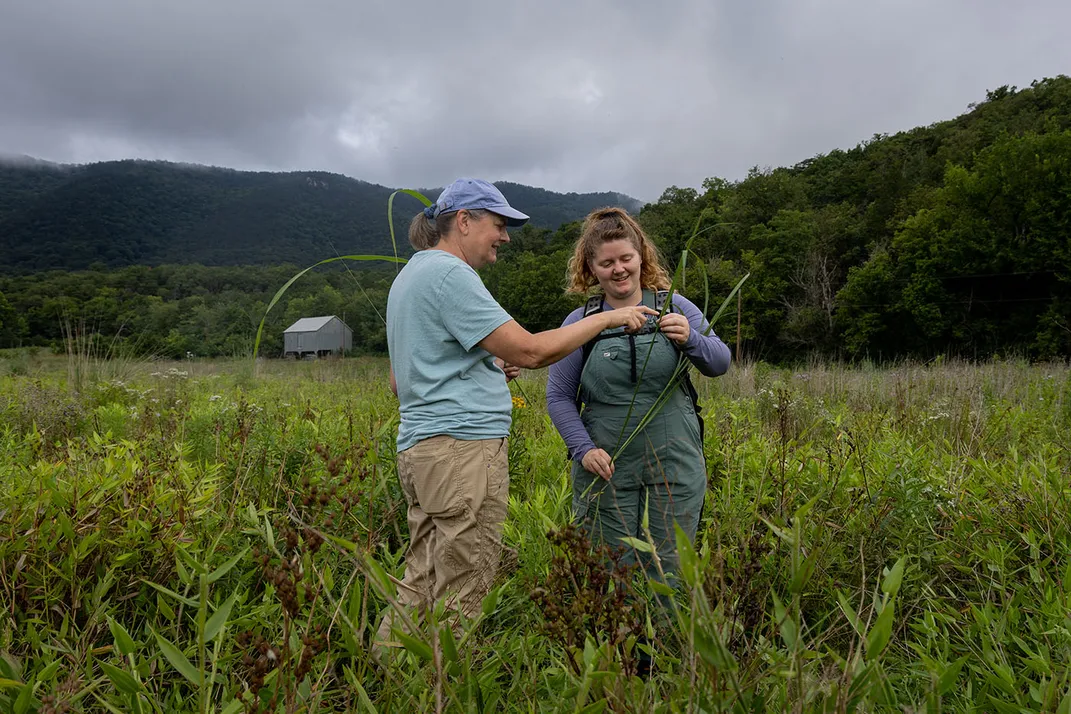
Botany technician Natalie Izlar never leaves these sites without a sense of awe for the management the Johns have put into their land.
She observed a handful of plant species with entertaining names, like hairy thoroughwort, cudweed and fuzzy wuzzy sedge.
“It’s not just an individual,” she said about the species she found. “It’s a collection or pattern that emerges when you spend some time in a place.”
/https://tf-cmsv2-smithsonianmag-media.s3.amazonaws.com/filer_public/36/a5/36a5b937-8176-4fa2-a1d3-d7414b2c0f10/20260603-_mg_4733-019em.jpg)
Izlar says identifying these plants instills confidence in management choices.
“Finding species like that in the understory is telling us that these landowners’ management is working,” she noted. “Finding stuff like that is optimistic and hopeful, and the land is communicating with them.”
VWL recruits landowners whose properties serve as sites for biodiversity surveys, like the Johns. Data from these farms are analyzed as part of a larger study on the relationship between land-management and native species biodiversity. VWL utilizes this data to predict the future of this region’s landscapes and identifies best management practices for farms.
Each time the VWL team conducts a survey on their land, the Johns eagerly join not just on their property, but each other's, too. During the silence and focus of a bird survey, or when the team huddles around the smallest plant to identify it, they lean in to learn about the world beneath their feet.
Making an Impact Beyond the Shenandoah Valley
Virginia is among leaders of the eastern states in wildlife corridor protections, having created a Wildlife Corridor Action Plan in 2023. The statewide initiative, managed by the Virginia Department of Wildlife Resources, emphasizes reducing wildlife-vehicle conflicts and reconnecting fragmented habitats separated by infrastructure, fostering long-term sustainability and biodiversity. The trend is on the rise throughout the country; at least 12 states have implemented landscape wildlife corridor projects.
Enacted legislation makes a significant difference in infrastructure, but in Virginia, where the commonwealth’s land is 90% privately owned, the impact of farms like those belonging to the Johns are equally monumental; their hard work is invaluable to fostering biodiversity in the region.
In a silent moment on an overlook of his property, John Rice sat still and took in the view. The hues of lush greenery as far as the eye can reach, the same greens that ironically make the Blue Ridge Mountains blue, awakened around him. Buzzes, chirps, hisses, and whooshes yield proof of bustling life.
And despite the number of taxing days in the hot sun, Rice says his “why” keeps him motivated.
“If you want the place to be truly productive and support a diversity of species, healthy populations, you have to do it,” Rice said, pointing to his chest before turning around to head back to work.
Want more conservation news? Sign up to receive the latest email updates on news, events, volunteer opportunities, and more from the Smithsonian's National Zoo and Conservation Biology Institute.