Eight Fascinating Facts About the Whooping Crane, the Tallest Bird in North America
They’re tall, graceful and among the rarest birds on earth. Here are eight things you probably didn’t know about this awe-inspiring species.
:focal(373x347:374x348)/https://tf-cmsv2-smithsonianmag-media.s3.amazonaws.com/filer_public/29/00/2900388a-6796-4395-9aa1-20098ce93150/20260430-817a9727-22rp.jpg)
With its striking white plumage, graceful flight and primitive call, the whooping crane is a rare and awe-inspiring bird. Learn what makes these animals so incredible:
1. Whooping cranes are North America’s tallest bird.
Enormous for a bird, whooping cranes can stand nearly 5 feet (1.5 meters) tall, with wingspans reaching an impressive 7 feet (2.1 meters), about the same size as a bald eagle.
/https://tf-cmsv2-smithsonianmag-media.s3.amazonaws.com/filer_public/74/8f/748f1f10-8faa-41a5-b670-1b660dd0690f/20260430-817a9695-18rp.jpg)
2. Whooping cranes pair up for life and strengthen their bonds through mating dances.
Male and female whooping cranes form pair bonds starting around 2 to 3 years of age that last until one of them dies (up to 30 years in the wild). Courtship for whooping cranes is coordinated and chaotic, as the amorous animals “dance” with each other by bouncing, flapping their wings, and tossing their beaks in the air like they just don't care.
Once these pairs form, they’re fiercely devoted to each other. They look after each other while foraging and resting, build nests together, and co-parent their young. They also sing “duets,” with loud, whooping calls that can travel up to two miles.
Listen to a pair calling together at the Smithsonian Conservation Biology Institute:


3. During migration, the oldest cranes are the best navigators.
With their ultralight bodies and huge wingspans, it’s no surprise that whooping cranes can travel incredible distances. Like many other bird species, whooping cranes migrate between summer and winter zones as a survival strategy to find food, mild weather and quiet places to raise their young. The longest whooping crane migration, linking Aransas National Wildlife Refuge in Texas to Wood Buffalo National Park in Canada, spans about 3,000 miles.
Believe it or not, whooping cranes aren’t born with the ability to trace the same flight route every year. In fact, it’s the oldest and most experienced cranes in the group that pass along their knowledge to the rest. According to one study, the presence of just a single 8-year-old adult helped a group of juveniles veer off the route 38 percent less than they would have otherwise. Science hasn't revealed exactly what makes older cranes the best navigators, but some researchers think they might be the best at spotting landmarks from the air.
4. Whooping cranes came within a hair’s breadth of extinction. In 1941, there are believed to have been just 21 left in the world. Today, they’re conservation icons.
Whooping cranes were never incredibly common, but there used to be a lot more of them than there are now. In the mid-1800s, naturalists documented whooping cranes all over North America, from as far west as Utah eastward into places like New Jersey, South Carolina and Georgia. But in just a few decades, human-driven habitat loss and overhunting wiped out virtually all of them. Their lowest point came in 1940, when a Louisiana hurricane decimated the wild population, which by then had already dropped into the double digits.
It wasn’t until the turn of the 20th century that conservationists began to realize how close whooping cranes were to being lost forever. Forward-thinking lawmakers moved to enact habitat protections and hunting bans, giving the whooping cranes a lifeline in the last patches of their natural range. To hedge against disaster, government biologists launched an effort to rebuild their numbers in human care, collecting over 400 wild crane eggs over several decades and eventually turning that group into a small but thriving wild population.
Whooping cranes are still endangered, but there are somewhere between 600 to 800 wild cranes alive today, making them one of the most famous symbols of conservation success.
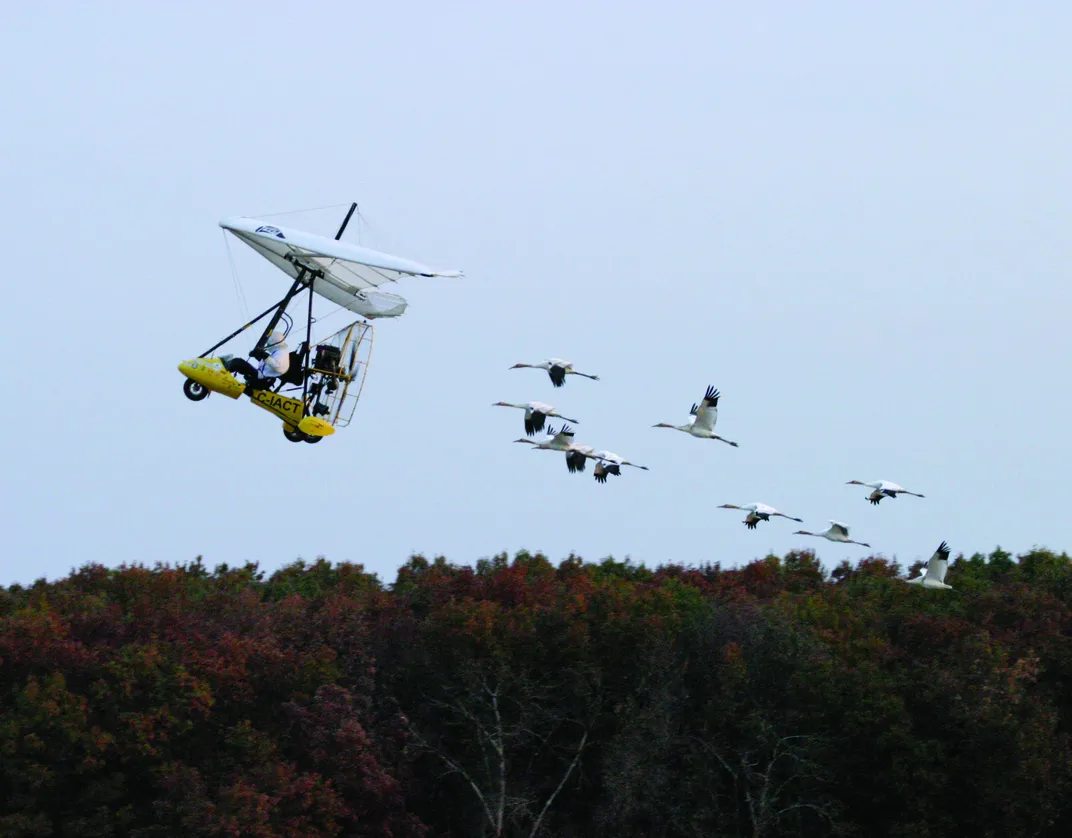
5. Scientists once used light aircraft to teach young cranes how to migrate.
Reintroducing young whooping cranes into the wild isn’t as easy as it sounds. Hatchlings raised by humans easily imprint on their caretakers, and when they do, they lack the skills they need to survive in the wild.
Researchers have employed some remarkable techniques to help establish the human-raised babies. Caretakers dressed up in giant crane costumes, mimicked crane movements with lifelike puppet heads and used hooded white suits so the cranes weren’t exposed to humans. One widely publicized experiment even had pilots flying ultralight aircraft to guide juveniles on their first migrations.
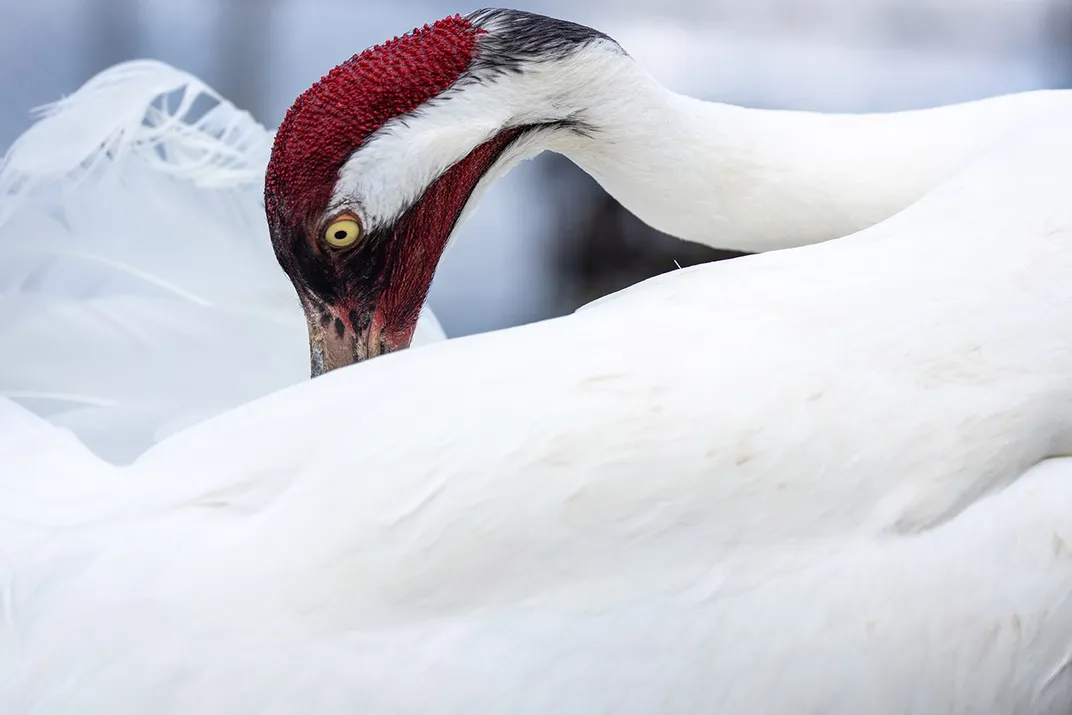
6. There are about 600 to 800 whooping cranes in the wild today, but they live in just four big groups.
The future looks brighter for whooping cranes than it did a century ago, but there are still just a few small populations of wild cranes left on Earth.
The biggest groups—the Texas-Canada population and a Wisconsin-Florida population—migrate between breeding and wintering grounds like most migratory birds. But interestingly, two smaller reintroduced groups—about 80 cranes in southern Louisiana and less than a dozen in central Florida — don’t migrate. Instead, they stay put all year.
7. Whooping cranes are legally protected, but they’re still threatened by flooding, oil spills, disease and power lines.
Whooping cranes survived their close call with extinction, but new threats are converging on their wintering habitat. Inside the Aransas National Wildlife Refuge—where more than 500 cranes spend their winters along the Texas coastal marshes—rising sea levels threaten to spill over into the freshwater wetlands that cranes use as drinking water. Persistent threats like oil spills, collisions with power lines and outbreaks of bird flu continue to challenge the growing but still-fragile population.
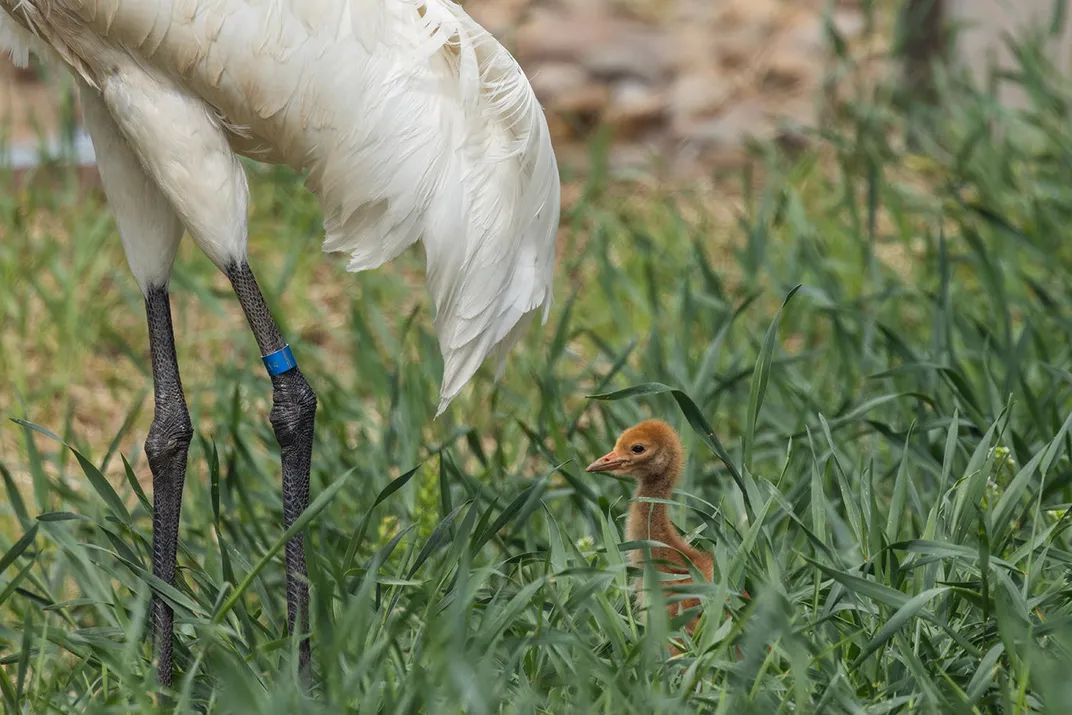
8. Groups like the Smithsonian’s National Zoo and Conservation Biology Institute are working to protect whooping cranes from extinction.
Only about a third of female whooping cranes in human care lay eggs. Finding out why could be the key to helping their populations take off, so scientists and animal care experts at the Smithsonian are working to unravel this and other mysteries about the animals’ breeding habits.
In 2016, animal experts at the National Zoo’s conservation science campus in Front Royal, Virginia, joined a network of collaborators to breed whooping cranes in human care, with the goal of raising enough babies to be released into the wild or join other reproduction programs. Four cranes have been successfully hatched at the Front Royal campus since 2021, including a pair of fuzzy whooping crane babies, or colts, in 2026.
Want more animal care news? Sign up to receive the latest email updates and information on Zoo news, events, volunteer opportunities, and more.
Love whooping cranes? Your donation helps protect wildlife around the world through Smithsonian conservation and research programs. Learn more or make a donation.