Inside a Komodo Dragon Vet Exam at the Smithsonian’s National Zoo
Learn how Zoo veterinarians deliver expert care for an apex island predator.
:focal(700x467:701x468)/https://tf-cmsv2-smithsonianmag-media.s3.amazonaws.com/filer_public/99/e5/99e583c4-5a14-4dce-9acf-09c91a10b36b/20260310-817a5217-001bk.jpg)
Whether tending to a tiny frog or an apex island predator, staff at the Smithsonian’s National Zoo help all animals thrive in our care. Take a look behind the scenes as a team of veterinarians delivers a comprehensive exam to Onyx, a six-year-old male Komodo dragon.
Training for a vet exam
Routine medical care for zoo animals often begins long before it’s time for an exam. For Onyx, a 6-year-old male Komodo dragon, it started with something deceptively simple: learning to step into the transport crate that would deliver him to the veterinary hospital.
To get him used to being in the crate, Reptile Discovery Center assistant curator Matt Evans and keeper Sara Hasenstab worked with Onyx in the weeks leading up to the exam. His motivation for training sessions usually came in the form of a desired food item. In this case, it's a frozen-thawed mouse.
It’s always easier for staff and less stressful for the animals if they can participate in their own care routine, said Evans.
“Onyx has been with us since he was a year old. We interact with him a lot, so he’s used to us.”
And on a sunny Tuesday morning in March, it was time for the exam. Just like he practiced, Onyx calmly walked into his containment box for his mouse reward. Then, Evans and Hasenstab lifted the crate into a heated van and drove him across Zoo grounds to the veterinary hospital.
Checking up on a dragon
/https://tf-cmsv2-smithsonianmag-media.s3.amazonaws.com/filer_public/e3/b8/e3b80858-35fe-4f20-a27d-e135675a9603/20260403-817a7716-11rp.jpg)
Komodo dragons are the largest lizard species in the world. Adults can grow to be over 10 feet long and weigh up to 300 pounds. At just 5 feet and 100 pounds, Onyx still has some growing to do. But the care team noticed that for a male dragon his age, he’s a bit undersized.
“He’s not growing at the speed and pace you’d expect, so we wanted to see if there was a medical reason behind it,” said Evans.
It’s uncommon for a Komodo dragon to undergo an exam under anesthesia — their size and strength mean they’re not routinely handled. So when the opportunity arose, Onyx’s care team aimed to run as many tests and diagnostics as they could while he was sedated.
Inside the exam
With Onyx safely inside at the vet hospital, the team worked methodically. Veterinarians opened a small flap in the back of the crate to deliver the sedative via an injection in his tail. From there, the team watched his behavior to determine when he was sleepy enough to safely place the breathing tube. Within just a few minutes, Onyx was anesthetized and the team was ready to start the procedure.
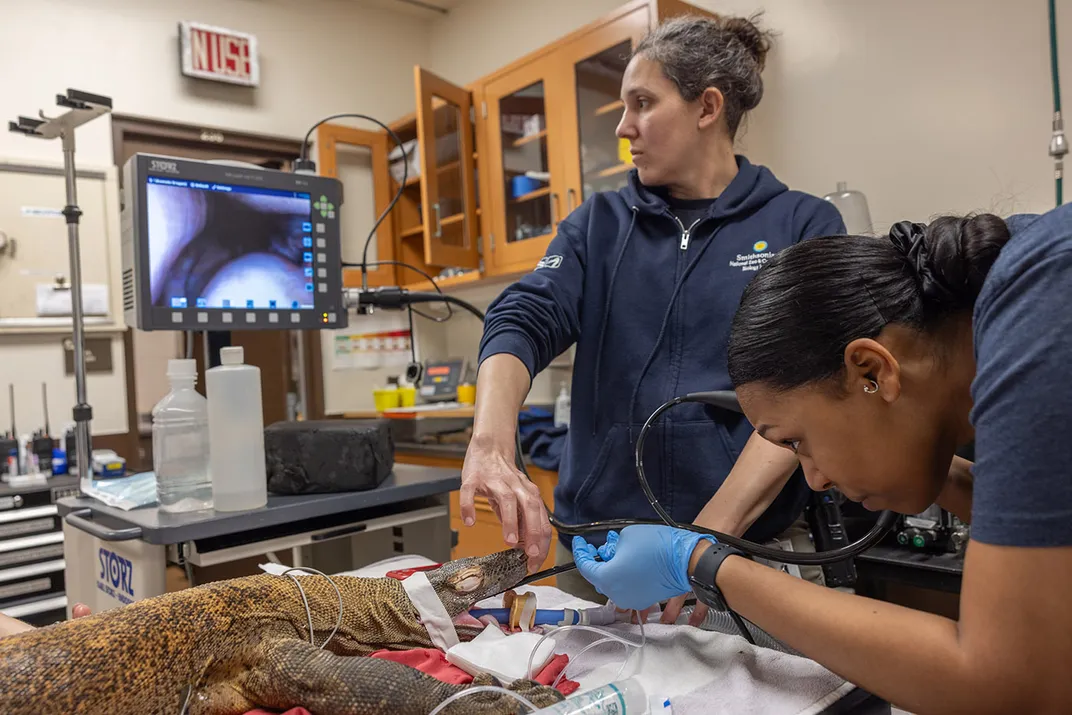
The team carefully lifted Onyx onto the operating table and got to work. The veterinarians quickly conducted a full, face-to-tail body check, feeling for any unexpected masses or lumps. Then, the team took X-rays and an ultrasound to get an inside look at Onyx’s bones and organs. An endoscope was then guided into his stomach, allowing the veterinarians to get a close look at his upper gastrointestinal tract. Throughout the procedure, veterinary technicians monitored his vital signs, collected samples of blood, and took oral and fecal swabs for testing after the exam.
/https://tf-cmsv2-smithsonianmag-media.s3.amazonaws.com/filer_public/cf/b0/cfb05aba-7e9c-4fe2-80ed-ffda591fa174/20260310-817a5256-002bk.jpg)
One of the most unusual challenges came from Onyx’s reptilian anatomy. The skin of a Komodo dragon is covered in tiny, rough plates called osteoderms. This natural armor protects their bodies from injury, but it makes ultrasound exams tricky (but not impossible).
/https://tf-cmsv2-smithsonianmag-media.s3.amazonaws.com/filer_public/61/12/6112278c-255e-491f-a834-d273f71bf926/20260310-817a5308-005bk.jpg)
With the exam complete, the team delivered drugs to reverse the sedative and slowly woke up Onyx inside the travel crate, manually helping him breathe until he fully awakened. After a few minutes, Onyx was groggy but conscious. Evans and Hasenstab transported him back to his habitat in Reptile Discovery Center. After just a few hours, Onyx was moving, climbing and digging inside the exhibit as usual.
/https://tf-cmsv2-smithsonianmag-media.s3.amazonaws.com/filer_public/b7/ff/b7ffe276-0bc5-47d2-9b55-8cde18c9071d/20260310-817a5351-007bk.jpg)
The results put the team at ease. “We were relieved not to find anything super significant,” said Dr. Kaye.
While no major health concerns emerged, Onyx has started taking dietary supplements to help him to draw more nutrients out of his food. A watchful eye from the keeper team will help ensure he has a good shot at reaching his full size someday.
“Overall, the whole thing went very smoothly,” said Evans. “Onyx did great and I’m happy with how it all turned out.”
/https://tf-cmsv2-smithsonianmag-media.s3.amazonaws.com/filer_public/10/8d/108d96ee-f086-4cae-a7d1-277a367f949d/20260403-817a7582-05rp.jpg)
Want more animal care news? Sign up to receive the latest email updates and information on Zoo news, events, volunteer opportunities, and more.
Love Komodo dragons? Your donation helps protect wildlife around the world through Smithsonian conservation and research programs. Learn more or make a donation.