
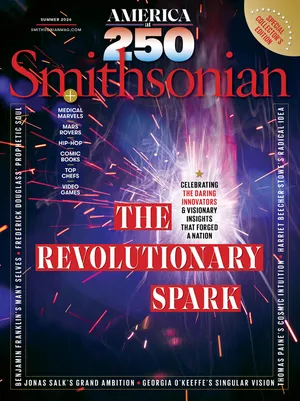
America at 250: The Revolutionary Spark
A Smithsonian magazine special report
They Were Just Having a Back-to-School Party in an Apartment Rec Room. Little Did They Know They Were Creating Hip-Hop
The music genre that became a global sensation started with some creative teens just getting together and riffing rhymes to DJ Kool Herc’s curated beats
/https://tf-cmsv2-smithsonianmag-media.s3.amazonaws.com/filer_public/ee/d5/eed52cc6-f007-436f-a082-26af049f9111/hiphop-clivecampbell.jpg)
At that party, the five elements of hip-hop culture all came together, says Emmett G. Price III, dean of Africana studies at Berklee College of Music. Along with the rap, dance (breaking) and the looping, merry-go-round style of spinning records, there was art (graffiti) and fashion (streetwear). Teens representing different neighborhoods often fused the two, explains Price, by spray-painting insignia on their jean jackets.
Adolescents who couldn’t get into 21-and-up nightclubs were drawn to Campbell’s parties. “It’s a substantially younger crowd,” says Chuck D, of the Grammy-nominated 1980s rap group Public Enemy. “He’s playing records for the kids.”
Price says that the youth “took the soundtrack of their ancestors and remixed and remastered it. Listen to hip-hop, and you end up learning about funk, soul, jazz, blues and spirituals.”
Hip-hop may borrow from earlier American music forms, but what makes it unique, according to Price, is its innovators: the teenagers of 1970s New York City, mostly marginalized Black youth who, until then, had no collective voice. Although genres like rock ’n’ roll had a primarily teenage fan base, the artists were typically adults. “Hip-hop culture was created and defined by young people,” Price says, “and not necessarily by the industry or by historians and music journalists.”
Did you know? Holding onto hip-hop culture
-
In August 2022, Christie’s auctioned more than 200 of Clive Campbell’s belongings, including his six-foot-tall custom speakers, turntables, classic vinyl records, disco balls and other memorabilia, earning more than $850,000.
-
The Smithsonian’s collection of hip-hop related items, primarily on exhibit in the National Museum of African American History and Culture, includes a clock worn by Flava Flav of Grammy-winning rap group Public Enemy, a suit worn by flamboyant West Coast artist M.C. Hammer and a microphone used by Rakim, a Grammy Hall of Fame lyricist.
-
In 2010, the Birthplace of Hip-Hop, 1520 Sedgwick Avenue in the Bronx, was saved from potential sale by a $5.6 million loan from the city of New York’s New Housing Marketplace plan.
By the mid-’80s, corporate America had begun to recognize hip-hop’s financial potential. Break dancers performed at the 1984 Summer Olympics in Los Angeles, and Hollywood released films like Beat Street and Krush Groove, starring a teenage LL Cool J, Doug E. Fresh and other budding young artists, bringing the culture into the mainstream.
Today, hip-hop is a $15 billion industry in the United States and a global phenomenon. Graffiti exhibitions can be found in Benin and Singapore, and streetwear is celebrated on runways in Paris and Milan. The music is everywhere.
Campbell unleashed it all in that Bronx rec room. “Herc was the innovator,” Price says. “Rarely do young people get the credit for changing the global economy. To think about their impact and influence and what they created then—that’s phenomenal.”
Subscribe to Smithsonian magazine now for just $19.99
This article is a selection from the Summer 2026 issue of Smithsonian magazine