
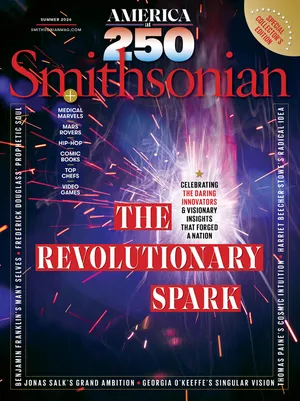
America at 250: The Revolutionary Spark
A Smithsonian magazine special report
The Queen of Soap Operas Started Off By Telling Stories About the Drama She Was Missing in Her Own Life
Irna Phillips was a radio voice actor in Chicago when she was asked to create a serialized program. From that, she created a legacy that includes ‘Guiding Light’ and ‘As the World Turns’
/https://tf-cmsv2-smithsonianmag-media.s3.amazonaws.com/filer_public/ec/67/ec676f94-e190-43e3-9c56-c1e598c0d251/soapoperaopener.jpg)
Tunie’s Jessica Griffin Harris of As the World Turns. Tunie now stars in CBS’ Beyond the Gates. Illustration by Addison Green
When Irna Phillips was working as a voice actor at Chicago’s WGN radio station in 1930, her boss asked her to develop a drama about a mother and her adult daughter. Phillips, a former schoolteacher, responded with Painted Dreams, a 15-minute daily series about an Irish American widow named Mother Moynihan, voiced by Phillips, and her unmarried daughter, Irene. “All the things I wanted as a young person I gave to Mother Moynihan’s daughter. I didn’t have men in my life, so I gave Irene men,” she told the Saturday Evening Post in 1960. Phillips played a key role in pioneering these scripted serials, with their melodramatic, open-ended stories about romance and domestic life. Sponsored by companies like Procter & Gamble (P&G) that were eager to sell detergents and other household products to a captive audience of homemakers, the shows soon took on a frothy moniker: soap operas.
Painted Dreams was not the first radio serial, but Phillips’ Guiding Light, which debuted in 1937, was the first soap to successfully transition to TV. Over the next four decades, Phillips earned her crown as “The Queen of the Soaps,” creating or co-creating more than a dozen daytime dramas, including the long-running As the World Turns and Another World. Her Guiding Light aired on TV for 57 years, longer than any other soap opera. Phillips established a blueprint that countless soaps would follow: crafting multigenerational, small-town sagas that spoke to the hopes and dreams of average women. She helped create the format and design of the productions. She understood the languid rhythm of daily storytelling, how to dole out cliffhangers and construct narratives that could be sustained indefinitely without resolution.
Phillips was astonishingly prolific, working on as many as six serials at once and, from her Chicago apartment, dictating two million to three million words a year to her trusted secretary, Rose Cooperman. She also trained a generation of daytime auteurs, including Agnes Nixon (All My Children) and William J. Bell (The Young and the Restless).
Fun fact: Soap operas breaking ground
-
Oscar winners Michael B. Jordan, Marisa Tomei, Julianne Moore and Leonardo DiCaprio all starred in daytime soaps early in their careers.
-
Phillips’ The Guiding Light is recognized as the first soap opera to bring awareness to a medical condition, introducing a uterine cancer storyline in 1962.
-
In 1984, The Young and the Restless became the first show to film a real-life face-lift when actress Jeanne Cooper allowed her procedure to be written into the plot.
/https://tf-cmsv2-smithsonianmag-media.s3.amazonaws.com/filer_public/b2/f1/b2f180c9-6e1c-45a4-ba1c-cc52bff71166/pbdirph_ec002-2.jpg)
While some of Phillips’ characters lived in a world she only dreamed of, many story lines were inspired by her real life, which was marked by hardship. She was the youngest of ten children born to a struggling Chicago grocer who died when Phillips was 8. Painfully shy, she preferred making up stories about her paper dolls to playing with other children. “I lived in a world of pretense and make-believe,” she said in the 1960 Post interview. Phillips wanted to become an actress until a drama instructor told her she was too short and homely for the stage. At 19, unmarried and abandoned by her boyfriend, Phillips gave birth to a stillborn child. Although she seemingly remained open to marriage, telling Time that she’d gladly give up her career “if the right man came along,” her broadcasting empire was her focus. (The same article described her as a “pigeon-plump spinster.”) Phillips never wed, but she adopted two children.
Despite attracting fans like Supreme Court Justice Thurgood Marshall and artist Andy Warhol, who titled one of his 1964 films Soap Opera, daytime dramas have long been dismissed as lowbrow melodrama for bored housewives. But beyond the catfights and steamy romances, soaps explored such taboo topics as domestic violence, eating disorders, addiction, sexual assault and a host of other social issues. Airing new episodes five days a week, the programs could dive into these subjects at greater length than the sporadic “very special episodes” devoted to the topics on primetime TV. Phillips pioneered some of these story lines: In 1964, Another World featured daytime TV’s first story arc about abortion. Her series Love Is a Many Splendored Thing, which premiered in 1967, included an interracial romance that riled the censors at CBS, prompting Phillips to leave the show.
The constant creative disputes eventually took their toll on Phillips, who gained a reputation for being difficult. In 1973, P&G fired her from As the World Turns over a story line about a woman who seduces her sister’s husband.
Throughout the ’70s, soap operas flourished, thanks in part to the work of Phillips’ protégés, Nixon and Bell. But Phillips, who died in 1973, never witnessed the pinnacle of the genre she created. By the end of the decade, more than a dozen soaps aired each day on ABC, CBS and NBC, which raked in millions in ad revenue by selling what Time called “sex and suffering in the afternoon” to an overwhelmingly female audience. For many, the programs offered more than a daily dose of escapism. They also became a cherished family tradition, with grandmothers, daughters and grandchildren often watching together.
Daytime TV reached its undisputed peak in 1981, when 30 million Americans tuned in to watch Luke and Laura’s wedding on General Hospital—the largest audience ever for a daytime soap.
But audiences began to wane in the ’90s as more viewers entered the workforce and explored newer offerings on cable TV. Many soap fans fell out of the daily viewing habit because of the real-life drama of the O.J. Simpson trial, which was broadcast each weekday throughout much of 1995, pre-empting many afternoon shows. Between 1999 and 2013, half a dozen long-running network soaps got the ax. As of this year, only four English-language daytime soap operas air on broadcast television. (Days of Our Lives moved to the streaming service Peacock in 2022.)
Yet since the heyday of the daytime drama, the rest of TV has gotten sudsier—prime-time soaps like Dynasty and Dallas created watercooler moments. More recently, acclaimed dramas like Mad Men and Succession have featured heavily serialized narratives about family conflict and romantic turmoil. Meanwhile, reality shows like the Real Housewives franchise and The Kardashians essentially function as (supposedly) unscripted soap operas.
Even in an era of infinite viewing choices, the daytime soap retains a powerful appeal. Last year, CBS launched Beyond the Gates, a drama about an affluent family navigating the cultural and political landscape of the Washington, D.C. area. It modernized a formula Phillips helped establish nearly a century ago, with relatable plots and issues, such as infertility and online bullying, for today’s viewers.
The ability to find the humanity that connects us is part of Phillips’ success. “All our lives are serial stories,” she said. “Each day brings a new installment in our private soap opera, and no matter how bad yesterday was, who can resist tuning in tomorrow to find out what will happen next?”
Subscribe to Smithsonian magazine now for just $19.99
This article is a selection from the Summer 2026 issue of Smithsonian magazine