
A Rare Recording of Harpo Marx Speaking Publicly Was Mislabeled in an Archive for Decades. Now You Can Listen to the ‘Silent’ Comedian Yourself
The comedian of the stage and big screen thrilled millions of Americans without ever speaking a word, leaving many to wonder what his voice sounded like
/https://tf-cmsv2-smithsonianmag-media.s3.amazonaws.com/filer_public/4d/99/4d99095c-0b7b-44ef-b185-766e0c2f094f/gettyimages-514962722-harpo-marx.jpg)
On March 20, 1964, the Riverside Symphony hosted a benefit concert on the eastern outskirts of Los Angeles that featured guest performer Harpo Marx, the silent member of the Marx Brothers comedy team. His antics on the stage and screen—at once childlike and hedonistic—delighted generations of audiences and now, as a newspaper advertisement proclaimed, he would speak publicly for the first time in 50 years.
In the first half of the program, Harpo, as was his wont, performed popular selections on the harp. Then he approached the microphone, slipped on a pair of reading glasses and announced, to rapturous applause, “Believe it or not … I’m gonna talk.”
What the audience could not have known was that this would be Harpo’s final public musical performance. In declining health, he died six months later, at age 75, following complications from heart surgery.
A recording of the concert was one of the few remaining Holy Grails for Marx Brothers fans, the vast majority of whom had never heard Harpo’s voice. Unearthing the precious recording—mislabeled and lost but preserved for more than six decades—has been “a detective story,” says Robert Bader, a Marx Brothers historian. He’s also a co-producer of a new album that allows the public to hear the recording for the very first time. Harpo Speaks! The Riverside Symphony Concert is now available on CD and vinyl from Ramseur Records.
/https://tf-cmsv2-smithsonianmag-media.s3.amazonaws.com/filer_public/5c/95/5c95da98-2bad-4b7d-b1f5-519273bea345/gettyimages-515138240.jpg)
The Marx Brothers—stage-named Chico, Harpo, Groucho, Gummo and Zeppo—were real-life, unruly brothers from Manhattan’s Upper East Side who were pushed into show business by their mother in the earliest years of the 20th century. Groucho and Gummo were already performing as part of the Three Nightingales when Harpo joined them in 1908. Chico came aboard four years later, and Zeppo followed after Gummo went into military service in 1918. After several years paying their dues on the lowest rungs of the cultural ladder, their monkey business would make them the toast of vaudeville, Broadway and, later, Hollywood.
In their act’s most popular incarnation, Groucho was a master of the quick-witted, insolent wisecrack, and Chico was an Italian-dialect comedian who, with partner in crime Harpo, served as a foil for Groucho and dazzled with his signature “pistol shot” piano playing. Zeppo was, well, Zeppo, the team’s proverbial straight man.
Harpo eventually became famous as the mute, devilishly childlike imp, but in the early years, he delivered verbal quips along with his pantomine. In 1914, the brothers toured the country with Home Again, a musical revue. The jokes were fast and inane but funny: “Dad, the garbage man is here.” “Tell him we don’t want any.”
According to Harpo’s 1961 memoir, a critic once praised his physical comedy but added, “Unfortunately, the effect is spoiled when he speaks.”
“I simply couldn’t outtalk Groucho or Chico, and it was ridiculous of me to try,” Harpo wrote. “It was a cruel blow to my pride nevertheless. I went silent. I never uttered another word, onstage or in front of a camera, as a Marx Brother.”
The Marx Brothers became Broadway sensations in 1924 with the revue I’ll Say She Is, which was championed by theater critic Alexander Woollcott. He was so taken with Harpo’s clowning that he recruited him to join the legendary Algonquin Roundtable alongside such wits as Dorothy Parker and Harold Ross, the founding editor of the New Yorker.
The brothers parlayed their Broadway successes into a movie career, beginning with filmed adaptations of their shows The Cocoanuts and Animal Crackers, followed by such comedy classics as Monkey Business, Horse Feathers, Duck Soup, A Night at the Opera and A Day at the Races. After 1949’s Love Happy, the last Marx Brothers film, Harpo maintained his code of silence in sporadic TV appearances. He memorably recreated Duck Soup’s classic mirror scene with Lucille Ball in a 1955 episode of “I Love Lucy” and made a surprise in-character appearance on Groucho’s quiz show, “You Bet Your Life,” in 1961 to promote his memoir.


The advertisement for the Riverside Symphony benefit concert overstated matters a bit. Harpo had spoken onstage over the years, albeit rarely, and never before a camera or a recording device. On random occasions, at the end of Home Again, after not saying a word the entire show, Harpo would address the audience in what came to be known as “Red’s Speech,” so named for the color of his character’s wig. Years later, in 1941, he appeared onstage in the Bucks County Playhouse production of The Man Who Came to Dinner as Banjo, a riotous character that playwrights George S. Kaufman and Moss Hart had based on him.
A YouTube video purports to be a compilation of recordings of Harpo’s voice. Among them are a newsreel outtake of Harpo saying “Honk, honk” into a radio microphone at a movie premiere and audio of Harpo sharing stories of his life with Rowland Barber, the co-writer of his memoir. The rest ply together Marx Brothers clips with speculative captions.
But the new album delivers fully on its promise. In addition to the Riverside Symphony concert being Harpo’s final performance before an audience, what is significant about the live album is that this was the first time Harpo allowed himself to be recorded speaking.
“He was very clear he wasn’t going to record his voice for public consumption, but in this case, he was making sure it was saved,” says Bader. “Perhaps it was because he knew it was the end of his performing career, and he had been silent long enough.”
A series of mild strokes and a heart attack had forced Harpo into retirement, but he agreed to perform with the Riverside Symphony at its “appreciation concert” for Thomas Facey, the symphony’s co-founder and its conductor in its first five years. At the time, Facey was undergoing “a serious and debilitating illness,” according to press accounts. “I couldn’t turn them down on something like this,” Harpo told the Riverside Press. “He’s such a wonderful guy.”
Harpo had “a fluid definition of retirement,” notes Bader, who collaborated with Harpo’s wife, Susan Marx, on her posthumously released memoir, Speaking of Harpo. “Susan loved to tell how Harpo would insist, ‘It’s a benefit show—they don’t pay me, so it’s not like I’m working.’ Susan would say, ‘How could I argue with that logic?’”
The first half of the Harpo Speaks! album features the Marx brother performing a medley of standards on the harp, including “Fly Me to the Moon,” “Swanee River” and “Guardian Angels.” In the guise of Umberto Harpolini, a character he introduced in the 1940s, he conducts six child musicians on Joseph Haydn’s Toy Symphony.
“Harpo loved classical music,” Bader says. “Someone once asked him to describe a typical day, and he said, ‘I get up, and I practice the harp until Mozart moves my bowels.’”
Jokes aside, he took his music very seriously. “He did not read music, but he had an amazing ear,” says his son, Bill Marx, a pianist, nightclub entertainer and film composer. “He learned Ravel, Debussy and Bach. He made trans-Atlantic phone calls with [harpist] Mildred Dilling about fingering in a piece he wanted to get right.”
But the concert’s second half was what the packed house had paid $2.50 to hear. “Harpo to end long silence” proclaimed an article in the Press four days before the concert, and following his initial greeting, he proceeded to introduce the evening’s featured attraction, Sergei Prokofiev’s Peter and the Wolf as narrated by Harpo himself with jokes written by Groucho sprinkled in.
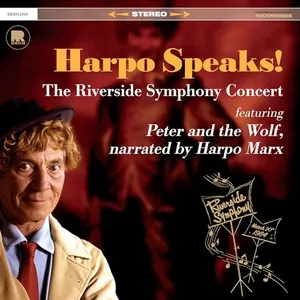
Harpo Speaks! - The Riverside Symphony Concert featuring Peter and the Wolf
Harpo Speaks! is the result of heroic archival work. Recently discovered by longtime Marx Brother archivist John Tefteller, he and Marx biographer and expert Robert Bader set out to restore the long lost recording.
Harpo concluded the concert with a version of “Red’s Speech” in which he thanked the audience for “the keenness and perspicacity which you have shown in recognizing true genius.” And those concertgoers may have been the only ones to hear his remarks were it not for Marx Brothers archivist John Tefteller.
“It was real serendipity, extreme luck,” says Tefteller, who is presently producing a set of every known available appearance of the Marx Brothers on radio. One of the world’s leading collectors of blues, R&B and rock ’n’ roll 78s and 45s, Tefteller was once dubbed “the Sherlock of Shellac.”
In 2020, Tefteller sold a recording of entertainer Allan Sherman—the “Weird Al” Yankovic of his day, a Grammy-winning song parodist whose 1962 debut album was the fastest selling record of its time—on eBay, and the buyer happened to be Sherman’s son, Robert.
The elder Sherman and Harpo were friends, and they did two shows together in January 1963 in Santa Monica and Pasadena. At the latter show, Harpo took Sherman aside and told him, prematurely, apparently, that this would be his final performance. The audience was stunned when Sherman relayed the news. In what he thought would be his farewell to performing, Harpo concluded the concert with an emotional version of “Red’s Speech.”
Knowing their importance in Marx Brothers lore, Tefteller recalls asking the younger Sherman if he had private recordings of these performances.
“He said, ‘Absolutely,’” Tefteller recalls. He “invited me to come to his home to make a copy. Robert had this tape labeled ‘Harpo’s farewell speech at the Pasadena Civic Auditorium,’ but when he played the tape back, I discovered it was the Riverside Symphony concert.”
All Robert Sherman remembers is that someone—maybe Harpo—asked him to record the Riverside Symphony concert. “For some strange reason, I knew how to work reel-to-reel tape recorders at the age of 12,” he says. But then the Harpo recording got mixed in with his father’s tapes, forgotten and unheard.
Once this historic find was discovered, Tefteller shepherded the 60-year-old tape, recorded on a commercial machine that was severely out of calibration, through a meticulous restoration process.
Did you know? A Harpo Marx biography
- Born Adolph Marx on November 23, 1888, in New York City, Harpo earned the nickname as he played the harp in theatrical performances in burlesque and vaudeville.
- The Marx Brothers were nephews of popular performer Al Shean.
- Harpo had little formal musical training or schooling.
- Early in his career, Harpo's wig was dyed pink, then blonde and eventually reddened.
- Harpo died on September 26, 1964, just a few months after his Riverside Symphony appearance.
Daniel Coston, a Marx Brothers fan and co-producer of Harpo Speaks!, sought out Dolph Ramseur, manager of the Avett Brothers and founder of Ramseur Records: “I told Dolph, ‘Look at it this way—you take this record on, and you can say you worked with two of the biggest brother acts in American history, the Avett Brothers and the Marx Brothers.’”
Ramseur grew up in rural North Carolina watching the Marx Brothers on local broadcasts. He found them to be “a breath of fresh air,” he says.
He credits director Judd Apatow as having influenced his decision to release the album. Apatow directed a documentary about the Avett Brothers as well as a series of documentaries on comedy icons George Carlin, Garry Shandling and Mel Brooks. “It is important to preserve these legacies,” Ramseur says, “and with this release, I feel I am doing the same. Whether this album is profitable or not isn’t the point. This recording simply needs to be available. It pulls back the curtain on a side of Harpo most of his fans have never heard before.”
Bill Marx agrees. He cried when he was presented with a copy of the album. “[My father] has meant much more to me every day,” he says. “I think how fortunate I was to be in his presence. Everyone he ever touched in his life had nothing but good things to say about him.”
As for the recording of Harpo’s first farewell concert at the Pasadena Civic Auditorium? The search continues.
Editor's note, June 15, 2025: This story has been updated to correct Harpo's age when he died. He was 75, not 70.

A Note to our Readers
Smithsonian magazine participates in affiliate link advertising programs. If you purchase an item through these links, we receive a commission.