
A Prayer for the Ganges
Across India, environmentalists battle a tide of troubles to clean up a river revered as the source of life
/https://tf-cmsv2-smithsonianmag-media.s3.amazonaws.com/accounts/headshot/Screen_Shot_2021-09-15_at_12.44.05_PM.png)
/https://tf-cmsv2-smithsonianmag-media.s3.amazonaws.com/filer/ganges-main-631.jpg)
A blue stream spews from beneath brick factory buildings in Kanpur, India. The dark ribbon curls down a dirt embankment and flows into the Ganges River. "That's toxic runoff," says Rakesh Jaiswal, a 48-year-old environmental activist, as he leads me along the refuse-strewn riverbank in the vise-like heat of a spring afternoon. We're walking through the tannery district, established along the Ganges during British colonial rule and now Kanpur's economic mainstay as well as its major polluter.
I had expected to find a less-than-pristine stretch of river in this grimy metropolis of four million people, but I'm not prepared for the sights and smells that greet me. Jaiswal stares grimly at the runoff—it's laden with chromium sulfate, used as a leather preservative and associated with cancer of the respiratory tract, skin ulcers and renal failure. Arsenic, cadmium, mercury, sulfuric acid, chemical dyes and heavy metals can also be found in this witches' brew. Though Kanpur's tanneries have been required since 1994 to do preliminary cleanup before channeling wastewater into a government-run treatment plant, many ignore the costly regulation. And whenever the electricity fails or the government's waste conveyance system breaks down, even tanneries that abide by the law find that their untreated wastewater backs up and spills into the river.
A few yards upstream, we follow a foul odor to a violent flow of untreated domestic sewage gushing into the river from an old brick pipe. The bubbling torrent is full of fecal microorganisms responsible for typhoid, cholera and amoebic dysentery. Ten million to 12 million gallons of raw sewage have been pouring out of this drainpipe each day, Jaiswal tells me, since the main sewer line leading to the treatment plant in Kanpur became clogged—five years ago. "We've been protesting against this, and begging the [Uttar Pradesh state] government to take action, but they've done nothing," he says.
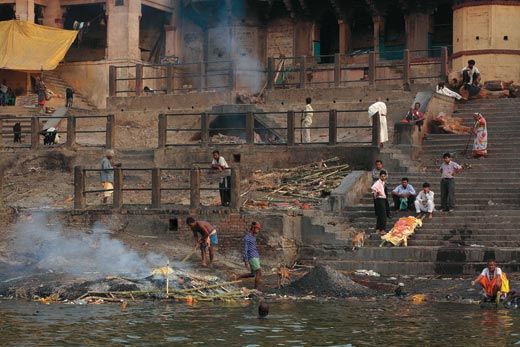
Half a dozen young fishermen standing by a rowboat offer to take us to a sandbar in the middle of the Ganges for "a better view." Jaiswal and I climb into the boat and cross the shallow river only to run aground 50 yards from the sandbar. "You have to get out and walk from here," a boatman tells us. We remove our shoes, roll up our trousers and nervously wade knee-deep in the toxic stream. As we reach the sandbar, just downstream from a Hindu cremation ground, we're hit by a putrid smell and a ghastly sight: lying on the sand are a human rib cage, a femur, and, nearby, a yellow-shrouded corpse. "It's been rotting there for a month," a fisherman tells us. The clothed body of a small child floats a few yards off the island. Although the state government banned the dumping of bodies a decade ago, many of Kanpur's destitute still discard their loved ones clandestinely at night. Pariah dogs prowl around the bones and bodies, snarling when we get too close. "They live on the sandbar, feeding on the remains," a fisherman tells us.
Sickened, I climb back into the rowboat. As we near the tanneries, a dozen boys frolic in the water, splashing in the river's foulest stretch. Jaiswal calls them over.
"Why do you swim in the river?" I ask one of the boys. "Aren't you worried?"
He shrugs. "We know it's poisonous," he says, "but after we swim we go wash off at home."
"Do you ever get ill?"
"We all get rashes," he replies, "but what can we do?"
Walking back toward the main road, Jaiswal seems despondent. "I would never have imagined the River Ganga could get like this, with stinking water, green and brown colored," he says. "It's pure toxic muck."
I shake my head at the irony. For more than two millennia, the River Ganges has been revered by millions as a symbol of spiritual purity. Originating in the frozen heights of the Himalayas, the river travels 1,600 miles across the teeming plains of the subcontinent before flowing east into Bangladesh and from there spilling into the Bay of Bengal. "Mother Ganga" is described by ancient Hindu scriptures as a gift from the gods—the earthly incarnation of the deity Ganga. "Man becomes pure by the touch of the water, or by consuming it, or by expressing its name," Lord Vishnu, the four-armed "All Pervading One," proclaims in the Ramayana, the Sanskrit epic poem composed four centuries before Christ. Modern admirers have written paeans to the river's beauty, historical resonance and holiness. "The Ganges is above all the river of India, which has held India's heart captive and drawn uncounted millions to her banks since the dawn of history," Jawaharlal Nehru, India's first prime minister, proclaimed.
For some time now, this romantic view of the Ganges has collided with India's grim realities. During the past three decades, the country's explosive growth (at nearly 1.2 billion people, India's population is second only to China's), industrialization and rapid urbanization have put unyielding pressure on the sacred stream. Irrigation canals siphon off ever more of its water and its many tributaries to grow food for the country's hungry millions. Industries in the country operate in a regulatory climate that has changed little since 1984, when a Union Carbide pesticide plant in the northern city of Bhopal leaked 27 tons of deadly methyl isocyanate gas and killed 20,000 people. And the amount of domestic sewage being dumped into the Ganges has doubled since the 1990s; it could double again in a generation.
The result has been the gradual killing of one of India's most treasured resources. One stretch of the Yamuna River, the Ganges' main tributary, has been devoid of all aquatic creatures for a decade. In Varanasi, India's most sacred city, the coliform bacterial count is at least 3,000 times higher than the standard established as safe by the United Nations World Health Organization, according to Veer Bhadra Mishra, an engineer and Hindu priest who's led a campaign there to clean the river for two decades. "Polluted river water is the biggest cause of skin problems, disabilities and high infant mortality rates," says Suresh Babu, deputy coordinator of the River Pollution Campaign at the Center for Science and the Environment, a watchdog group in New Delhi, India's capital. These health problems are compounded by the fact that many Hindus refuse to accept that Mother Ganga has become a source of illness. "People have so much faith in this water that when they bathe in it or sip it, they believe it is the nectar of God [and] they will go to heaven," says Ramesh Chandra Trivedi, a scientist at the Central Pollution Control Board, the monitoring arm of India's Ministry of the Environment and Forests.
Twenty years ago, then prime minister Rajiv Gandhi launched the Ganga Action Plan, or GAP, which shut down some of the most egregious industrial polluters and allocated about $100 million for constructing wastewater treatment plants in 25 cities and towns along the river. But these efforts have fallen woefully short. According to a 2001-2002 government survey, the treatment plants could handle only about a third of the 600 million gallons of domestic sewage that poured into them every day. (The volume has increased significantly since then). Many environmentalists say that the Ganges has become an embarrassing symbol of government indifference and neglect in a country that regards itself as an economic superpower. "We can send a shuttle into space, we can build the [new] Delhi Metro [subway] in record time. We can detonate nuclear weapons. So why can't we clean up our rivers?" Jaiswal laments. "We have money. We have competence. The only problem is that the issue is not a priority for the Indian government."
Early in 2007 the Ganges' worsening state made headlines around the world when Hindu holy men, known as sadhus, organized a mass protest against river filth during the Kumbh Mela festival. "The river had turned the color of Coca-Cola," says scientist Trivedi, who attended the festival and, against the advice of his colleagues at the Central Pollution Control Board, took a brief dip in the Ganges. ("I was not affected at all," he insists.) The sadhus called off the protests after the government opened dams upstream, diluting the fetid water, and ordered another 150 upstream industrial polluters to close. "But it was a short-term solution," says Suresh Babu. "It didn't achieve anything."
This past May, I followed Mother Ganga downstream for 800 miles, half its distance, to witness its deterioration firsthand and to meet the handful of environmentalists who are trying to rouse public action. I began my journey high in the foothills of the Himalayas, 200 miles south of the river's glacial source. Here the cold, pristine water courses through a steep gorge cloaked in gray-green forests of Shorea robusta, or sal trees. From a beach at the edge of a litchi grove below the Glass House, an inn where I stayed, I watched rafts of helmet-clad adventure-tourists sweep past on a torrent of white water.
Fifteen miles downriver, at Rishikesh, the valley widens, and the Ganges spills onto the northern Indian plain. Rishikesh achieved worldwide attention in 1968, when the Beatles, at the height of their fame, spent three months at the now-abandoned ashram, or meditation center, run by the guru Maharishi Mahesh Yogi (who today resides in the Netherlands). Built illegally on public land and confiscated by the government in the 1970s, the ruined complex rises on a thickly wooded hillside overlooking the Ganges. The place has been unoccupied ever since it was seized—an intragovernmental dispute has prevented its being sold or developed as a tourist resort—but I gave 50 rupees, about $1.25, to a guard, and he unlocked the gate for me. I wandered among derelict, stupa-like meditation chambers high above the river, which still conveyed a sense of tranquillity. Baboons prowled the ghostly hallways of the Maharishi's once-luxurious hotel and conference center, which was topped by three domes tiled in white mosaic. The only sounds were the chorusing of cuckoos and the cawing of ravens.
It's unlikely the surviving Beatles would recognize the busy, litter-strewn tourist town that Rishikesh has become. Down below the ashram, I strolled through a riverside strip of pilgrims' inns, cheap restaurants selling banana lassis and pancakes, and newly built yoga schools. A boat packed with Indian pilgrims, wild-haired sadhus and Western backpackers ferried me across the river, where I walked past dozens of storefronts offering rafting trips and Himalayan treks. A building boom over the past two decades has generated a flood of pollutants and nonbiodegradable trash. Each day thousands of pilgrims drop flowers in polyethylene bags into the river as offerings to Goddess Ganga. Six years ago, Jitendra Kumar, a local ashram student, formed Clean Himalaya, a nonprofit environmental group that gathers and recycles tons of garbage from hotels and ashrams every day. But public apathy and a shortage of burning and dumping facilities have made the job difficult. "It's really sad," Vipin Sharma, who runs a rafting and trekking company (Red Chili Adventures), told me. "All of our Hindus come with this feeling that they want to give something to the Ganga, and they've turned it into a sea of plastic."
From his base in Kanpur, Rakesh Jaiswal has waged a lonely battle to clean up the river for almost 15 years. He was born in Mirzapur, 200 miles downstream from Kanpur, and remembers his childhood as an idyllic time. "I used to go there to bathe with my mother and grandmother, and it was beautiful," he told me. "I didn't even know what the word 'pollution' meant." Then, one day in the early 1990s, while studying for his doctorate in environmental politics, "I opened the tap at home and found black, viscous, stinking water coming out. After one month it happened again, then it was happening once a week, then daily. My neighbors experienced the same thing." Jaiswal traced the drinking water to an intake channel on the Ganges. There he made a horrifying discovery: two drains carrying raw sewage, including contaminated discharge from a tuberculosis sanitarium, were emptying right beside the intake point. "Fifty million gallons a day were being lifted and sent to the water-treatment plant, which couldn't clean it. It was horrifying."
At the time, the Indian government was touting the first phase of its Ganga Action Plan as a success. Jaiswal knew otherwise. Kanpur's wastewater treatment plants broke down frequently and could process only a small percentage of the sewage the city was producing. Dead bodies were being dumped into the river by the hundreds every week, and most of the 400 tanneries continued to pour toxic runoff into the river. Jaiswal, who started a group called EcoFriends in 1993 and the next year received a small grant from the Indian government, used public outrage over contaminated drinking water to mobilize a protest campaign. He organized rallies and enlisted volunteers in a river cleanup that fished 180 bodies out of a mile-long stretch of the Ganges. "The idea was to sensitize the people, galvanize the government, find a long-term solution, but we failed to evoke much interest," he told me. Jaiswal kept up the pressure. In 1997, state and local government whistle-blowers slipped him a list of factories that had ignored a court order to install treatment plants; the state ordered the shutdown of 250 factories, including 127 tanneries in Kanpur. After that, he says, "I got midnight phone calls telling me, 'you will be shot dead if you don't stop these things.' But I had friends in the police and army who believed in my work, so I never felt my life was in real danger."
Jaiswal's battle to clean up the Ganges has achieved some successes. Largely because of his corpse-cleanup drive, a cemetery was established beside the Ganges—it now contains thousands of bodies—and a ban was enforced, obviously often violated, on "floaters." In 2000, the second phase of the Ganga Action Plan required 100 large- and medium-sized Kanpur tanneries to set up chrome-recovery facilities and 100 smaller ones to build a common chrome-recovery unit. Enforcement, however, has been lax. Ajay Kanaujia, a government chemist at Kanpur's wastewater treatment facility, says that "some tanneries are still putting chrome into the river without any treatment or dumping it into the domestic sewage system." This treated sewage is then channeled into canals that irrigate 6,000 acres of farmland near Kanpur before flowing back into the Ganges. India's National Botanical Research Institute, a government body, has tested agricultural and dairy products in the Kanpur area and found that they contain high levels of chromium and arsenic. "The irrigation water is dangerous," Kanaujia says.
I'm in a motorboat at dawn, putt-putting down the Ganges in Varanasi, where the river takes a turn north before flowing into the Bay of Bengal. Called Benares by the British, this ancient pilgrimage center is the holiest city in India: millions of Hindus come each year to a three-mile long curve of temples, shrines and bathing ghats (steps leading down to the river) along its banks. With a boatman and a young guide, I cruise past a Hindu Disneyland of Mogul-era sandstone fortresses and green, purple and candy cane-striped temples. None of the pilgrims sudsing themselves in the Ganges, bobbing blissfully in inner tubes or beating their laundry on wooden planks, seem to pay the slightest attention to the bloated cow carcasses that float beside them—or to the untreated waste that gushes directly into the river. If toxic industrial runoff is Kanpur's special curse, the befouling of the Ganges as it flows past the Hindus' holiest city comes almost entirely from human excreta.
The boat deposits me at Tulsi Ghat, near the upriver entrance to Varanasi, and in the intensifying morning heat, I walk up a steep flight of steps to the Sankat Mochan Foundation, which, for the past two decades, has led Varanasi's clean-river campaign. The foundation occupies several crumbling buildings, including a 400-year-old Hindu temple high over the Ganges. I find the foundation's director, Veer Bhadra Mishra, 68, sitting on a huge white cushion that takes up three-quarters of a reception room on the temple's ground floor. Draped in a simple white dhoti, he invites me to enter.
Mishra looks at the river from a unique perspective: he is a retired professor of hydraulic engineering at Banaras Hindu University and a mohan, a Hindu high priest at the Sankat Mochan Temple, a title that the Mishra family has passed from father to eldest son for seven generations. Mishra has repeatedly called the Ganga Action Plan a failure, saying that it has frittered away billions of rupees on ill-designed and badly maintained wastewater treatment plants. "The moment the electricity fails, the sewage flows into the river, and on top of that, when the floodwaters rise, they enter the sump well of the sewer system pumps and stop operations for months of the year," he tells me. (Varanasi currently receives only about 12 hours of power a day.) Moreover, he says, engineers designed the plants to remove solids, but not fecal microorganisms, from the water. The pathogens, channeled from treatment plants into irrigation canals, seep back into the groundwater, where they enter the drinking-water supply and breed such diseases as dysentery, as well as skin infections.
A decade ago, Mishra, with hydraulic engineers and scientists at the University of California at Berkeley, designed a water-treatment scheme that, he says, is far better suited to Varanasi's needs. Known as an "advanced integrated wastewater pond system," the process relies primarily on gravity to carry domestic sewage three miles downstream to four huge pools where oxygen-enriched bacteria break it down and pathogens are killed by sunlight and natural atmospheric action in a "maturation" pond. The projected cost of the system, which has been endorsed by the Varanasi municipal government, is $60 million.
Mishra was named one of Time magazine's Heroes of the Planet in 1999; in 2000, President Clinton praised him for his environmental work. But in spite of the honors that have come his way, Mishra has grown discouraged. The national government and the state government of Uttar Pradesh, which would have to fund the wastewater project, have openly opposed it on grounds ranging from doubts about the proposed technology to objections that treatment ponds would lie in a flood plain.
Meanwhile, the city's population keeps growing—it has doubled to three million in a generation—along with the bacteria count. Mishra says he's especially concerned for the future of India's most devout Hindus, whose lives are entirely focused on Mother Ganga. He calls them an endangered species. "They want to touch the water, rub their bodies in the water, sip the water," he says, "and someday they will die because of it," admitting that he himself takes a dip in the river every morning. "If you tell them 'the Ganga is polluted,' they say, 'we don't want to hear that.' But if you take them to the places where open sewers are giving the river the night soil of the whole city, they say, 'this is disrespect done to our mother, and it must be stopped.'"
But how? Suresh Babu of the Center for Science and the Environment in New Delhi believes that if municipalities were obliged to draw their drinking water from downstream rather than upstream, "they would feel an obligation" to keep the river clean. But growing pressures on the Ganges seem destined to outstrip all efforts to rescue it. By 2030, according to Babu, India will draw eight times the amount of water from the Ganges it does today. In the same time, the population along the river and its tributaries—up to 400 million, or one-third of India's total population—could double. Trivedi admits that the government "lacks a single coherent plan" to clean up the river.
Rakesh Jaiswal tells me that after all the years of small achievements and large setbacks, he finds it difficult to remain optimistic. "My friends tell me I've made a difference, but the river looks worse today than when I started," he says. In 2002, the Ford Foundation gave him enough money to hire 15 employees. But the next year, when the foundation cut its Environmental Equity and Justice Program, Jaiswal had to let his staff go and now works with one assistant out of a bedroom in his sister's house near the river. On his dresser stands a framed photograph of his wife, Gudrun Knoessel, who is German. In 2001, she contacted him after seeing a German TV documentary about his work; a long-distance courtship led to their marriage in 2003. They see each other two or three times a year. "She has a job in Baden-Baden," he explains. "And Kanpur needs me." So he often tells himself. But sometimes, in darker moments, he wonders if anybody really cares.
Writer Joshua Hammer is based in Berlin, Germany. Photographer Gary Knight lives in the South of France.
/https://tf-cmsv2-smithsonianmag-media.s3.amazonaws.com/accounts/headshot/Screen_Shot_2021-09-15_at_12.44.05_PM.png)
Planning Your Next Trip?
Explore great travel deals
A Note to our Readers Smithsonian magazine participates in affiliate link advertising programs. If you purchase an item through these links, we receive a commission.