
Bamboo Steps Up
An ancient plant becomes a new sensation
/https://tf-cmsv2-smithsonianmag-media.s3.amazonaws.com/filer/bamboo-631.jpg)
When producer Lesley Chilcott accepted the Oscar in 2007 for best documentary, "An Inconvenient Truth," it was perhaps fitting that she was wearing a dress made from bamboo. Yes, bamboo.
"Bamboo is not what we in the United States have imagined it to be," says Jackie Heinricher, owner of Boo-Shoot Gardens, a nursery in Mount Vernon, 60 miles north of Seattle. In 1880 Thomas Edison may have used a carbonized bamboo filament in the first light bulb—still burning in the Smithsonian—but for years bamboo was denigrated as the "poor man's timber," relegated to cheap lawn furniture and chintzy restaurant décor.
Today, influenced by its availability, low cost, versatility and eco-friendly credentials, the Western world is taking a fresh look at bamboo. You might say that bamboo has had a career change. "It has become the material of choice for fashions, flooring, skateboards, bicycles and buildings."
Not bad accomplishments for grass. Because that's what bamboo is: giant grass, a member of the Poaceae family. With over 1,000 species, bamboo ranges from feathery ground covers to tall timbers over 100 feet. It has two root systems. Runners stretch exuberantly-- and make the home gardener crazy. Clumpers spread more slowly. It grows in temperate and tropical climates, and can be found at sea level and on mountaintops 13,000 feet high. Bamboo is self-sustaining. Its extensive root system sends up new shoots annually, so it doesn't need to be replanted.
Bamboo is also the fastest growing plant on the planet. (Giant kelp comes in second.) One waist-high bamboo plant grew 42 inches in 24 hours. So instead of taking centuries to mature, like hardwood trees, bamboo reaches a useful height in three to five years. Bamboo can also be harvested selectively and manually, without leaving denuded swathes of land behind. (Most of the exported bamboo comes from forests in China with India a distant second.)
Its short growth cycle and sustainability are why architects and environmentalists are looking at bamboo as a replacement for timber. "Bamboo has the same utility as hardwood," says Daniel Smith, president of San Francisco-based Smith & Fong Plyboo, producers of bamboo flooring, plywood and paneling, "and costs about the same as grade A red oak." Some are using bamboo for more than flooring. Colombian architect Simon Velez recently created the largest bamboo structure ever built: the Nomadic Museum in Mexico City.
Bamboo's environmental report card keeps getting A's. It can be grown without chemical pesticides and fertilizers. Its net-like root system prevents erosion on steep surfaces and makes a bamboo grove a safe haven in an earthquake. It can detoxify wastewater, thanks to its high nitrogen consumption. It sequesters four times as much carbon as hardwood trees, and generates up to 35 percent more oxygen.
All these "green" qualities are causing people to jump on the bamboo bandwagon, but there are some caveats. While bamboo itself may be "green," many of the methods used to take the raw material from grove to marketplace are not. Cloth from bamboo is soft as silk and more absorbent than cotton, but the fibers are made in a rayon-like process that uses chemicals and solvents. Formaldehyde is used in the making of plywood. "People say they want bamboo flooring in their whole house," says Nancy Moore Bess, Arts & Crafts Coordinator of the American Bamboo Society and herself an artist who works with bamboo. "Not all bamboo floors are the same. Consumers should check that the product is made responsibly." And shipping the raw material from Asia to the U.S. adds to global warming.
"But we don't have to do that," says Boo-Shoots' Heinricher. "We could actually be farming it ourselves." Propagation from seed is not viable because bamboo flowers only once every 60 to 100 years. For eight years, Heinricher and her partner, Randy Burr, have been perfecting a method of tissue culture that produces reliable plants in large quantities. It takes about a month for the tiny sliver of bamboo placed in a nutrient soup to become dozens of plants. To date her clients have been nurseries but "we're getting some interest from Asia," she says.
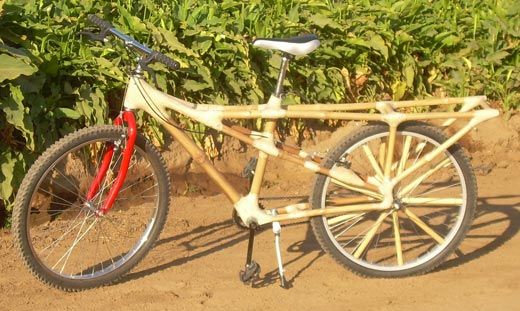
Given that bamboo is native to every continent except Europe and Antarctica, groups like the International Network for Bamboo and Rattan (INBAR) are looking for ways to use bamboo to create sustainable economies on a local level. Californian bike-builder Craig Calfee has already started a project. Last year Calfee, with support from the Earth Institute at Columbia University, initiated the Bamboo Bike Project. In March he returned from a second visit to Ghana where he helped Ghanaians build the first fully functional bamboo bike made in Africa by Africans. The hope is that eventually villagers will be able to sell these bikes to each other and even to tourists. "People want some economic benefit from bamboo so they won't have to illegally cut bigger trees to sell to the lumber market, Calfee says. Villagers were also impressed with the strength of the bike: a rider was able to deliver two 110 pound bags of cement to a man building a house.
"Bamboo is the most egalitarian crop around," says Adam Turtle, co-owner of Tennessee-based Earth Advocates Research Farm. Asian cultures have incorporated bamboo into their daily lives for millennia. "Most traditional bamboo working communities have a huge range of bamboo products, from the knife to cut a baby's umbilical cord, to the stretcher that carries him when he passes on," says Rebecca Reubens, coordinator of INBAR's Global Marketing Initiative.
Will bamboo become such an integral part of Western culture? "Bamboo is not a trend; it is here to stay," says Plyboo's Smith. "It's going to continue to affect every aspect of a wide range of people's lives."