• Smithsonian
    Institution
  • Travel
    With Us
  • Smithsonian
    Store
  • Smithsonian
    Channel
  • goSmithsonian
    Visitors Guide
  • Air & Space
    magazine

Smithsonian.com

  • Subscribe
  • History & Archaeology
  • Science
  • Ideas & Innovations
  • Arts & Culture
  • Travel & Food
  • At the Smithsonian
  • Photos
  • Videos
  • Games
  • Shop
  • People & Places

It's in the Bag

Sports Illustrated photographer Neil Leifer hit a grand slam when he set out to capture a double play on film

| | | Reddit | Digg | Stumble | Email |
  • By Owen Edwards
  • Smithsonian magazine, July 2008, Subscribe
View More Photos »
Willie Davis in mid-slide
Leifer's "handy" father helped rig the camera that caught the Dodgers' Willie Davis in mid-slide (Neil Leifer)

Photo Gallery (1/2)

Willie Davis in mid-slide

Explore more photos from the story

Related Books

Ballet in the Dirt: The Golden Age of Baseball

by Neil Leifer
Taschen, 2007

More from Smithsonian.com

  • The Sodfather
  • Olympic Athletes Who Took a Stand
  • Baseball’s Bat Man

(Page 2 of 2)

Leifer shot for Sports Illustrated from 1960 until he left in 1978 to make his mark photographing everything from politics to wildlife for other titles in the Time-Life family. His dad died in 1982. By the time the younger Leifer left Time Inc. in 1990 (to concentrate on filmmaking, both documentaries and shorts), he had produced more than 200 covers for the company's magazines—and an archive that suggests nobody got inside baseball better than he did.

Owen Edwards is a frequent contributor to Smithsonian.
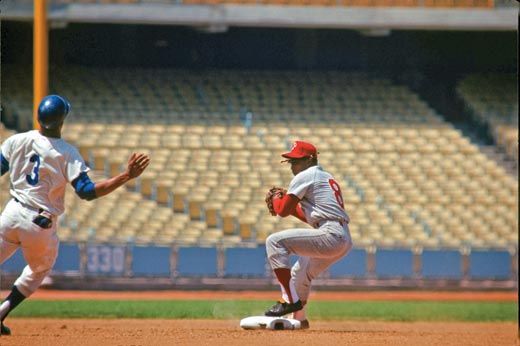

More than the home run, more than the strikeout, the double play distills the physicality of baseball. The instant the ball is hit, the fielders strive for timing and precision; the base runners strive for speed and disruption. When the lead runner launches himself cleats-first toward second base, it's like flashing a switchblade during a pas de deux.

Neil Leifer may appreciate the moment more keenly than even some of the countless major leaguers who have executed the double play over baseball generations. In 1965, Leifer figured out how to get a worm's-eye view of one. His ingenious methodology yielded just one image, but that was enough to capture what no photographer had captured before.

Leifer is both an artist and a techie, with an eye for iconic moments and a head for inventing ways to capture them. When the Houston Astros started playing in a domed stadium in 1965, he was quick to realize that he could shoot from a gondola mounted directly above the diamond—and did, to stirring effect. Using Life magazine's gargantuan 2000-millimeter lens in the late 1960s, he stationed himself in the center field bleachers to focus on where the pitch reached the catcher's mitt, a vantage point now standard for TV broadcasts. "Neil was the photojournalistic equivalent of Alfred Hitchcock, with shots like the overhead angle in Psycho," says Gabriel Schechter, a writer who contributed to a new collection of Leifer's baseball pictures, Ballet in the Dirt: The Golden Age of Baseball.

Born in New York City in 1942 and raised on the Lower East Side of Manhattan, Leifer grew up watching ballgames with his father, Abraham, a postal worker, at the Polo Grounds (home of his father's beloved Giants) and Ebbets Field (home of the Dodgers). Leifer remembers taking a picture of Jackie Robinson on Camera Day at a Dodgers game when he was 13. The young photographer received training in technique at the Henry Street Settlement in New York and began selling photos as a teenager. At 18, he scored his first Sports Illustrated cover (of New York Giants quarterback Y. A. Tittle).

Leifer almost had to align the planets to get his double-play photograph at Dodgers Stadium, in Los Angeles, on April 25, 1965. He had brought his father to the game to watch the Dodgers take on the Philadelphia Phillies. "It was his first trip to the West Coast," Leifer says. "Dad hadn't yet gotten over the Dodgers and the Giants moving to California, but it was a thrill for him to be there anyway." Abraham Leifer was "handy at building stuff," so the photographer asked him to put together a small wooden box that could be put into a space carved out of the padding in the second base bag. Into the box went a Leica connected—through wires buried a few inches under the infield dirt—to a remote release behind first base. (Dodgers officials, Leifer says, were keen to cooperate with Sports Illustrated, and seemingly indifferent to any travails this imposed on the groundskeepers.) "I used a 21-millimeter lens"—a wide-angle lens—"because I wanted to get the stands as well as the play," Leifer recalls. "My father actually had the remote release, while I was shooting with another camera."

A classic double play developed in the third inning. With Willie Davis—the Dodgers' great center fielder and then the fastest man in baseball—on first, batter Tommy Davis poked the ball to the infield. With perfect timing, Leifer père hit the remote release and caught Willie Davis launching into his slide toward the fielder's foot.

"We got the shot," Leifer recalls. But Davis hit the bag so hard he knocked the Leica out of place, so "that picture was the only one we got." (For the record, the Phillies got the two outs, and eventually the win, 6-4.) The image went unpublished in Sports Illustrated—it "just didn't fit into a particular story," Leifer says—and so makes its print debut in Ballet in the Dirt.

Did Davis see the camera? "No, I couldn't pay attention to stuff like that," he says. "I put a notebook together of all the ways to slide, so when I slid into base, I put everything together in a split second. In my mind, it was as if I'd already done it before I did it." Davis, 68, retired from the majors in 1979 and lives in Burbank, California, near his old team's stadium.

Leifer shot for Sports Illustrated from 1960 until he left in 1978 to make his mark photographing everything from politics to wildlife for other titles in the Time-Life family. His dad died in 1982. By the time the younger Leifer left Time Inc. in 1990 (to concentrate on filmmaking, both documentaries and shorts), he had produced more than 200 covers for the company's magazines—and an archive that suggests nobody got inside baseball better than he did.

Owen Edwards is a frequent contributor to Smithsonian.


Single Page « Previous 1 2

    Subscribe now for more of Smithsonian's coverage on history, science and nature.


Related topics: Photojournalists Baseball


| | | Reddit | Digg | Stumble | Email |
 

Add New Comment


Name: (required)

Email: (required)

Comment:

Comments are moderated, and will not appear until Smithsonian.com has approved them. Smithsonian reserves the right not to post any comments that are unlawful, threatening, offensive, defamatory, invasive of a person's privacy, inappropriate, confidential or proprietary, political messages, product endorsements, or other content that might otherwise violate any laws or policies.

Comments (2)

Nice piece. However you neglected to credit Neil Leifer's 1958 photo of Baltimore Colt fullback Alan "the Horse" Ameche's game winning touchdown (in sudden death overtime) in National Football League World Championship game against the New York Giants. Mr. Leifer was sixteen years old when he captured that image.

Posted by Mitchell Bober on July 22,2008 | 02:19 PM

As an old timer, I find it refreshing to see the second baseman's full shoe and not a droopy pant leg covering most of said shoe. In my mind, makes the picture that much better.

Posted by Jack Ledeboer on July 18,2008 | 05:16 PM

Thank you, Neil Leifer, for capturing that moment. And thank you, Smithsonian Magazine, for bringing it to me. As a 16-year-old, I may have been at that game. The Dodgers were our guys and the Davises (Willie and Tommy, numbers 3 and 12) kept the bottom innings of the home games intense. Incredible that the photo wasn't printed at the time, I'm just thankful that you saw fit to profile Mr. Leifer and introduce us to another man from behind the camera. I've absorbed much over the years from this monthly feature, facts both technical and otherwise. JJ

Posted by Jackie on July 2,2008 | 01:35 PM


Advertisement


Most Popular

  • Viewed
  • Emailed
  • Commented
  1. Why Are Finland's Schools Successful?
  2. PHOTOS: The Distressing Worldwide Boom in Cosmetic Surgery
  3. How a Missile Silo Became the Most Difficult Interior Decorating Job Ever
  4. To Be or Not to Be Shakespeare
  5. Keepers of the Lost Ark?
  6. What Became of the Taíno?
  7. Black History and Heritage Month
  8. Capturing Appalachia's "Mountain People"
  9. The Secrets Behind Your Flowers
  10. Children of the Vietnam War
  1. Keepers of the Lost Ark?

View All Most Popular »

Advertisement

Follow Us

Smithsonian Magazine
@SmithsonianMag
Follow Smithsonian Magazine on Twitter

Sign up for regular email updates from Smithsonian.com, including daily newsletters and special offers.

In The Magazine

February 2013

  • The First Americans
  • See for Yourself
  • The Dragon King
  • America’s Dinosaur Playground
  • Darwin In The House

View Table of Contents »


First Name
Last Name
Address 1
Address 2
City
State   Zip
Email


Travel with Smithsonian


Smithsonian Store

Framed Lincoln Tribute

This Framed Lincoln Tribute includes his photograph, an excerpt from his Gettysburg Address, two Lincoln postage stamps and four Lincoln pennies... $40


View full archiveRecent Issues


  • Feb 2013


  • Jan 2013


  • Dec 2012

Newsletter

Sign up for regular email updates from Smithsonian magazine, including free newsletters, special offers and current news updates.

Subscribe Now

About Us

Smithsonian.com expands on Smithsonian magazine's in-depth coverage of history, science, nature, the arts, travel, world culture and technology. Join us regularly as we take a dynamic and interactive approach to exploring modern and historic perspectives on the arts, sciences, nature, world culture and travel, including videos, blogs and a reader forum.

Explore our Brands

  • goSmithsonian.com
  • Smithsonian Air & Space Museum
  • Smithsonian Student Travel
  • Smithsonian Catalogue
  • Smithsonian Journeys
  • Smithsonian Channel
  • About Smithsonian
  • Contact Us
  • Advertising
  • Subscribe
  • RSS
  • Topics
  • Member Services
  • Copyright
  • Site Map
  • Privacy Policy
  • Ad Choices

Smithsonian Institution