
/https://tf-cmsv2-smithsonianmag-media.s3.amazonaws.com/filer_public/eb/07/eb072ca5-f39d-4932-9e8c-8a837218c2e0/gettyimages-522660430.jpg)
What You Need to Know About China’s Terra-Cotta Warriors and the First Qin Emperor
The thousands of clay soldiers guarding Qin Shi Huang’s tomb are enduring representations of the ruler’s legacy
:focal(3072x2048:3073x2049)/https://tf-cmsv2-smithsonianmag-media.s3.amazonaws.com/filer_public/eb/07/eb072ca5-f39d-4932-9e8c-8a837218c2e0/gettyimages-522660430.jpg)
In March 1974, a group of peasants digging a well in China’s drought-parched Shaanxi province unearthed fragments of a clay figure—the first evidence of what would turn out to be one of the greatest archaeological discoveries of modern times. Near the unexcavated tomb of Qin Shi Huang—who proclaimed himself first emperor of China in 221 B.C.E.—lay an extraordinary underground treasure: an entire army of life-size terra-cotta soldiers and horses, interred for more than 2,000 years.
The site, where Qin Shi Huang’s ancient capital of Xianyang once stood, lies a half-hour drive from traffic-clogged Xi’an, population nine million. It is a dry, scrubby land, planted with persimmon and pomegranate—bitterly cold in winter and scorching hot in summer—and marked by dun-colored hills pocked with caves. But hotels and a roadside souvenir emporium selling five-foot-tall pottery figures suggest that something other than fruit cultivation is going on here.
Over the past 50 years, archaeologists have located some 600 pits, a complex of underground vaults, across a 22-square-mile area. Some are hard to get to, but three major pits are easily accessible, enclosed inside Emperor Qinshihuang’s Mausoleum Site Museum, constructed around the discovery site and opened in 1979 as the four-acre Museum of Qin Terra-Cotta Warriors and Horses. In one pit, long columns of warriors, reassembled from broken pieces, stand in formation. With their topknots or caps, their tunics or armored vests, their goatees or close-cropped beards, the soldiers exhibit an astonishing individuality. A second pit inside the museum demonstrates how they appeared when they were found: Some stand upright, buried to their shoulders in soil, while others lie toppled on their backs, alongside fallen and cracked clay horses. The site ranks with the Great Wall and Beijing’s Forbidden City as one of China’s premier tourist attractions.
/https://tf-cmsv2-smithsonianmag-media.s3.amazonaws.com/filer_public/f6/4a/f64ae048-e7e2-4f95-97c6-f3fcd3e4a9cc/2010_chine_4567500148.jpeg)
Specimens unearthed from the pits in Xi’an have stunned audiences around the world. Between 2007 and 2009, the British Museum, Atlanta’s High Museum, California’s Bowers Museum, the Houston Museum of Natural Science and the National Geographic Society Museum in Washington, D.C. all hosted traveling exhibitions featuring original terra-cotta warriors. More recently, the soldiers have made appearances at Seattle’s Pacific Science Center, New York City’s Metropolitan Museum of Art and England’s World Museum Liverpool.
Exhibitions have featured statuary—armored officers, infantrymen, and standing and kneeling archers—as well as terra-cotta horses and replicas of intricately detailed bronze chariots, drawn by bronze horses. These artifacts offer a glimpse of the treasure trove that attracts visitors to the Xi’an museum site, where more than 2,000 of the estimated 8,000 warriors have been disinterred so far.
The stupendous find at first seemed to reinforce conventional thinking—that the first emperor had been a relentless warmonger who cared only for military might. As archaeologists have learned, however, that assessment was incomplete. Qin Shi Huang may have conquered China with his army—believed to consist of 500,000-plus men—but he held it together with a civil administration system that endured for centuries. Among other accomplishments, the emperor standardized weights and measures and introduced a uniform writing script.
/https://tf-cmsv2-smithsonianmag-media.s3.amazonaws.com/filer_public/1e/2b/1e2bfebb-eabc-479e-a985-f1c6556eb90a/2015-09-22-091227_-_museum_der_grabanlage_des_qin_shi_huangdi.jpeg)
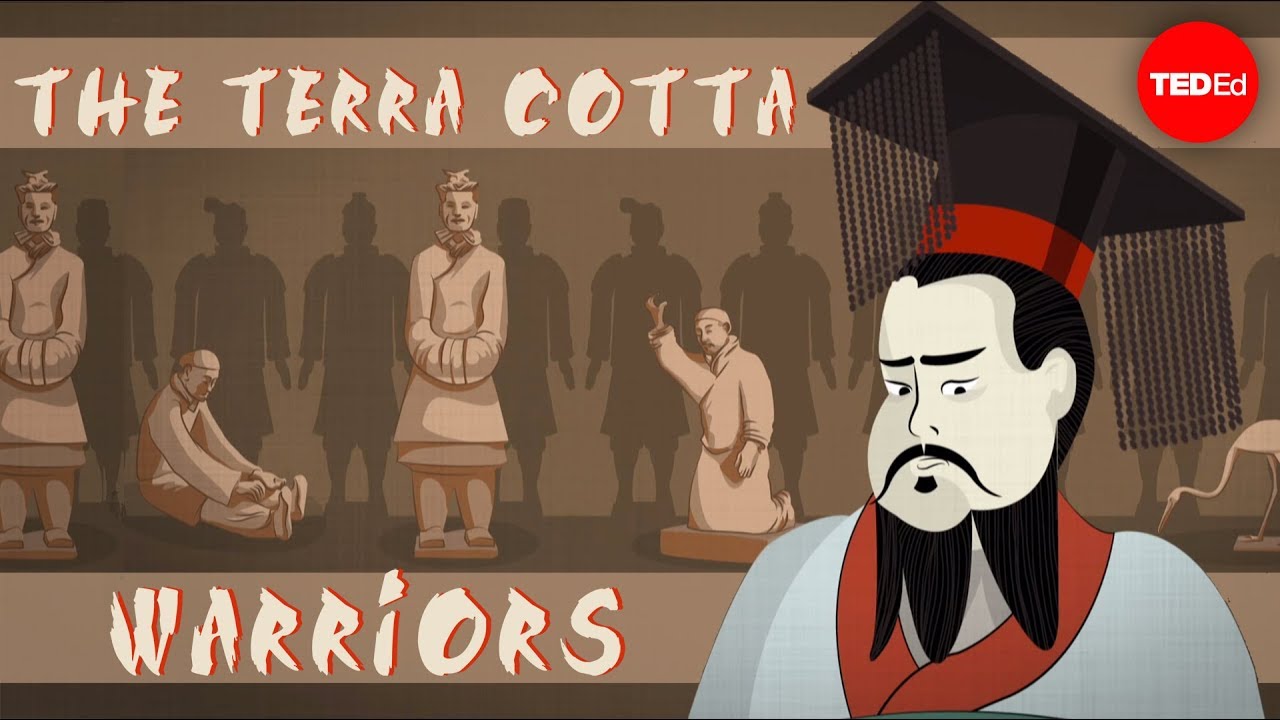
Digs have revealed that in addition to the clay soldiers, Qin Shi Huang’s underground realm, presumably a facsimile of the court that surrounded him during his lifetime, is also populated by delightfully realistic waterfowl, crafted from bronze and serenaded by terra-cotta musicians. The emperor’s clay retinue includes terra-cotta officials and even troupes of acrobats, slightly smaller than the soldiers but created with the same methods. “We find the underground pits are an imitation of the real organization in the Qin dynasty,” says Duan Qingbo, head of the mausoleum excavation team. “People thought when the emperor died, he took just a lot of pottery army soldiers with him. Now they realize he took a whole political system with him.”
Qin Shi Huang decreed a mass-production approach; artisans turned out figures almost like cars on an assembly line. Clay, unlike bronze, lends itself to quick and cheap fabrication. Workers built bodies, then customized them with heads, hats, shoes, mustaches, ears and so on, made in small molds. Some of the figures appear so strikingly individual that they seem modeled on real people, though that is unlikely. “These probably weren’t portraits in the Western sense,” says Hiromi Kinoshita, who helped curate the 2007 exhibition at the British Museum. Instead, they may have been aggregate portraits: The ceramicists, says Kinoshita, “could have been told that you need to represent all the different types of people who come from different regions of China.”
The first emperor’s capital, Xianyang, was a large metropolis, where he reportedly erected more than 270 palaces, of which only a single foundation is known to survive. Each time Qin Shi Huang conquered a rival state, he is said to have transported its ruling families to Xianyang, housing the vanquished in replicas of palaces they had left behind. At the same time, the emperor directed construction of his tomb complex; some 720,000 workers reportedly labored on these vast projects.
/https://tf-cmsv2-smithsonianmag-media.s3.amazonaws.com/filer_public/fd/d4/fdd45365-cf40-40dc-9405-b434067e8b2c/qinshihuang19century.jpeg)
/https://tf-cmsv2-smithsonianmag-media.s3.amazonaws.com/filer_public/da/5d/da5deaf7-9f6c-4c4f-b900-0d87aef4753f/clsoeupview.jpg)
Upon the death of his father, Yiren, in 246 B.C.E., the future Qin Shi Huang—then a 13-year-old prince named Ying Zheng—ascended the throne of the Qin kingdom. Celebrated for its horsemen, Qin sat on the margin of civilization, regarded by its easterly rivals as a semi-savage wasteland. Its governing philosophy was as harsh as its terrain. Elsewhere in China, Confucianism held that a well-run state should be administered by the same precepts governing a family: mutual obligation and respect. Qin rulers, however, subscribed to a doctrine known as legalism, which rested on the administration of punitive laws.
In his early 20s, Ying Zheng turned for guidance to a visionary statesman, Li Si, who likely initiated many of the sovereign’s accomplishments. Under Li’s tutelage, Ying Zheng introduced a uniform script (thereby enabling subjects of vastly different dialects to communicate). Standardization, a hallmark of the Qin state, was applied to weaponry as well: Should an arrow shaft snap or the trigger on a repeating crossbow malfunction, the component could be easily replaced. The young ruler also presided over the creation of an advanced agricultural infrastructure that incorporated irrigation canals and storage granaries.
With methodical zeal, Ying Zheng set about conquering the warring states that surrounded him in the late third century B.C.E. As his armies advanced, principalities fell. No one could thwart consolidation of an empire that eventually stretched from parts of present-day Sichuan in the west to coastal regions along the East China Sea. Having unified the entire civilized world as he knew it, Ying Zheng in 221 B.C.E. renamed himself, adopting the title of huangdi, or emperor.
He then invested in infrastructure and built massive fortifications. His road network likely exceeded 4,000 miles, including 40-foot-wide speedways with a central lane reserved for the imperial family. On the northern frontier, the emperor dispatched his most trusted general to reinforce and connect existing border barriers, creating a bulwark against nomadic marauders. Made of rammed earth and rubble, these fortifications became the basis for the Great Wall, most of which would be rebuilt in stone and brick during the 15th century under the Ming dynasty.
As the grandeur of his tomb complex suggests, Qin Shi Huang kept an eye on posterity. But he also longed to extend his life on earth—perhaps indefinitely. Alchemists informed the emperor that magical herbs could be found on what they claimed were three Islands of the Immortals in the East China Sea. The emissaries most likely to gain entry to this mystical realm, they asserted, were uncorrupted children. Around 219 B.C.E., Qin Shi Huang reportedly dispatched several thousand youngsters to search for the islands. They never returned. A few years later, the emperor sent three alchemists to retrieve the herbs. One of them made it back, recounting a tale of a giant fish guarding the islands. Legend has it that the emperor resolved to lead the next search party himself; on the expedition, he used a repeating crossbow to kill a huge fish. But instead of discovering life-preserving elixirs on his journey, the emperor apparently contracted a fatal illness.
As he lay dying in 210 B.C.E., 49-year-old Qin Shi Huang decreed that his estranged eldest son, Fusu, should inherit the empire. The choice undercut the ambitions of a powerful royal counselor, Zhao Gao, who believed he could govern the country behind the scenes if a more malleable successor were installed. To conceal Qin Shi Huang’s death—and disguise the stench of a decomposing corpse—until the body returned to the capital, Zhao Gao took on a cargo of salted fish. The delaying tactic worked. Once Zhao Gao managed to return to Xianyang, he was able to operate on his home turf. He managed to transfer power to Ying Huhai, a younger, weaker son.
/https://tf-cmsv2-smithsonianmag-media.s3.amazonaws.com/filer_public/b7/5b/b75b2850-f07d-43c3-b7ad-8ada86ac9303/gettyimages-76681496.jpg)
Ultimately, however, the scheme failed. Zhao Gao could not maintain order, and the country descended into civil war. The Qin dynasty outlived Qin Shi Huang by only four years. The second emperor died by suicide; Zhao Gao eventually was killed. Various rebel forces coalesced into a new dynasty, the Western Han.
For archaeologists, one indicator that Qin rule had collapsed suddenly was the extensive damage to the terra-cotta army. As order broke down, marauding forces raided the pits where clay soldiers stood guard and plundered their real weapons. Raging fires, possibly set deliberately, followed the ransacking, weakening support pillars for wooden ceilings, which crashed down and smashed the figures. Some 2,000 years later, archaeologists discovered charring on the walls of one pit.
Throughout recorded Chinese history, the first emperor’s Epang Palace—located on the Wei River, south of ancient Xianyang—was synonymous with ostentation. The structure was said to have been the most lavish dwelling ever constructed, with an upper-floor gallery that could seat 10,000 and a network of covered walkways that led to distant mountains to the south.
/https://tf-cmsv2-smithsonianmag-media.s3.amazonaws.com/filer_public/fb/33/fb33dc2a-c336-4b16-a105-d2293f748f3f/soldiers2.jpg)
“All Chinese people who can read, including middle-school students, believed that the Qin dynasty collapsed because it put so much money into the Epang Palace,” says Duan. “According to excavation work from 2003, we found it was actually never built—only the base. Above it was nothing.” Duan notes that if the palace had been erected and demolished, as historians thought, there would be potsherds (ceramic fragments) and telltale changes in soil color. “But tests found nothing,” he says. “It is so famous a symbol of Chinese culture for so long a time, showing how cruel and greedy the first emperor was—and archaeologists found it was a lie.” Duan also doubts accounts of Qin Shi Huang’s expedition for life-prolonging herbs. His version is more prosaic: “I believe that the first emperor did not want to die. When he was sick, he sent people to find special medicines.”
The emperor’s tomb lies beneath a forested hill, surrounded by cultivated fields about a half-mile from the museum. Out of reverence for an imperial resting place and concerns about preserving what might be unearthed there, the site has never been excavated. According to a description written a century after the emperor’s death, the tomb contains a wealth of wonders, including man-made streambeds contoured to resemble the Yellow and Yangtze Rivers, flowing with shimmering, quicksilver mercury that mimics coursing water. (Analysis of soil in the mound has indeed revealed a high level of mercury.)

Answers about the tomb are not likely to emerge anytime soon. “I have a dream that one day science can develop so that we can tell what is here without disturbing the emperor, who has slept here for 2,000 years,” says Wu Yongqi, former director of the original Museum of Qin Terra-Cotta Warriors and Horses. “I don’t think we have good scientific techniques to protect what we find in the underground palace. Especially if we find paper, silk or textiles from plants or animals; it would be very bad if they have been kept in a balanced condition for 2,000 years, but suddenly they would vanish in a very short time.” He cites another consideration: “For all Chinese people, he is our ancestor, and for what he did for China, we cannot unearth his tomb just because archaeologists or people doing tourism want to know what is buried there.”
Whatever future excavations reveal about Qin Shi Huang’s enigmatic nature, some things seem unlikely to change. The emperor’s importance as a seminal figure of history won’t be diminished. And the mysteries that surround his life will likely never be completely resolved.
/https://tf-cmsv2-smithsonianmag-media.s3.amazonaws.com/accounts/headshot/Sonja_headshot.png)